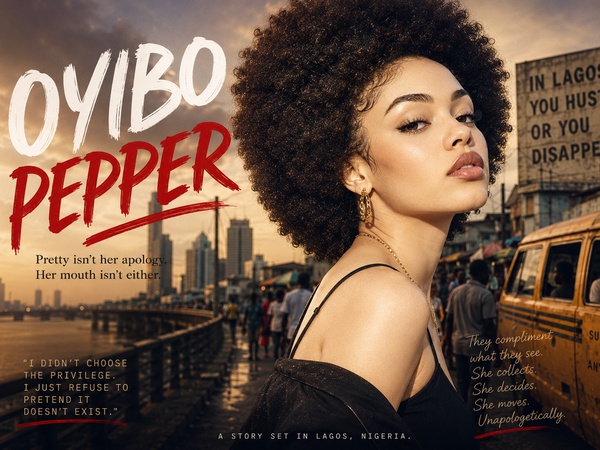
Clara had learned early that beauty could be a kind of passport.
Not the sort stamped at an airport. The quieter kind. The kind that got you through doors without anyone checking your name.
At the bank, the security guard opened the glass door before she reach
“Good morning, fine girl.”
Clara nodded. “Good morning. I have a name, you know.”
He laughed.
Inside, the queue was long. People stood beneath the fluorescent lights, sweating through their shirts while the air conditioner rattled uselessly overhead. Clara joined the line.
Five minutes later, a customer-service woman looked up.
“Madam, come. I can attend to you here.”
A man who had been waiting ahead of her turned around.
“Madam, we have been here since morning.”
Clara looked at him.
“Then you should have worn something pretty.”
The man stared.
The woman behind the counter covered a laugh with her hand.
Clara smiled sweetly and walked over.
She wasn't proud of the joke.
She wasn't ashamed either.
That was the uncomfortable thing about being Clara. She knew exactly what her face did for her, and she had stopped pretending otherwise.
Her skin was fair, almost golden beneath Lagos sunlight. Her mother was Nigerian; her father had been half Nigerian and half Jamaican, though Clara rarely bothered explaining herself. People decided what she was before she opened her mouth.
Oyibo.
Fine girl.
Light-skinned.
Spoilt.
Pepper.
The last one suited her.
She had a tongue sharp enough to ruin a person's afternoon.
At the market in Yaba, women called after her before she had even reached their stalls.
“Fine girl! Come and see this one.”
“Oyibo pepper, I have your size!”
“Madam, don't pass me!”
Clara stopped at a fabric stall.
The woman brought out a lace blouse.
“Try this.”
“How much?”
“For you, forty.”
Clara raised an eyebrow.
“For everybody else?”
The woman hesitated.
“Fifty-five.”
Clara laughed.
“So my face has already reduced fifteen thousand?”
“You are a customer I like.”
“No. You like my face.”
The woman laughed.
“Both.”
Clara bought it for forty.
She knew what was happening.
She also knew the darker-skinned woman standing beside her had been quoted fifty-five for the same fabric.
Clara glanced at her.
Their eyes met briefly.
There was no accusation in the woman's face.
That somehow made Clara feel worse.
Outside, the afternoon smelled of dust, ripe fruit and hot engine oil. A danfo roared past, its conductor hanging halfway out of the door.
Clara walked beneath the sun with her shopping bag swinging against her knee.
Two girls near a cosmetics stand watched her.
One whispered something.
The other looked Clara over and rolled her eyes.
Clara stopped.
“You people want to say something?”
They froze.
“No.”
“Good. Because whispering is rude and I hate guessing.”
She walked away before they could answer.
She could have ignored them.
Sometimes she did.
Sometimes she enjoyed making people uncomfortable.
That was another thing Clara would never confess in polite company.
She liked the power.
She liked watching people reconsider their tone when they realized she wasn't the soft, grateful pretty girl they expected.
Men were worse.
They bought flowers.
Sent money.
Paid restaurant bills.
Once, a man she barely knew sent a driver to pick her up because it was raining.
She accepted the ride.
Of course she did.
When her friend asked if she wasn't worried about owing him something, Clara laughed.
“I didn't sign a contract.”
“You know what he wants.”
“That's his problem.”
“And if he gets angry?”
Clara shrugged.
“Then he'll be angry in his own car.”
She refused to turn someone else's expectation into her debt.
Still, there were nights when the confidence became quieter.
She would stand before the mirror after washing off her makeup and look at the woman underneath.
Without the lashes.
Without the lipstick.
Without the carefully arranged hair.
She sometimes wondered what people would offer that woman.
The thought never frightened her.
It irritated her.
Because she knew the answer.
Probably less.
Maybe nothing.
And that was the part nobody wanted to discuss.
Pretty privilege wasn't magic. It was a system of tiny permissions. A waiter who smiled longer. A lecturer who remembered your name. A stranger who forgave your rudeness because he liked looking at you.
Clara had benefited from all of it.
She had also weaponised it.
She wasn't going to apologise for either.
One evening, she sat in traffic on Third Mainland Bridge, watching Lagos glow beneath the dirty orange sky.
Her phone buzzed.
Another gift.
A man had sent her the keys to a new car.
No occasion.
No explanation.
Just:
For you.
Clara stared at the message.
Then she laughed.
“Mad people,” she muttered.
She accepted the car.
Not because she owed him anything.
Because he had offered, and she wanted it.
The traffic barely moved.
Across the bridge, the city shimmered through heat and haze. Horns rose and fell around her like an argument nobody could finish.
Clara rested her head against the seat.
She wondered, briefly, what it would be like to live in a world where nobody gave her anything for her face.
Then she imagined it.
The longer queues.
The closed doors.
The indifferent smiles.
She sat with the thought.
Then she shook her head.
“No, thank you.”
The light changed.
Cars began moving.
Clara drove into the evening without guilt, without gratitude, and without pretending she didn't know exactly why some doors opened for her.
She was beautiful.
She knew it.
The world knew it.
And if the world insisted on making that beauty useful, Clara saw no reason to waste the opportunity.


 105