Score |
17


Fee
 Lawyer @ University of Abuja
Lawyer @ University of Abuja



The Question We Are Not Asking
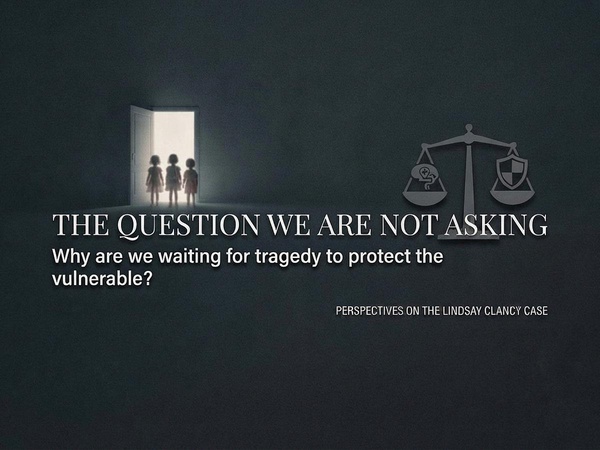
<p>When we all talk about the Lindsay Clancy case, the conversation almost always gets stuck on one massive question: Was she criminally responsible for killing her three kids while suffering from acute postpartum psychosis? It is a heavy question, and completely necessary. But by focusing all of our energy entirely on what happens inside a courtroom after the fact, I think we are missing a much more urgent truth. Why did three innocent children have to die before anyone noticed how dangerous the situation had become?</p><p><br/></p><p>Postpartum psychosis is a terrifyingly real, severe mental illness. It completely twists reality, breaking a person's mind into hallucinations and intense delusions. There is absolutely no doubt that Lindsay Clancy was profoundly sick and desperately needed immediate medical help. But those three children also desperately needed protection. Their basic right to be safe shouldn't become a secondary thought just because their mother was going through a massive psychiatric crisis.</p><p><br/></p><p>We have to face an uncomfortable reality here. A parent can deeply love their children and still become temporarily incapable of safely keeping them alive. Both of those things can be true at the exact same time. Often, society hesitates to step in because we are afraid that separating a mother from her babies is cruel. We worry about crossing lines or taking away parental rights. Out of a good, compassionate desire to help, we try to keep families together at all costs. But what if forcing a family to stay together is actually the most dangerous choice we could possibly make?</p><p><br/></p><p>I am definitely not saying we should strip custody from every woman who is dealing with postpartum depression. That would be an unfair, dangerous overreach that would only make moms hide their struggles. Instead, I am arguing that when severe, scary warning signs show up, a child's safety cannot depend on whether we are one hundred percent certain a tragedy is going to happen. We don't wait for a building to literally collapse before we tell people to get out. So why do we wait for a psychiatric break to turn fatal before we step in to protect the vulnerable?</p><p><br/></p><p>Children are completely defenseless. They cannot look at a parent, recognize that a severe mental illness is taking over, and advocate for themselves. They cannot say, “Something is wrong with my mom, please take me somewhere safe.” They depend entirely on the adults around them to make that call. Stepping in during these terrifying moments isn't about punishing the parent; it is about saving the kids. Sometimes that means a temporary separation, immediate hospital care for the mom, or strictly supervised visits. That isn't punishment; it is pure prevention.</p><p><br/></p><p>And this is exactly where our ideas about justice need to become a lot more honest. Having a mental illness explains why a tragedy happened. It does not automatically erase the physical consequences of what happened. On the question of prison, my position is direct. If the legal system ultimately decides that Lindsay Clancy met the criteria for criminal responsibility, she should face a prison sentence. This perspective doesn't ignore how incredibly sick she was. It doesn't assume that prison works as a magic warning to someone trapped in a state of psychosis. Instead, it recognizes that criminal responsibility means there must be actual, real accountability when three young lives are taken from this world.</p><p><br/></p><p>In our legal system, we talk about criminal intent, but we also have to talk about justice for victims who can no longer speak for themselves. Proper psychiatric treatment can, and absolutely should, exist right alongside a prison sentence inside a secure facility if it is medically necessary. Having compassion for a suffering mother shouldn't mean we pretend her victims don't matter anymore. And holding someone accountable shouldn't mean we pretend the illness never existed in the first place. We have to look at both of those realities at the exact same time.</p><p><br/></p><p>Hindsight is a massive luxury. It is incredibly easy for people online to look back years later and say what should have been done. Her family didn't have that luxury. Her husband was living through a non-stop, unimaginable nightmare without a map. Blaming the people caught in the middle of this crisis is wrong. But this tragedy should still force families, friends, and doctors to ask some agonizingly hard questions. At what exact point does supporting a sick loved one become dangerous for the kids? At what point does protecting an adult's independence become less important than keeping a child alive? And who is supposed to make that call before a disaster makes it for everyone?</p><p><br/></p><p>The three children in this case don't get another chance. They cannot tell us what they went through, and they cannot ask us to balance their terrifying final moments against their mother’s medical diagnosis. They are simply gone. While we must keep a deep sense of compassion for people suffering from mental health crises, that compassion cannot happen at the complete expense of the people who were actually destroyed by it. The children have to stay at the very center of this conversation.</p><p><br/></p><p>If Lindsay Clancy is held responsible by the law, justice means a sentence combined with the right medical care. If she is found not responsible, that still shouldn't be the end of the story. We still have to look closely at systemic failures and figure out how we are going to protect children in the next inevitable crisis. The most critical question this case leaves us with isn't just about whether a sick mother belongs behind bars. It is this: Why are we still waiting for children to die before we finally decide they need protecting?</p>



 10
10


Other insights from Fee





Contributor Points

Points-to-Coupons

Referral Earning

Insights for you.


Silence: The things we don't say.🥺
I walked out of my house, shutting the door behind me, and moved to the terrace.I neede...
221 views
59 upvotes
63 comments
Suicide: The Permanent Solution.
“Did you regret it?”“You know…”I hesitated.“What happened?”A heavy sigh was the first r...
224 views
51 upvotes
54 comments


2 a.m.
Maybe it's all the nights I spent not sleepingOr all the days I sat thinkingOf how I've...
236 views
50 upvotes
48 comments
Yours in the Empty
Losing a father is one thing,Losing a best friend is another.Losing the "head" is one t...
389 views
59 upvotes
43 comments

I’m Skinny, and So What?
What if I told you that I have cried more over my own arms than over any guy who has ev...
202 views
47 upvotes
50 comments


One step forward, Three steps back
I'm tired...But not for the reason you're thinking How much more must life take?How muc...
422 views
51 upvotes
40 comments


After Alhaji
"Kai, yarinyar nan ta yi sa'a ƙwarai.""Wallahi. Alhaji Ibrahim da kansa zai aura ta.""T...
257 views
36 upvotes
43 comments

A Passing Thought
Literally didn't even know it,How could I miss it when it was always right in front of ...
357 views
62 upvotes
30 comments

HARBINGER
HARBINGERWhere have I come to catch you? In your room? At your workplace? In school? Wh...
111 views
40 upvotes
41 comments