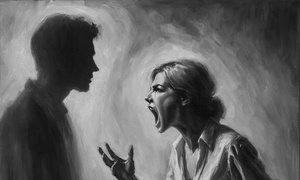






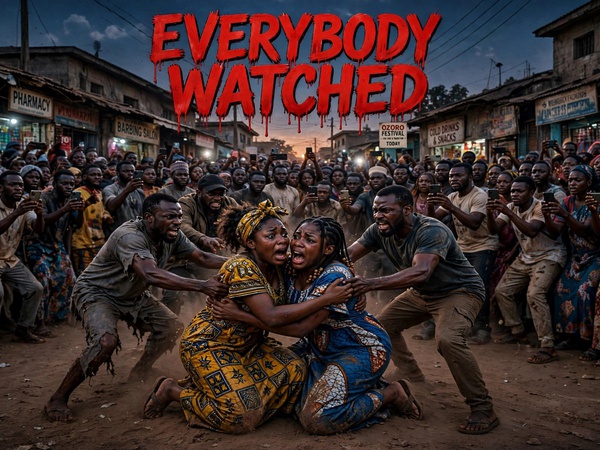
On March 19, 2026, in Ozoro, Delta State, women were attacked in public during the Alue-Do festival.People watched...Everybody Watched.
Some laughed; Some filmed...Some walked away. Later, the police said 18 suspects were arrested. Four women came forward. Police also said no rape was reported by them, while allegations of sexual assault were investigated. The National Human Rights Commission condemned what happened and called for prosecution and reform of harmful practices.
That is what we know from reporting by the ICIR, the BBC, and the NHRC.
What we do not yet know is what happens next. Arrest is not conviction. And conviction is not healing. And also a press statement is not safety. Let's understand the difference.
I keep returning to that image of a crowd. Not because I want to describe violence in detail. I do not. I keep returning to it because I want to understand how so many people can watch women being harmed and still go home feeling like they did nothing wrong.
The men who attacked those women are responsible for what they did. That part is clear and it should stay at the centre of any conversation about justice. But if we stop there, we miss how violence like this becomes possible in the first place.
Violence does not only need a person willing to commit it. It also needs an environment that makes it easier to commit and harder to report.
In Ozoro, that environment included a festival rule that was said to forbid women from being outside at a certain time. Whether that rule was understood correctly or twisted by the attackers, the message it sent was familiar: a woman outside is a woman who has broken a rule, and a woman who has broken a rule can be punished.
That logic is not new. We hear it in different forms all over Nigeria.
She should have stayed indoors. She should have dressed differently. She should not have been there. She should have known better.
All of those sentences do the same work. They move the conversation away from the person who chose to harm and toward the person who was harmed. They turn a public assault into a lesson about how women should behave.
I am not writing this to attack African culture. I grew up inside this culture. I know what it gives us. It gives us language, family, respect for elders, music, food, ways of greeting, ways of mourning, ways of celebrating. It teaches us to belong to something larger than ourselves. I would not trade that for anything honestly...But belonging should not require a woman to surrender her safety. A tradition that can only survive by frightening women is not being preserved, it is being protected from questions. And any tradition that needs to be protected from questions should be questioned.
Culture changes. It has always changed. We have dropped practices our grandparents accepted. We have kept practices that still give life. The question is not whether we respect culture. The question is who gets to decide which parts stay, and what happens to the people who pay the price when we refuse to change.
Then there is the crowd... Honestly I have thought a lot about the crowd because I think most of us imagine we would act differently. We imagine we would shout, intervene, call for help. But in real life, crowds do something strange to people. One person assumes another person will act. Another person decides it is not their business. Another person decides that filming is the same as helping. Before we know it, nobody has done anything useful, even though everybody saw everything.
I do not think every bystander is guilty in the same way. That would be dishonest and it would ignore fear. A person who is small, unarmed, alone, or afraid of being attacked next may not be able to physically stop a group of young men. Fear is real. We should not demand that ordinary people become heroes to prove they are good.
But fear is different from indifference. Fear is different from laughter. Fear is different from encouragement.
There is a difference between a man who freezes because he is terrified and a man who lifts his phone to record for entertainment, shares the video for likes, and then says he was only raising awareness. There is a difference between a woman who slips away to call for help and a woman who stands there and urges the attackers on.
We need language for those differences, because right now we treat all watching as the same. But truthfully It is not.
Filming can be evidence. It can also be a second violation. Imagine surviving an assault and then finding out that strangers have watched your humiliation, commented on your body, forwarded your pain like a joke. You did not consent to that. You did not ask for your worst moment to become content. When we share a video without the survivor's consent, we are not helping her. We are using her.
If we want to help, the help has to be safe and it has to be practical. Call for help. Find someone with authority. Document from a distance and hand the footage to police or to a trusted organisation, not to WhatsApp groups. Stay with the survivor after, if she wants that. Believe her when she speaks. Do not ask her to perform her pain to prove it happened.
That brings me to the family, because for many Nigerian women, the hardest conversation does not happen in public. It happens at home.A woman goes home and tells her mother, her aunt, her husband's family. And she hears the sentences that sound like advice but work like bondage.
Do not bring shame to the family. Think about your children. What will people say? Be patient. Do not destroy your marriage. Go back and pray.
I understand why families say these things. Sometimes they are afraid. They are afraid of gossip, of retaliation, of a marriage breaking, of a daughter being labelled. Sometimes they genuinely believe they are protecting her from public embarrassment...But we have to ask: protection for whom?
When a family tells a woman to stay silent, who is being protected? Her, or the reputation of the people who hurt her? Her, or the family's standing in church, in the community, in the village meeting? A family's reputation is not worth more than a daughter's life. It is not worth more than her safety. It is not worth more than her ability to sleep without fear in her own house.
The same hard question applies to religious leaders and traditional leaders. I am not blaming religion for violence. Religion has also given many women strength, community, and a place to be heard. But influence comes with responsibility. When a woman walks into a pastor's office or an imam's study or an elder's compound and says she is being hurt, she should not be sent back with only prayer and patience. Prayer matters to many people, including me. But prayer should not replace medical care. It should not replace a safe place to stay. It should not replace a report to the police when a crime has been committed.
Counselling that tells a woman to endure is not counselling. It is instruction to stay in danger.
And then there is the state. Nigeria is not short of laws. The Violence Against Persons (Prohibition) Act of 2015 already provides a framework for addressing different forms of violence. The problem is what happens after a woman tries to use it.
According to the 2024 Nigeria Demographic and Health Survey, 58 percent of women who had experienced physical or sexual violence had never sought help to stop it... Read that again. More than half never sought help.
Why? Because help is far from them, Because help is expensive and costs even more; Because help requires telling a stranger what happened and trusting that stranger will believe you. Because help can mean leaving your home, your children, your income. Because sometimes the police station itself feels unsafe.
A law that a woman cannot reach is not protection. It is a promise on paper...So what would justice actually look like here?
It would start with the perpetrators facing a real investigation, a fair trial, and consequences that match what they did. But it cannot end there.
Justice would also mean that people who deliberately intimidate survivors, hide evidence, or use their position to shut a case down face consequences. It would mean that institutions that failed to act are asked why. It would mean that a survivor gets to decide what happens to her story, her image, her name. She does not owe the public her trauma to prove she deserves support.
Justice would mean a woman in Ozoro, or in Lagos, or in Abuja, or in any small town, can walk outside without calculating whether she has broken an unwritten rule. It would mean a family that chooses to believe her instead of protecting its image. It would mean a crowd that chooses to act instead of filming. It would mean boys being taught that respect is not about controlling women, but about leaving them alone when they say no, and standing up when other men refuse to.
I am not saying every person who watched is a criminal. I am saying nobody should be allowed to use culture, religion, family, authority, or a phone to make violence easier to commit and harder to report.
The women in Ozoro were not attacked because they were outside. They were attacked because a group of men decided they could attack them and get away with it. That decision was made easier by every person and every institution that had already taught those men that women's bodies are public property when women disobey.
If we want this to change, we have to stop asking only, what did the attackers do? We also have to ask, what did we do? What did we allow? What did we laugh at? What did we share? What did we silence?
Everybody watched...The question now is whether everybody will keep watching, or whether we will finally do something different to make a change.


 37