Score |
324


Prof. Boluwatife.
 Student. @ Federal University Oye Ekiti.
Student. @ Federal University Oye Ekiti.



GENTRIFICATION.
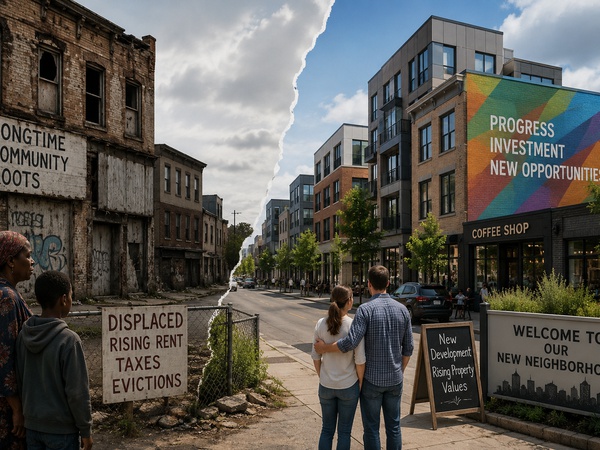
<p>Fellow writers,</p><p>I would like to give you a quick walk down a street, an ordinary street, where children played barefoot in familiar dust, and where the scent of old recipes drifted from the corner shop. Now, imagine that same street years later, glass buildings rise where cottages once stood, cafes replace corner stores, and the rent? Doubled, even tripled. </p><p>That, my audience, is gentrification, a word that sounds like a progress, but smells of displacement. Now, to define the word gentrification, it is the process by which once low income neighbourhoods are transformed through an influx of wealthier residents, news businesses and urban development. </p><p>On paper, it promises revival - better roads, cleaner streets and investment. But beneath that glossy surface lies a painful paradox: the very people who built the soul of those communities can no longer afford to live there. </p><p>Do you know the tragedy of gentrification? It is in its execution and not the intention. </p><p>Why? It replaces culture with capital, memory with modernity, and community with commerce. Shall I tell us what this looks like? It's like repainting a masterpiece without asking the artist. </p><p>William Shakespeare has very wisely said and I quote "There is nothing either good or bad, but thinking it makes it so." Now, on a pragmatic level, development is essential, cities must evolve, but genuine progress must be inclusive, and it must be built without bulldozing identity. </p><p>Policy makers must design urban renewal strategies that protect affordable housing, support local businesses, and involve residents in decision making. Why? Because development that forgets its people, is not development, it's displacement, if not even replacement. </p><p>In conclusion, a city's true wealth is not in the skyscrapers, but in its stories, in the laughter, the language and the life of its people. Let us build cities that do not just look beautiful but feel like home for everyone. </p><p>At its core, gentrification is a mirror - reflecting our values as a society. Do we prioritize profit over people? Or can we reimagine growth as something that uplifts rather than uproots? </p><p><br/></p><p>Prof. Boluwatife. ✍️✍️✍️</p>


 89
89


Other insights from Prof. Boluwatife.






Contributor Points
Points-to-Coupons

Referral Earning
Insights for you.

Gen Z, Are We.... Hungry?
If aliens were to read our texts, they'd think Gen Z are in a perpetual state of starva...
626 views
62 upvotes
71 comments



The Gender War.
I was doomscrolling yesterday.I hardly do that, but for some reason, I chose that and s...
239 views
55 upvotes
68 comments


In Her Likeness.
I hail from the southwestern part of Nigeria, and oftentimes, when I walk through the n...
196 views
49 upvotes
56 comments

The Yahoo Culture.
Let's talk about the Yahoo CultureSomething that is gradually becoming a norm.And every...
215 views
50 upvotes
61 comments


Dear Dad
Dear dad,It's been 7 years, 3 months and 1 day and your name still echoes in my brain.W...
318 views
49 upvotes
44 comments


HE IS EVERYWHERE
Yes, He is everywhere I have gone to a place where needles are used to pound yam. I saw...
120 views
42 upvotes
45 comments

Curiosity or Clout?
Omooo I have a bad habit. 😭Whenever something starts trending in Nigeria, I click on it...
258 views
36 upvotes
49 comments