Two Cents: How an Insight Actually Comes Together
This is not a manifesto. It’s a walkthrough.
An insight for Two Cents doesn’t arrive fully formed. It usually starts messy, half-clear, and slightly annoying. What follows is the actual thinking process — what’s happening in my head before anything becomes an insight.
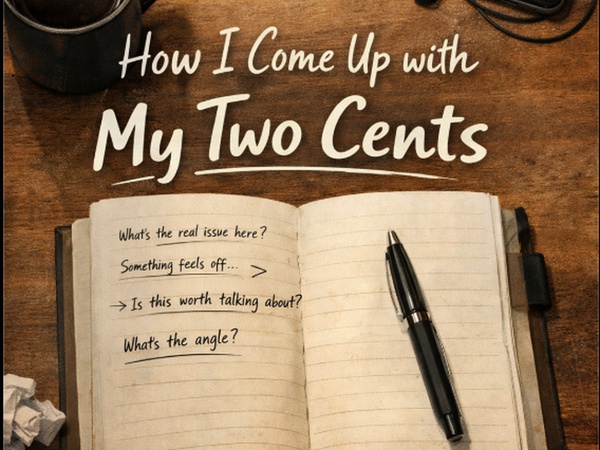
1. Something Feels Off (Before I Can Name It)
Most insights start as irritation, not inspiration.
I notice a sentence that keeps repeating online. A behaviour people defend too quickly. A trend everyone applauds but no one examines. At this stage, I don’t know my position yet. I just know something about it feels thin, rushed, or dishonest.
I don’t write immediately. I let the discomfort sit. If it disappears after a day, it wasn’t real. If it keeps resurfacing in different contexts, I pay attention.
2. I Track the Pattern, Not the People
When the feeling sticks, I start mentally collecting examples — conversations, tweets, habits, stories. Not to judge individuals, but to see the pattern underneath.
This is where the question shifts from “Why do people do this?” to “What does this behaviour protect?”
I’m looking for repetition, not outliers. One example is noise. Five similar ones is signal.
3. I Argue With Myself First
Before I form an insight, I test the opposite view.
I ask:
* What’s the most generous explanation for this behaviour?
* In what situations would this actually make sense?
* Am I reacting emotionally, or is there a structural issue here?
If my idea can’t survive that internal argument, it doesn’t deserve airtime.
4. The Real Question Emerges Late
The insight doesn’t start with a question — the question shows up after the thinking.
It’s usually sharper and less dramatic than the original irritation. It often sounds like:
“When did this become acceptable?”
“What are we avoiding by calling this growth?”
“Who is being inconvenienced if this belief is challenged?”
Once I have that question, the direction becomes clearer.
5. I Strip Away the Internet Language
At this point, I deliberately remove buzzwords.
I rewrite the idea without terms like healing, soft life, alignment, productivity era. If the thought collapses without those words, it wasn’t an insight — it was aesthetic agreement.
What remains is usually plainer, slightly uncomfortable, and harder to romanticise.
6. I Decide What I’m Actually Saying (and What I’m Not)
This is a narrowing stage.
I decide:
* What I am directly addressing
* What I am deliberately leaving out
* What responsibility stays with the listener
I’m not trying to cover every angle. I’m trying to be precise. Over-explaining weakens the insight.
7. Writing Sounds Nothing Like the Final Audio
The first draft is blunt and inelegant. That’s intentional.
I write as if explaining the thought to myself, not to an audience. Only after the idea is clear do I refine language, pacing, and tone.
The audio version is shaped by pauses and emphasis, not by dramatic delivery. Silence is part of the thinking, so it stays in.
8. The Final Check
Before releasing an insight, I ask:
* Does this sound like I’m trying to convince, or trying to clarify?
* Am I offering relief, or responsibility?
* Would this still stand if it didn’t feel validating?
If it leans toward comfort over clarity, it goes back to the draft.
This is the process. It’s slow, internal, and sometimes inconvenient. Two Cents isn’t about arriving loudly — it’s about thinking honestly, then speaking only when the thought has earned its shape.
If anything remains unclear, please let me know.
♡˖꒰ᵕ༚ᵕ⑅꒱


 445