Score |
648


Tari Ogbowei

 Content Writer and contributor/Seafarer @ TwoCents/SEEPCO
Content Writer and contributor/Seafarer @ TwoCents/SEEPCO



NIGERIA'S POVERTY IS NOT GOVERNMENT'S FAULT ALONE
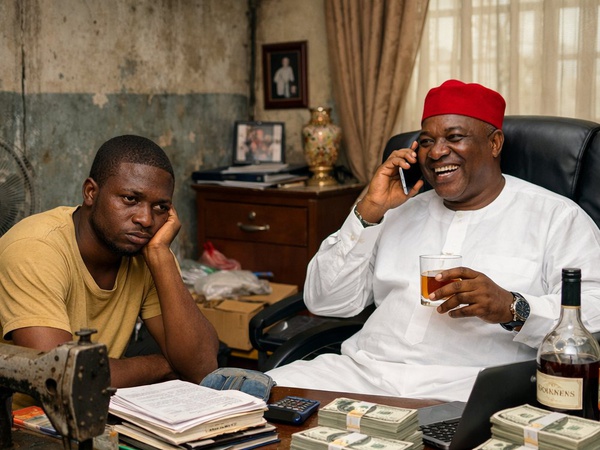
<p>A few years ago, under President Buhari, Nigeria overtook India as the poverty capital of the world. Things have arguably gotten even worse under the rudderless leadership of the plague currently occupying the office.</p><p><br/></p><p>We complain — rightly — about poverty, unemployment, inflation and the declining standard of living. We blame the government, and there is certainly enough blame to go around. The Nigerian government at every level has done a terrible job of creating the policies and enabling environment required for businesses to thrive.</p><p><br/></p><p>But while we are fixated on government’s failures, we seem to overlook something equally important: Government cannot, and will never, employ everybody.</p><p>That means we need to talk about PRIVATE EMPLOYERS.</p><p><br/></p><p>Small and Medium-scale Enterprises (SMEs) are the backbone of most functional economies. They create jobs, circulate money, provide goods and services, and give people alternative sources of income.</p><p><br/></p><p>Yet, in Nigeria, we often expect the government to solve unemployment while conveniently ignoring the responsibility of those who actually employ people.</p><p><br/></p><p>In my opinion, private employers share a significant part of the blame for the unemployment and, especially, underemployment crisis in Nigeria.</p><p><br/></p><p>Yes, the economy is terrible. Yes, starting and running a business has become incredibly difficult. Inflation is eating into profits, operating costs are rising, electricity is expensive, taxation is burdensome, and purchasing power is declining.</p><p><br/></p><p>But Nigerians are resilient.</p><p>Despite all these challenges, people continue to start businesses. Many even manage to thrive.</p><p><br/></p><p>Why? </p><p>First, because Nigerians are incredibly resilient.</p><p><br/></p><p>Second, because we have a massive population that provides a ready market.</p><p><br/></p><p>And third, because regardless of how bad the economy becomes, people must still trade. Food must be sold. Clothes must be made. Hotels must operate. Transportation must be provided. Repairs must be done. Goods and services must change hands for society to function.</p><p>So businesses continue to make money. And this is where my problem begins.</p><p><br/></p><p>As inflation rises, business owners increase the prices of their goods and services. When the cost of diesel increases, they increase their prices. When rent increases, they increase their prices. When transportation costs rise, they increase their prices.</p><p>But somehow, the worker's salary remains exactly where it was. That is where I struggle.</p><p><br/></p><p>A while back, I was having a conversation with a friend who told me that the brother of one of his friends owns a hotel in the city where we live and reportedly makes about ₦6 million in net profit every month.</p><p><br/></p><p>It's not a very big establishment and probably has about 10 employees.</p><p>If the average employee earns ₦50,000 monthly, that's approximately ₦500,000 in total staff salaries.</p><p>Five hundred thousand naira out of six million naira in monthly net profit.</p><p><br/></p><p>Now imagine the owner decided to allocate another ₦1 million to staff salaries.</p><p>He would still be making approximately ₦5 million in monthly net profit. The workers, however, would have significantly more breathing room. But greed will not let us be great.</p><p><br/></p><p>Many employers would rather buy another car, build another house, acquire another plot of land or expand their personal lifestyle than pay the people helping them generate millions a decent wage.</p><p><br/></p><p>And this isn't about that particular hotel. The example simply illustrates something that happens in businesses all over Nigeria. Business owners complain about the government. They complain about the economy. They complain about inflation. They complain that Nigerians don't have purchasing power, yet some of these same people are paying their employees starvation wages that barely keep them alive.</p><p><br/></p><p>And here's the uncomfortable question:</p><p>How can you pay someone ₦50,000 a month, knowing full well that it cannot realistically cover food, rent, transportation, clothing and other basic necessities, and then turn around and complain about the Nigerian government?</p><p><br/></p><p>I am not saying business owners don't deserve to make profit. They absolutely do.</p><p>It is their capital, their risk, their investment and, in many cases, years of sacrifice that created the business in the first place. Neither am I saying every business can afford huge salaries. Some genuinely cannot. But where a business is making substantial profits, there has to be a moral responsibility to share some of that prosperity with the people whose labour helps create it.</p><p><br/></p><p>You cannot demand that the government care about the welfare of citizens while you treat the people who work for you as disposable tools for profit.</p><p>Government has a responsibility to create an economy where businesses can thrive and workers can earn decent incomes, but employers also have a responsibility to ensure that the people who generate their profits can actually afford to live. Because poverty is not only created in government offices. Sometimes, it is created in the workplace.</p><p><br/></p><p>And if we genuinely want to build a better Nigeria, perhaps it is time we stopped asking only: "What is the government doing for us?"</p><p>And started asking ourselves: "What are we doing for the people who depend on us?"</p>


 129
129


Other insights from Tari Ogbowei









Contributor Points

Points-to-Coupons

Referral Earning

Insights for you.


Dear 2026, You Had Everything
I've heard that you should never send a letter to the past. Too messy, they say. Too m...
318 views
21 upvotes
20 comments





ONCE BITTEN, TWICE SHY
Just a few years ago, in 2014 precisely, the dollar traded between #150 and #170. Tod...
1007 views
20 upvotes
12 comments

Pick your Poison: Economy or Education
Picture the finance minister sitting down to build next year's budget. There is one pot...
141 views
18 upvotes
12 comments


When Work is Repriced
The fastest way to lose a job today is not by being replaced by someone betterbut by be...
265 views
11 upvotes
12 comments
BAT
The Tinubu certificate saga has been one hot topic in the past few days. A few days ago...
1025 views
13 upvotes
12 comments

Politics and Stomach Infrastructure
This particular political season has been the most interesting yet and promises to ge...
1024 views
12 upvotes
10 comments

Readers are Leaders
It is no news that the Labour Party candidate, Peter Obi has chosen Doyin Okupe as his ...
2700 views
11 upvotes
10 comments