You have Nigerian roots.
You can't exactly hide that, even if you wanted to. Your name carries a story. Your ancestry carries a history.
Both your parents are Nigerian. Your father, Femi Adegoke, was a medical doctor, and your mother, Feyi, was a professor of physiology.
Through their circumstances and the decision to have you in Britain, you had the privilege of being born on British soil.
And suddenly you declare you're no longer Nigerian just because you want to run for the office of the prime minister of united kingdom.
That sounds really crazy right?
Trust me this is a true story and it's the story of a woman named
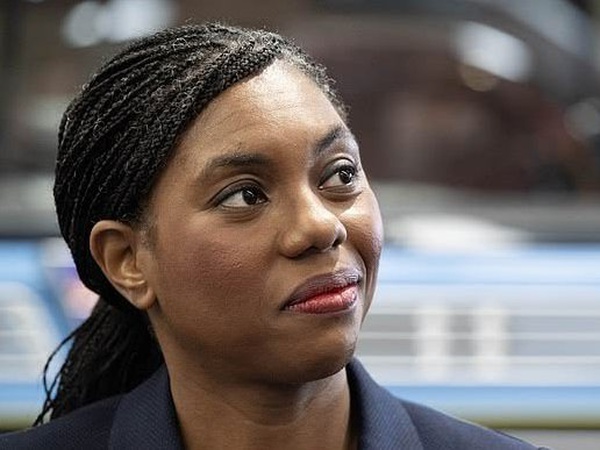
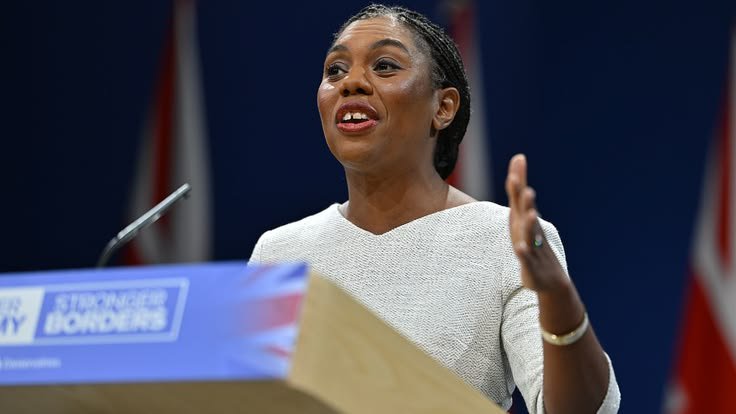
Olukemi Adegoke Badenoch.
Kemi was born in Wimbledon, London, on 2 January 1980, but she spent much of her childhood in Lagos, Nigeria. She experienced the country, its people, its peculiarities, its struggles, and the realities of growing up here.
At 16, she returned to Britain to continue her education.
She studied Computer Systems Engineering at the University of Sussex, later obtained a law degree from Birkbeck, and built a career that eventually led her into politics.
She joined the Conservative Party in 2005.
She contested elections, became a member of the London Assembly in 2015, and eventually secured a seat in the British Parliament in 2017.
She rose through the ranks, held ministerial positions, and became Secretary of State for Business and Trade.
Then came the bigger ambition.
In 2022, she contested the Conservative Party leadership but didn't make it.
She tried again.
And on 2 November 2024, she emerged victorious, becoming the first Black woman to lead the Conservative Party.
A remarkable political journey, no doubt.
But here's where things get interesting.
The same woman whose roots are deeply connected to Nigeria later make a rather interesting declaration about her identity.
In August 2025, during an interview, she stated that she no longer identified as Nigerian.
Kemi acknowledged being Nigerian through ancestry and birth, but explained that, in terms of identity, she didn't really see herself as Nigerian anymore.
She also disclosed that she hadn't renewed her Nigerian passport since the early 2000s.
And suddenly, the conversation became bigger than politics.
Because what exactly does it mean to belong?
Is it where you were born?
Where you grew up?
The passport you hold?
The people whose history you carry?
Or simply the place you choose to call home?
Now, I'm not suggesting that she must identify with a country simply because her parents come from there. Identity is personal, and nobody should be forced to claim an allegiance they don't feel.
But this is where we have issues...
In 2022, Kemi argued that the British Empire had done good things alongside the terrible things, insisting that both sides of its history should be told.
In 2024, she challenged the idea that Britain's wealth and economic success could be attributed to colonialism, imperialism or racial privilege.
And more recently, in November 2026, she went further, describing the British Empire as, overall, a force for good.
Ehnnn?
She acknowledged that terrible things happened, but argued that other empires and societies had their own histories of wrongdoing. She also maintained that Britain had apologised enough and should move forward rather than continue revisiting its past.
Apologized?😭
Now, there's a conversation to be had here.
Nobody is arguing that African societies were perfect before European colonialism. They had their own political structures, conflicts, inequalities and systems of oppression.
But acknowledging those realities does not erase what British colonial rule did to Nigeria.
It's not news what the British colonial rule did to Africa especially Nigeria.
Trying to twist the truth because of your ambition is the lowest of the low.
Nigeria's colonial experience involved conquest, political domination, the amalgamation of different territories and peoples, economic extraction, and the suppression of local political autonomy.
These are not merely uncomfortable chapters in a history book. They shaped the foundations of the country and influenced the political and economic realities that followed independence.
So, when we discuss the British Empire, telling both sides of the story should not mean treating the benefits claimed by its defenders as though they cancel out the damage experienced by the colonised.
And when someone argues that Britain's wealth cannot be explained by colonialism, that argument deserves to be examined against the historical evidence of imperial trade, extraction and the wealth generated through colonial systems.
You have every right to hold your position. You can disagree with reparations, reject apologies, or argue that Britain should focus on the future.
But those positions also deserve scrutiny, particularly when they concern a history that affected millions of people, including the country from which your own family comes.
You can acknowledge your ancestry without identifying with the people. You can appreciate where you came from without necessarily wanting to be associated with its present realities.
But can you separate yourself from the history of that same place when discussing the history of the country you now call home?
Over the years, her comments about Nigeria have attracted criticism, particularly her remarks about corruption, insecurity and her experiences growing up in the country.
From Olukemi Adegoke, born to Nigerian parents and raised partly in Lagos, to Kemi Badenoch, leader of Britain's Conservative Party and a woman who now occupies one of the most prominent positions in British politics.
What a journey.
You can change your nationality, your political affiliation, your address, and even the way you identify.
But history has a way of keeping its records.
And Olukemi's is quite an interesting one.


 18