


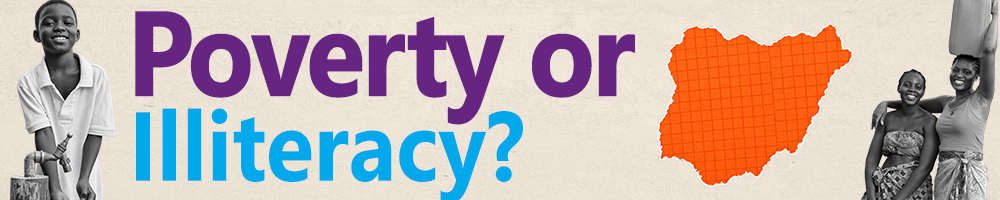
POVERTY, NOT ILLITERACY, IS THE BANE OF UNDERDEVELOPMENT IN NIGERIA
Introduction
Imagine a young Nigerian who has spent years in school, obtained a university degree and graduated with good results, but cannot find a decent job. Despite having the knowledge and qualifications needed to contribute to society, the individual remains financially dependent and struggles to meet basic needs. Now imagine a small business owner who has little formal education but has access to capital, customers, electricity and a supportive business environment. The business owner may be able to create employment and contribute to economic growth.
These examples raise an important question: Is education alone enough to develop a nation? Nigeria has educated citizens, skilled professionals and talented young people, yet poverty, unemployment and inadequate infrastructure remain serious challenges. This suggests that the problem of underdevelopment goes beyond the inability to read and write. Although illiteracy limits opportunities, poverty is a deeper obstacle because it restricts people's ability to access resources, use their knowledge and improve their living conditions.
Understanding Poverty and Illiteracy
Poverty is not simply the absence of money. It is a condition in which individuals lack the resources needed to live a decent life. It may involve inadequate food, poor housing, limited healthcare, unemployment and restricted access to education and other essential services.
Illiteracy, on the other hand, refers to the inability to read and write effectively. It can limit people's access to information, reduce employment opportunities and make it difficult to participate fully in certain aspects of modern society.
Both conditions are connected, but they do not have the same effects. A person may be educated and still live in poverty, just as someone with limited formal education may possess practical skills and run a successful business. Therefore, while education is important, the economic conditions that allow people to apply their knowledge must also be considered.
Why Poverty Is a Greater Obstacle to Nigeria's Development
One major way poverty contributes to underdevelopment is through unemployment and limited economic opportunities. Every year, Nigerians graduate from different institutions with the hope of securing employment and becoming independent. However, obtaining a certificate does not automatically guarantee a job. When educated people cannot find opportunities to use their skills, their knowledge may remain underutilised. This represents a loss not only to the individual but also to the country.
Poverty also affects access to quality education. Some children are unable to attend school regularly because their parents cannot afford transportation, learning materials, school fees or other basic needs. Others may leave school early to support their families financially. This shows that poverty can actually produce illiteracy. It is therefore difficult to address illiteracy effectively without considering the economic conditions that prevent people from receiving an education.
Another important issue is healthcare. A country cannot achieve meaningful development when a large number of its citizens struggle to afford medical treatment. When people cannot access proper healthcare, their ability to work, study and contribute productively to society may be affected. Development should not be measured only by the number of educated citizens but also by the quality of life those citizens enjoy.
Furthermore, poverty limits entrepreneurship and industrial growth. Many Nigerians have business ideas, talents and practical skills but lack the financial resources to establish or expand their businesses. For example, a skilled tailor may have the ability to produce quality clothing but may be unable to purchase sewing equipment or rent a suitable workspace. If such individuals receive access to finance, electricity and business support, they may create employment for others. This demonstrates how economic opportunities can turn individual skills into wider social and economic benefits.
The Importance of Illiteracy in Underdevelopment
Although poverty is a major obstacle, it would be unfair to suggest that illiteracy has no serious effect on Nigeria's development. Education helps citizens understand their rights, access information, make informed decisions and participate in national development.
For example, a person who cannot read may find it difficult to understand official documents, follow written instructions or access certain employment opportunities. Illiteracy can also make individuals more vulnerable to misinformation and exploitation.
Education is equally important for technological advancement, research, innovation and effective governance. A country that neglects education may struggle to develop the skilled workforce required to compete in a rapidly changing world.
However, the existence of educated people does not automatically guarantee development. Education must be supported by employment opportunities, functional infrastructure, responsible leadership and a productive economy.
To reduce underdevelopment in Nigeria, the government must adopt policies that address poverty while strengthening education. Employment opportunities should be expanded, small businesses supported and vocational training made accessible to young people. Investments in electricity, transportation, healthcare and other essential infrastructure are also necessary.
Furthermore, education should be affordable, practical and relevant to the needs of society. Schools should equip students with knowledge and skills that can help them solve real-life problems. Government programmes aimed at reducing poverty should also be transparent and properly implemented so that their benefits reach the people who need them.
Most importantly, development should create opportunities for citizens to use their abilities productively. A country does not become developed simply because its people possess certificates; it develops when people can translate their knowledge and skills into improved living conditions.
In Conclusion, Poverty and illiteracy are both serious challenges to Nigeria's development, and neither should be ignored. However, poverty remains a more fundamental obstacle because it affects access to education, healthcare, employment, business opportunities and other essential resources. It can also create conditions that make illiteracy difficult to overcome. Education provides people with knowledge, but economic opportunities give them the means to apply that knowledge. Therefore, Nigeria's development requires more than producing educated graduates; it requires building a society where citizens have the resources and opportunities to live productive and meaningful lives. Ultimately, knowledge can equip a nation for progress, but without the economic conditions to put that knowledge into practice, development will remain limited.


 8