You wake up.
Before your feet touch the floor, your fingers are already scrolling.
A tweet.
A reel.
A hot take.
A breaking story.
In less than 5 minutes, you’ve consumed more “information” than someone in the 1800s might have encountered in a week.
But pause for a second…
Did you actually learn anything? Or did you just pass through information?
🌍 The Age of Instant Everything
We are living in a world where information travels at lightning speed. Social media has turned everyone into a broadcaster, a commentator, and sometimes… an “expert.”
With just one viral post, a person can influence thousands even millions within hours. Studies show that social platforms are powerful tools for knowledge sharing, collaboration, and engagement, especially among young people.
And honestly? You’ve probably learned something useful from social media before:
- A business tip from a random thread
- A life hack from a 30-second video
- A new perspective from a viral debate
It feels efficient. Fast. Alive.
But here’s the uncomfortable truth:
👉 Speed does not always equal depth.
📚 The Quiet Power of Books
Now picture this instead:
You’re sitting still.
Phone face down.
A book open.
No notifications. No distractions. Just you and ideas unfolding slowly.
Books demand something social media rarely does; your full attention.
They don’t rush you.
They don’t scream for clicks.
They don’t reward you with instant gratification.
Instead, they stretch your thinking.
Reading forces your brain to:
- Analyze
- Reflect
- Imagine
- Question
Unlike the fragmented nature of social media content, books offer structured, in-depth exploration of ideas, helping readers truly understand complex topics.
And that’s where something powerful happens:
👉 You don’t just consume information, you transform it into knowledge.
⚡ Social Media: Influence Without Depth?
Let’s be real, social media is unmatched when it comes to influence.
It shapes:
- Trends
- Opinions
- Politics
- Culture
In fact, information online is often driven by engagement metrics; likes, shares, and views rather than accuracy or depth.
And that creates a problem.
Because when speed meets popularity, truth sometimes takes a back seat.
Recent findings even suggest that many content creators don’t verify information before sharing it, increasing the spread of misinformation.
So while social media is powerful, it can also be:
- Superficial
- Biased
- Emotion-driven
- Easily manipulated
It informs quickly…
but not always correctly.
🧠 Books: Knowledge That Stays
Books move slower, but they go deeper.
They are usually:
- Carefully written
- Edited
- Structured
- Thought-out
Reading builds critical thinking, focus, and long-term understanding, something short-form content struggles to achieve.
Discover books
And here’s something people don’t talk about enough:
👉 Books don’t just give you answers.
👉 They teach you how to think.
🤔 So… Which One Truly Drives Knowledge?
Let’s break it down:
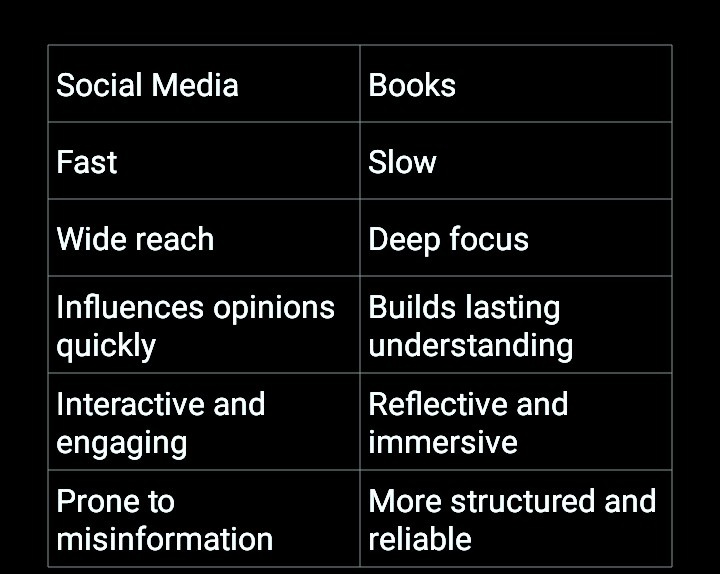
So the real question isn’t:
“Which is better?”
It’s:
👉 “What kind of knowledge do you want?”
- If you want to stay updated, connected, and influenced → Social media wins
- If you want to understand deeply, think critically, and grow intellectually → Books win
🔥 The Real Twist: You Don’t Have to Choose
Here’s the part most people miss:
Social media and books are not enemies. They’re tools.
Social media can:
- Introduce you to ideas
Books can:
- Help you understand them
-
Social media can:
- Spark curiosity
Books can:
- Satisfy it
💭 Let’s Make This Personal
Think about this for a second:
- When last did a post change your thinking for life?
- When last did a book stay with you for years?
And more importantly…
👉 Are you just informed… or truly knowledgeable?
🧩 Final Thought
In a world obsessed with speed, choosing depth is almost rebellious.
Social media may shape what we talk about.
But books shape how we think.
And in the long run?
**Thinking always wins.**


 272