How broken are you?
It is a strange question to ask someone who looks whole.
He doesn’t walk around announcing his fractures. He doesn’t introduce himself with a list of things that hurt him. He doesn’t sit people down and say, Here are the places I have broken.
He has learned to make brokenness look like responsibility.
Like work.
Like silence.
Like being tired.
Like saying, “I’m fine,” because explaining why he isn’t would require more energy than he has left.
So perhaps the better question isn’t whether he is broken.
Perhaps it is:
Where?
Piece by piece.
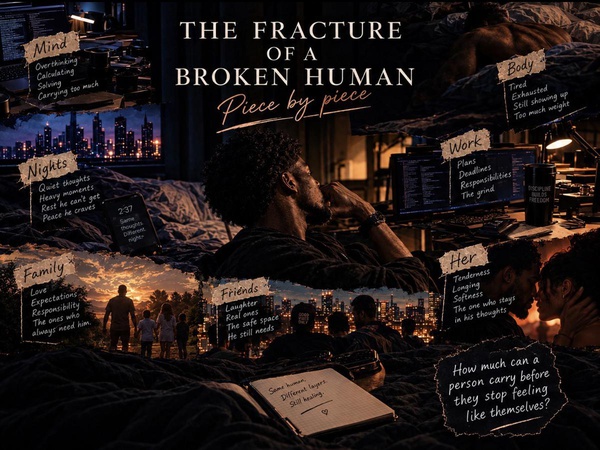
His mind
His mind never seems to rest.
Even when his body is lying down, something in him is still moving.
A problem.
A calculation.
A responsibility.
A conversation he hasn’t finished having with himself.
A decision he has postponed because there are already too many decisions waiting for him.
He thinks in solutions.
If something is wrong, fix it.
If someone needs something, provide it.
If there is a problem, find the problem inside the problem and solve that too.
But some things don’t respond to solutions.
Some things simply hurt.
And perhaps that is where he struggles most.
Because what do you do with pain when there is nothing practical to repair?
You cannot negotiate with exhaustion.
You cannot reason your way out of loneliness.
You cannot build a spreadsheet for grief.
You cannot work hard enough to make every fear disappear.
So he keeps thinking.
Keeps calculating.
Keeps moving.
Because sometimes thinking is easier than feeling.
And sometimes being busy is simply another word for I don’t want to sit still long enough to hear myself.
His body
His body carries what his mouth doesn’t say.
The tiredness.
The long days.
The nights that end later than they should.
The mornings that begin before he has recovered from the night before.
He knows how to keep going.
That is one of his greatest strengths.
It may also be one of his greatest weaknesses.
Because people praise endurance without asking what endurance is costing the person who keeps enduring.
His body becomes the place where responsibility collects.
His shoulders carry things.
His eyes reveal things.
His silence carries things.
And sometimes he sleeps, not because everything is peaceful, but because his body has finally demanded what his mind refused to give it.
Rest.
A temporary surrender.
A few hours where nobody needs anything from him.
His nights
Night changes him.
During the day, there are things to do.
People to answer.
Business to handle.
Places to be.
Problems to solve.
At night, everything becomes quieter.
And quiet has a way of making certain thoughts louder.
The room gets dark.
The phone becomes less interesting.
The responsibilities don’t disappear; they simply stop making noise.
And that is when a person can hear himself.
Maybe he thinks about things he doesn’t tell anyone.
Maybe he wonders whether he is doing enough.
Whether he is becoming enough.
Whether all the things he is building are actually giving him somewhere to rest.
Maybe there are nights when sleep comes easily.
And maybe there are nights when he has to exhaust his body before his mind finally agrees to shut up.
Nobody sees those nights.
People see the man who functions the next morning.
They rarely see what functioning cost him.
His love life
Love is perhaps his strangest fracture.
Because he can love someone and still struggle to know what to do with that love.
He can want closeness and still retreat from it.
He can miss someone and still refuse to say it properly.
He can care deeply and communicate badly.
He can be affectionate one moment and unreachable the next.
Not necessarily because the feeling disappeared.
Sometimes because feeling too much is frightening when you have spent years learning how to control everything else.
He has probably learned that love makes a person vulnerable.
And vulnerability is dangerous when you are accustomed to being the person who has everything handled.
So he loves in fragments.
A phone call.
A meal.
A hand reaching out.
A quiet moment beside someone.
A joke.
A question.
An invitation to stay.
A person sleeping beside him while he works.
Small things.
Almost insignificant things.
Except they aren’t.
Because sometimes the things a person cannot say become visible in the things they repeatedly do.
And perhaps he doesn’t always know how to say:
I want you here.
So he finds another way to communicate it.
Stay.
Eat.
Sleep.
Come back.
His family
Family is rarely just love.
It is expectation.
History.
Responsibility.
Memory.
The people who knew you before you became whoever you are now.
The people who can look at you and still see the child beneath the man.
Family can make a person feel protected.
It can also remind them of everything they have become responsible for.
There are roles you don’t apply for.
You simply grow into them.
The dependable one.
The strong one.
The one who should know what to do.
The one who should be able to handle it.
And after a while, nobody asks whether you are tired of being that person.
They simply assume you will continue.
So he does.
Because sometimes love for family looks like carrying things quietly.
Even when your hands are already full.
His friends
His friends probably know a version of him.
The funny one.
The stubborn one.
The one who can joke through almost anything.
The one who disappears when things become too personal.
The one who can sit in a room full of people and still
keep certain parts of himself completely private.
Friendship gives him somewhere to breathe.
But even there, there are boundaries.
There are things he can joke about.
Things he can admit.
Things he cannot.
Because there is a difference between being known and being completely seen.
Being known is allowing someone to know what you like.
Being seen is allowing them to know what scares you.
And perhaps he is still learning the second one.
Piece by piece
Maybe this is what a broken human actually looks like.
Not someone lying on the floor in pieces.
Not someone visibly falling apart.
But someone who has learned to arrange the fragments so beautifully that nobody notices they were ever fragments.
The mind keeps working.
The body keeps moving.
The nights keep passing.
Love keeps happening in complicated ways.
Family keeps needing.
Friends keep laughing.
Life keeps going.
And somewhere underneath all of it is a person asking questions he rarely says aloud.
Am I doing enough?
Am I enough?
How long can I keep carrying this?
What happens when I finally get tired?
Perhaps being broken isn’t the absence of strength.
Perhaps sometimes it is what happens when strength is required for too long without somewhere safe to put it down.
And maybe that is why asking someone, “How broken are you?” is not really asking them to confess their failures.
It is asking them to look.
Not at the version everyone knows.
Not at the man who works.
Not at the son.
Not at the friend.
Not at the lover.
Not at the person who always seems to know what to do.
But at the human underneath all those roles.
The one who has fractures.
The one who has scars.
The one who has survived things nobody applauded him for surviving.
The one who may still be trying to figure out which pieces belong together.
Piece by piece.
Because perhaps healing isn’t becoming whole again.
Perhaps it is learning how to hold every broken piece without being ashamed that it broke.
And perhaps the most frightening question isn’t:
How broken are you?
It is:
What happens when someone finally sees every piece?


 128