Score |
257


𝑫'𝒙𝑪𝑬𝑳𝑳𝑬𝑵𝑻 ™ ✍️🥇
 Content Writer @ University of Ilorin
Content Writer @ University of Ilorin



The Man Who Was “Sleeping” at the UN Was Actually Protesting
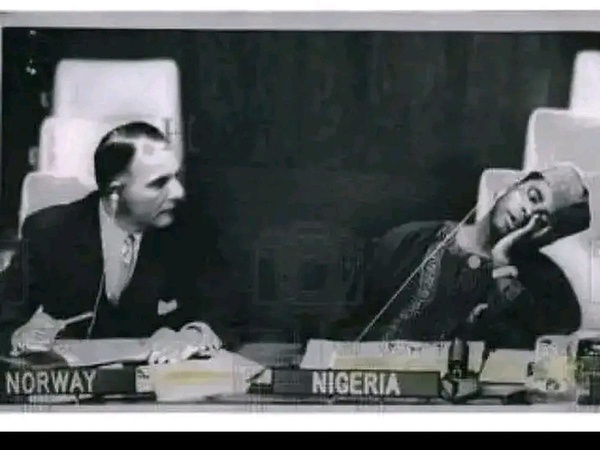
<p>When I first saw the photograph, I laughed.</p><p>I saw a Nigerian man sitting at the United Nations with his eyes closed, and my first thought was simple:</p><p><br/></p><p>How is this man sleeping inside a serious United Nations meeting?</p><p>Then I started asking questions.</p><p>Who was this man?</p><p>Why was he there?</p><p>What was happening before that photograph was taken?</p><p>Why have we remembered the closed eyes more than the man who was wearing the suit?</p><p><br/></p><p>His name was Jaja Anucha Ndubuisi Wachuku.</p><p>Born on 1 January 1918 in what is now Abia State, Wachuku became one of the important figures in Nigeria's early political and diplomatic history.</p><p><br/></p><p>He studied law at Trinity College Dublin and was called to the Irish Bar in 1944. He returned to Nigeria in 1947 and became involved in the nationalist movement.</p><p><br/></p><p>In 1949, he founded the New Africa Party. In 1959, he became the first indigenous Speaker of Nigeria's House of Representatives.</p><p><br/></p><p>When Nigeria became independent in 1960, Wachuku became the country's first Ambassador and Permanent Representative to the United Nations.</p><p><br/></p><p>Think about that for a moment.</p><p>Nigeria had just emerged from colonial rule.</p><p>A country that had spent decades under British colonial administration had finally become independent.</p><p>And one of the Nigerians carrying that new country's voice into the international system was Jaja Wachuku.</p><p><br/></p><p>So when I look at that photograph today, I don't just see a man sitting with his eyes closed.</p><p>I see a newly independent Africa sitting at the table of the world.</p><p><br/></p><p>Then I ask:</p><p>What happened?</p><p>Historical accounts tell us that during a United Nations debate, a racial remark was made that offended Wachuku. He demanded an apology and a retraction.</p><p><br/></p><p>According to historian Patrick Geoghegan's 2025 Trinity College Dublin memorial discourse on Wachuku, the apology did not come.</p><p>Wachuku then deliberately pretended to fall asleep as a form of silent protest.</p><p>Now the photograph makes sense to me.</p><p><br/></p><p>He was not simply sleeping.</p><p>He was making a statement.</p><p>This is where I think we need to have an uncomfortable conversation about how African history is remembered.</p><p>Who tells the story matters.</p><p><br/></p><p>If all I show you is the photograph, you may see a lazy African delegate sleeping at the United Nations.</p><p><br/></p><p>But if I give you the history, you see something else.</p><p>You see a Nigerian lawyer who had already built a remarkable career before independence.</p><p>You see the first indigenous Speaker of Nigeria's federal parliament.</p><p>You see Nigeria's first ambassador to the United Nations.</p><p>You see a diplomat who later chaired the United Nations Conciliation Commission for the Congo.</p><p>You see a representative of a newly independent African country operating in an international system that had once been dominated by colonial powers.</p><p><br/></p><p>Suddenly, those closed eyes mean something different.</p><p>But there is another question I cannot ignore.</p><p>What were the other Africans doing?</p><p>Wachuku was not Africa's only representative at the United Nations.</p><p>There were already African representatives from countries such as Ghana, Ethiopia, Liberia, Sudan, Morocco and Tunisia, alongside the newly independent African states entering the organisation.</p><p>Did they support him?</p><p>Did they challenge the remark?</p><p>Did they disagree with his method?</p><p>Did they remain silent?</p><p><br/></p><p>I have not found enough evidence to tell you what every African delegate did in that particular moment.</p><p>And I will not invent an answer.</p><p><br/></p><p>But the question matters.</p><p>Because what does Pan-African solidarity actually mean when one African is insulted?</p><p>African governments did not always agree with one another. Wachuku himself had disagreements with other African leaders over questions of representation and strategy.</p><p>That is part of African history too.</p><p><br/></p><p>This is why I have become increasingly interested in African history.</p><p>I do not want Africans to inherit every interpretation of Africa simply because it was written first.</p><p><br/></p><p>I want us to ask questions.</p><p>I want us to return to the archives.</p><p>I want us to read the documents.</p><p>I want us to listen to oral histories.</p><p>And, most importantly, I want Africans to tell African stories with African historical consciousness.</p><p><br/></p><p>This does not mean that I believe every European account of Africa is false.</p><p>European records can contain valuable historical evidence. African scholars have also built on European archives, and Africans and Europeans have collaborated in the production of knowledge.</p><p>The problem begins when a European interpretation automatically becomes the final interpretation of an African experience.</p><p>That is where I disagree.</p><p>Africa must not always appear in history as the object being studied.</p><p><br/></p><p>Sometimes, Africa must be the subject doing the studying.</p><p>Jaja Wachuku's Pan-African outlook did not begin at the United Nations.</p><p>He founded the New Africa Party in 1949, a movement connected to Pan-Africanism and Nigerian independence. Later, as Nigeria's first Foreign Minister, his foreign-policy thinking placed strong emphasis on African unity, Afrocentrism and Africa's interests.</p><p>So perhaps the sleeping photograph tells us something larger than what happened inside one UN meeting.</p><p><br/></p><p>Perhaps it reminds us that African dignity cannot depend on how the world chooses to photograph us.</p><p>People can misunderstand us.</p><p>They can reduce our history.</p><p>They can laugh at an image.</p><p>They can tell the story from another angle.</p><p>But we cannot afford to remain silent about our own past.</p><p>Because if we do not tell our stories, someone else will tell them for us.</p><p><br/></p><p>And when someone else's interpretation is repeated long enough, it can become the version of history we inherit.</p><p>I am writing because I want young Africans to understand that our history is filled with people who stood in places we sometimes imagine Africans were never meant to occupy.</p><p><br/></p><p>People like Wachuku.</p><p>People who studied.</p><p>People who represented Africa.</p><p>People who challenged power.</p><p>People who walked into international institutions and refused to behave as though Africa had arrived there by permission.</p><p>And that is the part of this story I find most important.</p><p>The photograph shows a man closing his eyes.</p><p><br/></p><p>History shows me a man who knew why he was there.</p><p>So the next time you see that photograph, don't laugh too quickly.</p><p>Look again.</p><p>Ask questions.</p><p>Find the history behind the image.</p><p><br/></p><p>Because the greatest injustice we do to our history is not forgetting it.</p><p>It is remembering it wrongly.</p><p><br/></p><p>As Africans, we must learn to do more than preserve our history.</p><p>We must reclaim the authority to interpret it.</p><p><br/></p><p><br/></p><p>Sources: Patrick Geoghegan, Jaja Wachuku (1918–1996), Trinity College Dublin Memorial Discourse, 2025; United Nations Digital Library records on Wachuku and Nigeria.</p>


 79
79


Other insights from 𝑫'𝒙𝑪𝑬𝑳𝑳𝑬𝑵𝑻 ™ ✍️🥇



Contributor Points
Points-to-Coupons

Referral Earning
Insights for you.

Dear African Parents,
Every "African parent" disapproves of suicide. "Why take his life over something so lit...
406 views
70 upvotes
76 comments

SOMETHING MUST KILL A MAN
Something must kill a man! That's what Emeka thought to himself that afternoon, outside...
262 views
42 upvotes
39 comments


BREAST IRONING
Ever heard of the breast ironing practice? well, I am from Cameroon and we have strong ...
1953 views
37 upvotes
43 comments

UNTAMED WORDS
They came with fire, but feared our flame,taught us silence, then gave it a name.Stole ...
424 views
33 upvotes
27 comments

My Greatest fear
My Greatest FearMy greatest fear isn’t death ,it’s the inability to write.I have a wild...
429 views
28 upvotes
29 comments

Divide The National Moi Moi
While embarking on my beauty stroll this evening, I pondered what I would write about. ...
1005 views
21 upvotes
24 comments

BE CAREFUL OF WHAT YOU START
Work hard.Be consistent.Be patient.These are the songs we hear,the sermons we swallow.B...
234 views
23 upvotes
25 comments

LET'S TALK ABOUT YOUR COUSINS
Family has always been the foundation of social relations.the ↗ very first people you c...
607 views
29 upvotes
25 comments

Hotel Rwanda 🇷🇼 part 1 Nomshu
Hotel Rwanda: Part 1 – How I Ended Up in the MadnessOkay, so you know how life sometime...
154 views
24 upvotes
24 comments
THE GIVE AND TAKE OF MASTURBATION
GBAM!Door closed.Shiiiiiiion!Window closed.The hand becomes the most useful and wonderf...
278 views
23 upvotes
28 comments