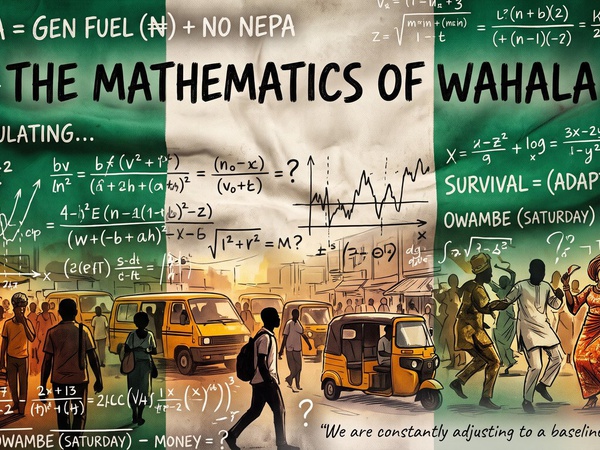
THE MATHEMATICS OF WAHALA
An Exercise in Being Nigerian
Being Nigerian is an ongoing exercise in calculating how much absurdity a person can accommodate before losing their mind. And somehow, we've become exceptionally good at the mathematics.
~Me
I have come to the conclusion that being Nigerian requires a certain level of intellectual flexibility and perhaps even a PhD in mental health.
I mean, how else do you explain the ability to wake up every morning, encounter a fresh set of problems, adjust your expectations, improvise solutions and somehow convince yourself that everything is under control?
I have learnt that living in Nigeria is less about making plans and more about developing the capacity to recalculate them and just when you think you've figured out the equation, somebody introduces another variable.
Take electricity, for instance.
I have discovered that my relationship with electricity in Nigeria is almost transactional. I no longer expect it to be available; I am simply grateful when it remembers that I exist.
Where I live in that place they call it, buying fuel for the generator has almost become part of the daily routine. You wake up, make provisions for fuel, calculate how long the generator can run, and somehow factor the cost into an already stretched budget. If NEPA eventually gives us electricity, we count ourselves lucky. Sometimes, you even wonder whether you should be grateful or suspicious.
Imagine having to spend money to generate the electricity you should ordinarily have access to, only to celebrate when the national grid decides to do its job. At this point, the generator is practically another member of the household. It has its own feeding requirements, maintenance schedule and, occasionally, an attitude.
And then there is the heat.
As though unreliable electricity wasn't enough, the weather occasionally decides to remind us that we are not, in fact, in a particularly comfortable part of the world. One minute you're trying to go about your day, the next you're questioning whether the sun has developed a personal grievance against you. This current period of intense heat that has had everyone talking about El Niño certainly did not make matters any easier.
Between the heat, the absence of electricity and the generator that requires fuel before it can perform its assigned duties, one begins to wonder whether staying indoors is actually a survival strategy or an elaborate form of punishment.
You could be sitting quietly, minding your business, sweating in places you didn't even know could sweat, when the power supply disappears. You look at the ceiling fan as it gradually loses momentum, look at your generator, remember the current price of fuel, and then look at the sky.
At that point, what exactly is a person supposed to do? Fight the sun?
And the most fascinating part? I've adjusted.
I know when to charge my devices, when to conserve battery, when to switch on the generator and when to simply surrender to the heat. I have mastered the art of rearranging my day around something as basic as electricity which shouldn't even be.
Perhaps that's the first lesson in the Nigerian survival manual: never become too attached to a plan.
There is always a possibility that something entirely outside your control will introduce itself.
But electricity and the weather are only two variables in this rather complicated equation.
There is also the matter of money.
I sometimes wonder what exactly happens to money between the time it enters my account and the time I check my balance again. It is almost as though my allowance has a life of its own, with several dependants, outstanding obligations and personal commitments I was not informed about. Before I can even admire the notification, the money has begun distributing itself.
Going to the market is another exercise entirely. I have learnt that prices can change so frequently that one almost needs to establish a relationship with the market before attempting to shop. You go with a mental budget, return with half the items on your list and somehow still manage to spend more than you planned.
At this point, I don't think I'm shopping. I'm negotiating with the economy.
You pick up an item, check the price, put it down, pick it up again, as though the price might have reconsidered its decision. Sometimes you ask the seller, "Is this the price?" and they look at you with the expression of someone who is also a victim of the situation.
And yet, somehow, we move.
That expression deserves its own chapter in the Nigerian dictionary. "E go be nau." "Na today?" "No be Tinubu?" "APC dey suffer us." Two or three words, sometimes a whole sentence, capable of communicating frustration, sarcasm, political commentary and resignation all at once.
Something happens, somebody makes a remark, another person adds their own interpretation, and before long, the entire conversation has become a comedy routine. We have a remarkable ability to find the appropriate Nigerian expression for almost every unfortunate circumstance.
The funny thing is that these expressions are not always intended to make anyone laugh. Sometimes, they are simply the only responses we have left. Other times, we genuinely find the situation hilarious. And occasionally, we laugh because the alternative is to sit down and think too deeply about what is happening.
We really do move. Sometimes forward, sometimes sideways, sometimes in circles, but we move.
Perhaps nowhere is this ability to find humour in our circumstances more evident than on social media.
Particularly on X, where it seems no national disappointment is complete until somebody has turned it into a meme. A national grid collapse happens, and within minutes, timelines are flooded with jokes, sarcastic commentary, screenshots and skits. Someone is already asking whether the electricity supply has travelled abroad for greener pastures. Another person has probably designed a farewell message for the national grid. Before long, Instagram has picked up the conversation, content creators are doing their thing, and everybody has something to contribute.
Sometimes, I genuinely wonder how Nigerians come up with these things. The creativity is almost suspicious.
You can open X to find out why there is no electricity and leave with a collection of memes, three political arguments, somebody's skit about the situation and a new phrase you will probably use for the rest of the week. Even the comments section is an event of its own. One person is angry, another is making a joke, someone else is asking for the source of the information, another person is doing an analysis of it like Daniel Regha and there is always that one person who has somehow found a way to turn the whole thing into a business opportunity.
We have become so efficient at turning national events into content that sometimes I wonder if our next national development plan will include a department for meme production.
And it is not just electricity. Fuel prices, inflation, political statements, government announcements, the cost of living and the latest national embarrassment all receive the same treatment. Someone makes a promise, Nigerians bring out the memes. Something goes wrong, Nigerians bring out the memes. Somebody says something that contradicts what we can all see with our own eyes, and the internet becomes a courtroom.
The jokes can be brutal.
But beneath the laughter, there is something worth examining.
There is something admirable about people who can manufacture laughter in the middle of frustration. Humour gives us a way to release tension, connect with one another and, sometimes, make a difficult day feel a little less heavy. It allows us to laugh at circumstances that might otherwise leave us completely overwhelmed.
Yet, I find it both fascinating and slightly unsettling.
Because sometimes, we laugh because something is genuinely funny. Sometimes, we laugh because we need somewhere to put the frustration. And sometimes, after experiencing the same disappointment repeatedly, laughter becomes almost automatic. We have learnt to turn the things that should outrage us into punchlines before the dust even settles.
We translate trauma into punchlines before the dust even settles.
And then we move on.
The problem is that the meme disappears from the timeline, the trending topic changes, and the actual problem remains. The generator still needs fuel. The prices at the market have not suddenly become reasonable. The roads have not repaired themselves. The next announcement comes, and we are back to calculating.
Our humour is a survival tool, no doubt. But I sometimes wonder whether it also becomes a sedative. Does laughing at the absurdity help us endure it, or does it sometimes make us too comfortable with things we should never have accepted in the first place?
This is where the mathematics becomes more complicated.
Because it is one thing to laugh at how much Nigerians can adapt. It is another to ask why we are constantly required to adapt in the first place.
We are often praised for being resilient. We hear about the Nigerian spirit, the ingenuity of our people, our ability to create opportunities where none seem to exist. And honestly, there is plenty to admire. Nigerians are resourceful. We find ways around obstacles, build businesses, support one another, create entertainment, pursue opportunities and keep imagining better possibilities even when the present gives us very little reason to be optimistic.
But resilience can become a convenient word when it is used to excuse the conditions that demand it.
At what point does celebrating our ability to survive become a way of avoiding conversations about why survival is this difficult?
We cannot keep applauding citizens for finding alternatives to services they should ordinarily receive, while ignoring the people and institutions responsible for providing them. We cannot turn every failure into a joke and pretend that the joke is the solution. And we certainly cannot keep asking people to be patient while promises are made, repeated, abandoned and replaced with new promises.
Sometimes, the absurdity is not even in the problem itself. It is in the confidence with which we are expected to pretend that everything is fine.
You hear an explanation that does not quite match your experience. You hear another promise. You listen, look around at your immediate surroundings and wonder whether you and the person making the announcement are living in the same country.
And then, naturally, somebody posts a meme.
We laugh because what else can we do with the sheer audacity of it all? But somewhere between the laughter and the reposts, there has to be room for accountability. We must be able to ask questions, demand explanations and insist that public responsibility means something beyond another speech.
Our ability to make jokes should not be mistaken for a lack of awareness. We know what is happening. We know what things cost. We know what we are being told, and we know what we experience. We are not oblivious. We are simply trying to live through it.
Which brings me to another Nigerian contradiction I find particularly interesting.
Monday to Friday, we are amateur economists. We calculate fuel costs, monitor prices, compare transport fares, reconsider purchases and occasionally stare into the distance while asking ourselves what exactly we are still doing in this country.
Then Saturday arrives.
Suddenly, somebody is getting married.
The same people who spent Thursday lamenting the price of fuel are now dressed in beautifully starched aso-ebi, attending an owambe where the jollof rice has been prepared with an almost unreasonable level of confidence. There is music, dancing, an impressive spread of food and a competition that nobody officially announced but everybody seems to understand.
Somebody is spraying money. Somebody else is taking pictures. Another person is determined to leave with a souvenir, preferably a plastic basin that may or may not ever be used.
And I find myself wondering: where did everybody find the energy?
How do we move from calculating the cost of a loaf of bread to celebrating a wedding with this much enthusiasm?
But perhaps that is another part of the Nigerian experience that cannot be reduced to simple mathematics.
We love to celebrate. We value community, family, friendship and the occasions that bring people together. Sometimes, people save for months to attend a celebration or contribute to one. Sometimes, the party is not about having money to spare; it is about refusing to let difficult circumstances take away every opportunity to be happy.
There is something beautiful about that.
For all our complaints, we still find reasons to gather. We still make music, tell stories, visit one another, dress up, cook, laugh and dance. We still find joy in ordinary moments. We can be exhausted by the state of the country and still be excited about a friend's wedding. We can complain about the economy in the morning and sing at the top of our lungs by evening.
It is not necessarily denial. Sometimes, it is simply life refusing to pause until everything is perfect.
And perhaps this is why being Nigerian is so difficult to explain to anyone who has not experienced it.
How do you describe a place where the same people can be deeply frustrated and unbelievably joyful? Where a power outage can become a trending topic, a market trip can feel like a negotiation with international economic forces, and a wedding can temporarily convince everyone that life is still worth celebrating?
How do you explain a people who have mastered the art of making do, not because they always want to, but because they often have no other choice?
I think the absurdity of being Nigerian lies somewhere in that contradiction.
We are constantly adjusting to a baseline of normal that keeps shifting beneath our feet. We have learnt to anticipate disappointment, improvise when plans fail and find humour in situations that should never have become ordinary. We have developed an entire language around endurance. We know how to say "e go be" even when we have absolutely no idea how it will be.
But I do not want our story to end with how well we endure.
I do not want resilience to become the highest standard we expect from ourselves. I do not want our ability to survive poor conditions to become an excuse for those who should be making those conditions better. And I do not want us to confuse being able to laugh about a problem with having solved it.
We deserve more than the opportunity to become experts at surviving.
We deserve electricity that does not feel like a surprise visitor. We deserve an economy that does not turn ordinary necessities into luxury purchases. We deserve public institutions that work, leaders who can be questioned and a country where making plans does not require preparing for every possible disaster.
Until then, we will probably keep doing what we know how to do.
We will calculate, recalculate, improvise and occasionally look at the situation before us and ask, "Na today?"
We will make memes on X, repost them on Instagram, argue in comment sections, laugh at skits, attend owambes, complain about fuel and still find something to look forward to.
We will keep saying "e go be nau."
But perhaps, alongside that familiar expression, we must learn to ask another question: when will it be better, and who is responsible for making it so?
Because wahala may be woven into the fabric of our everyday experiences, but it should never be the standard by which we measure a country.
And if there is one thing I have learnt from all this mathematics, it is that Nigerians should not have to keep solving the same problems every single day.
At some point, the equation itself needs to change.



 1