James ran.
His lungs burned, his legs ached, and somewhere behind him—too close—the city groaned and screamed. He didn't look back. He couldn't. The crowd pushed him forward like water through a narrow crack, bodies slamming against bodies, feet stumbling over rubble.
Then the ground vanished.
He fell—hard—landing on packed earth, the breath knocked clean out of him. Above, the opening he'd tumbled through showed a sliver of smoke-filled sky. Boots pounded past, and no one stopped.
He lay there, gasping.
Then he realized: he wasn't alone.
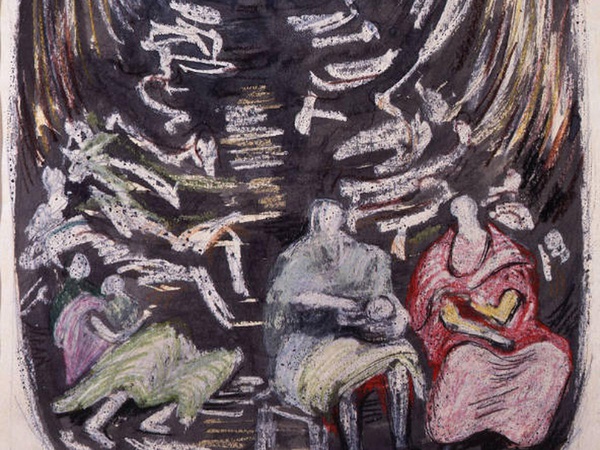
A dozen faces stared back at him. Old. Young. Weary. A child clutched a rag doll. A man held a tin cup. No one spoke. They just... watched.
Then, one by one, they turned away and went back to what they were doing.
James pushed himself up, wincing. His palms were scraped raw. He limped toward the wall, away from them, and sank down beside a man who leaned against the tunnel's curved brick. He was broad-shouldered, with a gray beard and calm eyes.
"What... what are you doing?" James whispered.
The man glanced at him. "Preparing for a meal."
James blinked. "A meal? There's—outside—"
"I know," the man said, and smiled. "That's why we eat."
A woman emerged from the shadows carrying a small clay pot, steam curling from the lid. She was young, maybe thirty, with dirt on her cheeks and something fierce in her eyes. Her name was Ngozi.
She sat the pot down and began to share.
It was root stew—thin and watery, with chunks of potato and carrot, and a faint hint of wild herbs. Not much. Not nearly enough. But she moved through the tunnel, spooning it into bowls and cups and cupped hands, speaking softly to each person.
To the old man: "Eat, Papa Emeka . You need your strength."
To the child with the doll: "There you go, little one. Warm your belly."
To a teenager staring blankly at the wall: "Come now. Today is still today."
James watched her. She spoke like the world wasn't collapsing. Like the explosions in the distance were just... thunder. And the people—they listened. They ate. They nodded.
No one cried.
He realized, with a jolt, that they'd been doing this for a while. This was their routine. Their rhythm. Their small rebellion.
When the last spoonful was gone, the gray-bearded man beside James stood up.
He wiped his hands on his trousers, cleared his throat, and began to clap.
Slow at first.
Clap... clap... clap...
Then faster.
Clap-clap-clap-clap.
He opened his mouth and sang—deep and rough, like gravel rolling down a hill:
"When the walls come tumbling down,
And the sky forgets the sun—
We still have hands to hold around,
We still have songs unsung..."
Other men joined him. Voices rose. A bald man with a scar across his cheek stomped his foot. A young soldier—still in tattered uniform—closed his eyes and let the words pour out.
Then the women.
Ngozi's voice cut through like a bell—clear, bright, unbreakable. She stepped into the center of the circle and sang the next verse:
"We remember bread and honey,
We remember rain on leaves—
We remember peace was ours,
And we will have it back, believe..."
The children stared. Some were still afraid, hugging their knees. But others—slowly, tentatively—began to smile. A little girl tugged at her mother's sleeve and started swaying. A boy joined his voice to his father's, high and wobbly.
James sat frozen.
He watched men who'd lost everything stomp their feet. He watched women who'd buried loved ones throw their heads back and laugh. He watched children—frightened, hollow-eyed children—light up like candles.
And outside?
Outside, the world burned.
People ran through smoke-choked streets. Buildings crumbled. Guns cracked. The city was dying.
But here—in this tiny tunnel with its flickering fire and thin stew and broken voices—
They sang.
The chorus swelled until it seemed to rise through the earth, through the concrete and rubble, past the smoke and the screams and the falling shells. It was a song of hope and fear, of grief and stubborn joy. It remembered the good times. It declared that better times were coming — whether or not the world believed it.
James's hands wouldn't stop shaking. He stared at the bowl in front of him and didn't trust himself to lift it without spilling.
Ngozi crouched beside him. "You'll learn the words," she said. "Everyone does eventually."
He didn't answer. But his foot, without his permission, had started to tap.


 229