Score |
2


Goodyboy/Joe
 tailor @ lagos, nigeria
tailor @ lagos, nigeria



The Weight of an Unheard Voice
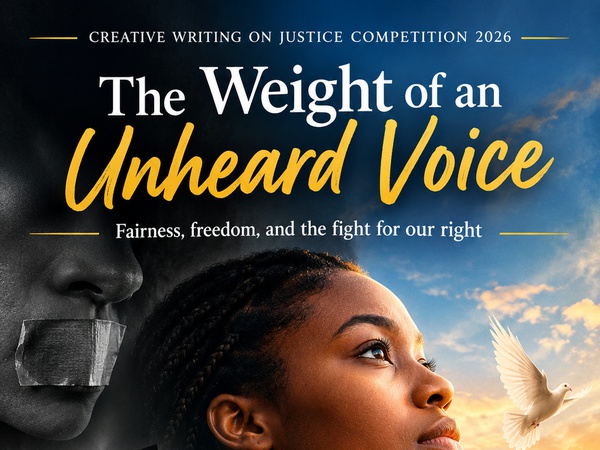
<p><br/></p><p><br/></p><p><br/></p><p><br/></p><p>The day Amara lost her voice, the world did not stop.</p><p><br/></p><p>The sun rose. Children laughed. Buses rumbled through crowded streets. Somewhere, someone celebrated a victory while someone else silently endured defeat.</p><p><br/></p><p>The world continued.</p><p><br/></p><p>That was the frightening part.</p><p><br/></p><p>Injustice does not always arrive with sirens. Sometimes, it slips into ordinary life so quietly that people mistake it for normal.</p><p><br/></p><p>Amara was seventeen when she discovered this.</p><p><br/></p><p>Her voice had not disappeared. She still greeted neighbours and laughed with friends. But after witnessing an injustice that frightened everyone into silence, she found herself afraid to speak.</p><p><br/></p><p>Her mother once told her, “A person can survive hunger. What is harder to survive is being treated as though you do not matter.”</p><p><br/></p><p>Amara finally understood.</p><p><br/></p><p>It happened in a crowded market. Traders called out prices, customers hurried between stalls, and the air carried the smell of freshly cooked food.</p><p><br/></p><p>Everyone was busy living.</p><p><br/></p><p>And injustice flourished in the background.</p><p><br/></p><p>Amara witnessed something wrong. Others witnessed it too. Yet nobody spoke.</p><p><br/></p><p>Not because they did not care, but because they feared what speaking might cost.</p><p><br/></p><p>That is how injustice survives: through the cruelty of those who commit it and the silence of those who witness it.</p><p><br/></p><p>Silence can look harmless.</p><p><br/></p><p>Sometimes, however, it is a locked door. Sometimes, it is a blindfold. Sometimes, it is the comfortable excuse, It is not my problem.</p><p><br/></p><p>Until one day, it is.</p><p><br/></p><p>That evening, Amara discovered an old notebook beneath her mother's bed. On its first page, someone had written:</p><p><br/></p><p>“A right that must be begged for is a right already in danger.”</p><p><br/></p><p>She read the sentence twice.</p><p><br/></p><p>Then she understood: rights do not survive merely because they are written down. They survive because people defend them.</p><p><br/></p><p>The following morning, Amara spoke.</p><p><br/></p><p>Her hands trembled. Fear stood beside her like a shadow.</p><p><br/></p><p>But she spoke anyway.</p><p><br/></p><p>Nothing extraordinary happened. The sky did not change. The powerful did not suddenly become humble.</p><p><br/></p><p>Yet something changed.</p><p><br/></p><p>Amara had stopped allowing fear to speak for her.</p><p><br/></p><p>She discovered that courage is not the absence of fear; it is the decision that fear will not have the final word.</p><p><br/></p><p>Her voice was only one voice.</p><p><br/></p><p>But one voice can become a question. A question can become a movement. A movement can transform a future.</p><p><br/></p><p>Sometimes, justice begins with four simple words:</p><p><br/></p><p>“This is not right.”</p><p><br/></p><p>Justice is larger than a courtroom. It lives wherever human beings recognise one another's dignity.</p><p><br/></p><p>It exists when poverty does not determine whose rights matter, when children are heard, when women can speak without fear, and when the powerful are held accountable.</p><p><br/></p><p>Justice is not simply the punishment of wrongdoing. It is the refusal to allow wrongdoing to become normal.</p><p><br/></p><p>And freedom?</p><p><br/></p><p>Freedom is more than walking through an open door.</p><p><br/></p><p>What is freedom if fear determines what you can say? What is equality if opportunity depends on wealth or connections? What is a right if only the powerful can exercise it?</p><p><br/></p><p>Freedom is the right to remain fully human.</p><p><br/></p><p>To think. To speak. To question. To disagree. To dream without surrendering one's dignity.</p><p><br/></p><p>Yet freedom without fairness can become another prison.</p><p><br/></p><p>A society cannot call itself just when some people are protected while others are abandoned. Nor can it claim to value equality when a person's dignity depends on their background, beliefs, or social standing.</p><p><br/></p><p>Perhaps the greatest test of justice is not how we treat people who resemble us.</p><p><br/></p><p>It is how we treat people who do not.</p><p><br/></p><p>It is easy to defend fairness when we are suffering. It is harder when fairness benefits someone we dislike.</p><p><br/></p><p>It is easy to demand freedom for ourselves. It is harder when another person's freedom challenges our beliefs.</p><p><br/></p><p>But justice that protects only our friends is not justice. Freedom reserved for the majority is not freedom.</p><p><br/></p><p>Justice must remain justice even when the face before us is unfamiliar.</p><p><br/></p><p>Throughout history, people have challenged injustice despite being told they were powerless, troublesome, or destined to fail.</p><p><br/></p><p>Some marched. Some wrote. Some protested. Others simply refused to participate in wrongdoing.</p><p><br/></p><p>Their circumstances differed, but they shared one conviction: accepting injustice was not the only available choice.</p><p><br/></p><p>Change often begins when one person acts and another discovers the courage to follow.</p><p><br/></p><p>Years later, a young girl asked Amara, “Were you afraid?”</p><p><br/></p><p>“Yes,” Amara replied.</p><p><br/></p><p>“Then why did you speak?”</p><p><br/></p><p>Amara looked towards the horizon.</p><p><br/></p><p>“Because I realised my silence was helping the wrong person.”</p><p><br/></p><p>The girl fell quiet.</p><p><br/></p><p>Some truths require no decoration.</p><p><br/></p><p>They simply need to be heard.</p><p><br/></p><p>Perhaps that is what justice asks of every generation: not perfection, but participation.</p><p><br/></p><p>We will never inherit a flawless world. There will always be another unfairness to confront, another voice to defend, another door to open.</p><p><br/></p><p>Our responsibility is not to create a perfect world overnight. It is to leave behind a world fairer than the one we inherited.</p><p><br/></p><p>One day, history may forget our names and speeches. But the consequences of our choices will remain.</p><p><br/></p><p>It will matter who looked away, who chose comfort, and who stood trembling but determined when silence seemed easier.</p><p><br/></p><p>So listen when someone is silenced. Challenge unfairness when others accept it. Defend freedom when doing so becomes inconvenient. Choose fairness even when it costs you something.</p><p><br/></p><p>Because justice does not begin when everyone agrees.</p><p><br/></p><p>It begins when someone decides that another person's dignity is worth defending.</p><p><br/></p><p>And when the crowds have disappeared, the arguments have faded, and the world has moved on, one question will remain for each of us:</p><p><br/></p><p>When you heard a voice being silenced, what did you do with the silence?</p><p><br/></p><p><br/></p>


 2
2


Other insights from Goodyboy/Joe





Contributor Points
Points-to-Coupons

Referral Earning
Insights for you.


Let's Forikori
Honestly, I have been hearing "Olodo Uprising" for the longest time, and I think it's h...
223 views
35 upvotes
30 comments


My journey:From the Gates of UniAbuja...
The dust of Gwagwalada hung in the air, a familiar yet distinct scent that marked the b...
427 views
27 upvotes
39 comments

HOW PETTY THEY CAN BE
I've always enjoyed Spotify and other streaming services, I mean if nothing I get to co...
694 views
35 upvotes
25 comments

I won guys
I won English guys. I had done all the typing and guess what I lost it. Don't worry I'm...
134 views
24 upvotes
25 comments


LIFE OF A FUTURE DIPLOMAT (I GUESS) T...
Okay, hi.My name is Nomshu, but most people here know me as Grace, and I’m a student of...
412 views
25 upvotes
88 comments


A WORD IS ENOUGH FOR THE WISE
There is something extremely powerful about words, they hold power most never pay atten...
2319 views
17 upvotes
21 comments

I am Olodo
Insult me however you like, but don't think you are insulting me when you call me **Olo...
150 views
19 upvotes
22 comments
School is a scam
The concept of education has been debated for centuries, and its true meaning has been ...
759 views
19 upvotes
23 comments

The Bridge to Adulthood
I remember when I was in secondary school, my classmates and I had great dreams and pla...
1342 views
17 upvotes
22 comments

The weight of A's
I sit in the cold, dark my torch the only source of light.I ignore the bite of the air...
459 views
18 upvotes
16 comments