Score |
400


Keeyra Writes✍🏽

 A freelancer @ Federal University Oye Ekiti.
A freelancer @ Federal University Oye Ekiti.



To Stay or to Japa: The Price of Patriotism

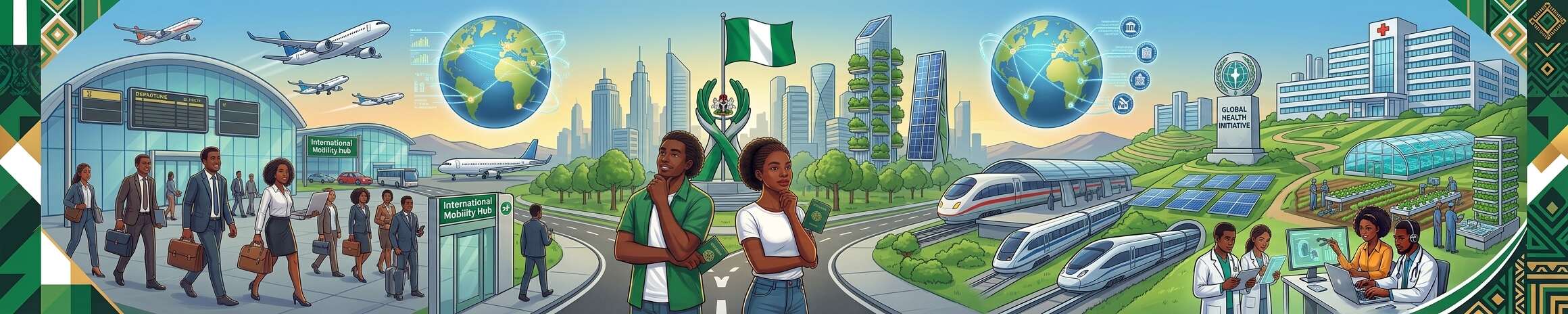
<p> <strong>To Stay or to Japa: The Price of Patriotism</strong></p><p><br/></p><p>Every 1st of October, politicians wear green and white, give long speeches on television, and praise the resilience of young Nigerians. They ask us to be patient, stay home, and help fix the country. But resilience does not pay rent, and patience does not put food on the table. Today, a difficult question divides our generation. Is leaving Nigeria an act of betrayal, or is it simply self preservation?</p><p><br/></p><p>To be fair, there is a reason people argue that we should stay. A country cannot fix itself by magic. It takes people doing real work. Young Nigerians are building businesses, creating technology, making music and films that travel beyond our borders. Doctors, engineers, teachers, researchers and entrepreneurs have the skills Nigeria needs to become better. But there is a problem with telling all of them to stay.</p><p><br/></p><p>Patriotism is a two way street. Citizens have responsibilities to their country, but a government has responsibilities to its citizens too. We pay taxes, obey laws, contribute to our communities and spend years trying to build decent lives. In return, it is reasonable to expect safety, functioning infrastructure, electricity, good public institutions and an economy where hard work has a fair chance of producing a decent life. When those things repeatedly fail, asking young people to stay and suffer simply because Nigeria needs them begins to feel less like patriotism and more like an expectation to endure.</p><p><br/></p><p>Look at what a young Nigerian goes through just to get an education. You spend years in university dealing with strikes, overcrowded lecture halls, rising fees and an uncertain academic calendar. Your parents sacrifice. You sacrifice. You keep going because you believe that one day the degree will open a door. Then you graduate, start looking for a job, and suddenly the conversation becomes, “Start something. Sell something. Do business.”</p><p><br/></p><p>The recent controversy over First Lady Oluremi Tinubu mentioning businesses such as akara, roasted corn and kuli kuli captures some of this frustration. There is absolutely nothing shameful about selling akara. There is dignity in honest work. But after years of education, what kind of economy are we building if the answer to unemployment is simply to tell graduates to create their own small businesses? The problem is not akara. The problem is an economy that can educate people for years and still struggle to create enough productive opportunities for them. We have become so used to surviving that sometimes we mistake survival for development.</p><p><br/></p><p>And this is where the “stay and fix Nigeria” argument becomes difficult for me. Young Nigerians have tried to fix things before. In October 2020, thousands came out during the EndSARS protests. They carried Nigerian flags, sang the national anthem and demanded an end to police brutality. They were not protesting because they hated Nigeria. They were protesting because they believed Nigeria could be better. At Lekki Toll Gate and Alausa, Amnesty International documented at least 12 people killed by security forces on 20 October 2020. The Lagos Judicial Panel of Inquiry later found that military and police personnel killed unarmed protesters who were sitting on the ground, waving Nigerian flags and singing the national anthem. Questions of accountability have remained unresolved. Think about that. Some of those young people never went home.</p><p><br/></p><p>So when we tell the next generation to stay and sacrifice for Nigeria, we need to ask what exactly we are asking them to sacrifice. Their money? Their opportunities? Their comfort? Their youth? At what point does patriotism stop being responsibility and become an expectation to suffer?</p><p><br/></p><p>Still, I do not believe the answer is that everyone should leave. That would be its own tragedy. If every doctor leaves, who treats the people who cannot afford to travel? If every engineer leaves, who builds? If every researcher leaves, who develops new ideas? When skilled people leave in large numbers, Nigeria loses more than people. It loses possibilities. That is the painful reality of brain drain. The person who leaves may have a perfectly rational reason for doing so, while the country still pays a serious price for losing them. Both things can be true. Leaving can be rational, and losing skilled Nigerians can hurt Nigeria.</p><p><br/></p><p>But the answer cannot be to guilt people into staying. If Nigeria genuinely needs its doctors, engineers, researchers and entrepreneurs, then it must become a place capable of retaining them. We cannot keep asking individuals to personally absorb the cost of structural problems because the country needs their skills.</p><p><br/></p><p>And leaving does not necessarily mean cutting ties. A Nigerian abroad can support family members, invest in businesses, create jobs, mentor younger people and return with skills, connections or capital. You can leave a country without leaving it behind. Of course, life abroad is not automatically perfect. People leave behind family, friendships, familiarity and a sense of belonging. Some discover that the greener grass still requires plenty of work.</p><p><br/></p><p>But none of that changes the central question. Why should a young Nigerian have to choose between personal survival and national development? We cannot ask a generation to spend its youth repairing foundations it did not break. Nigeria can take another twenty, thirty or forty years to develop. An individual does not get another twenty years of youth.</p><p><br/></p><p>That is why I cannot accept the idea that leaving is automatically treason. Some people will stay and build. Some will leave and build somewhere else. Some will leave, succeed and eventually return. Others may never return but still contribute to Nigeria in ways that are not immediately visible. These choices do not automatically make one person more patriotic than another.</p><p><br/></p><p>What Nigeria needs is not a generation forced to stay because it feels guilty about leaving. It needs a country where staying makes sense. A country where a young person can look at their future and see more than survival. A country where education is not merely a certificate, entrepreneurship is not merely a substitute for employment, and resilience is not constantly required to compensate for broken systems.</p><p><br/></p><p>The young Nigerians who stood at EndSARS were already willing to fight for a better Nigeria. Some paid the ultimate price. We should remember them not by demanding that another generation repeat their suffering, but by building the country they were asking for.</p><p><br/></p><p>So, is leaving Nigeria a betrayal? I don't think so. Sometimes leaving is ambition. Sometimes it is opportunity. And sometimes, it is simply survival. The real failure is not that Nigerians have found reasons to leave. It is that we have created a country where so many young people believe their best chance at a decent life exists somewhere else.</p><p><br/></p><p> Nigeria should not have to beg its citizens to stay. It should give them reasons to want to. And perhaps that is the harder question we should be asking: What would Nigeria have to become for them to want to stay?</p><p><br/></p>


 108
108





Other insights from Keeyra Writes✍🏽













Contributor Points

Points-to-Coupons

Referral Earning

Insights for you.

Dear African Parents,
Every "African parent" disapproves of suicide. "Why take his life over something so lit...
403 views
70 upvotes
76 comments

SOMETHING MUST KILL A MAN
Something must kill a man! That's what Emeka thought to himself that afternoon, outside...
259 views
42 upvotes
39 comments


BREAST IRONING
Ever heard of the breast ironing practice? well, I am from Cameroon and we have strong ...
1949 views
37 upvotes
43 comments

UNTAMED WORDS
They came with fire, but feared our flame,taught us silence, then gave it a name.Stole ...
423 views
33 upvotes
27 comments


My Greatest fear
My Greatest FearMy greatest fear isn’t death ,it’s the inability to write.I have a wild...
429 views
28 upvotes
29 comments



TRAUMA😣💊😊
"Get out of my house, you have no place in this world.""Why is she so quiet? She's dang...
442 views
26 upvotes
20 comments


Divide The National Moi Moi
While embarking on my beauty stroll this evening, I pondered what I would write about. ...
1004 views
21 upvotes
24 comments

When Little Faith Came Back🥺
"The Child We Left Behind"😶Little Faith: Want to play? 🤗Big Faith: Adunni.Little Faith:...
305 views
31 upvotes
27 comments


BE CAREFUL OF WHAT YOU START
Work hard.Be consistent.Be patient.These are the songs we hear,the sermons we swallow.B...
233 views
23 upvotes
25 comments