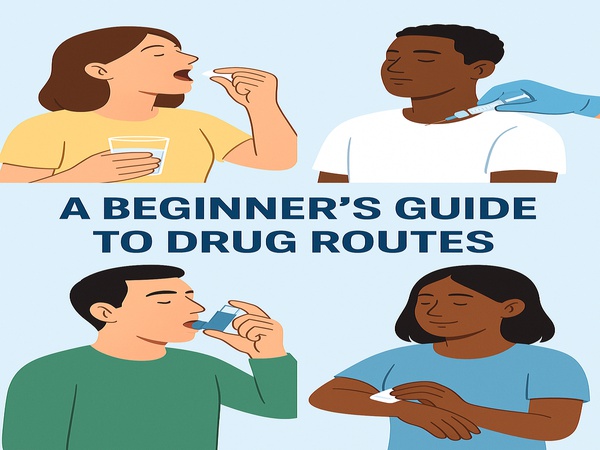
Have you ever paused to wonder why some medicines are swallowed, others injected, and some even come as creams or inhalers?
When we take any form of medications, it doesn't just magically go to work. The route a drug takes to enter the body have a profound effect upon the speed and efficiency with which the drug acts, that is; how fast it acts, how long it lasts, and how well it works.
Let's break it down in a simple, relatable way:
ENTERAL ROUTES
These involve the direct or indirect placing of drugs in the gastrointestinal tract.
- Oral - This is the administration of drug by swallowing. Drugs taken by this route undergo a first-pass effect (an effect that occurs when a drug taken orally, is metabolized by the liver before reaching systemic circulation), leading to a reduction in its bioavailability.
- Sublingual - The drug is taken by placing it under the tongue. The drug dissolves quickly and is absorbed directly into the bloodstream, thus bypassing the first-pass effect.
- Buccal - The drug is administered by placing it between the gum and cheek. The drug is absorbed through the buccal mucosa, and also bypass the first-pass effect.
- Rectal - This is the route of taking drug by inserting it into the rectum.
PARENTERAL ROUTES
These involve the direct delivery of drugs into the systemic circulation, bypassing the intestinal mucosa, and are usually administered by injection.
- Intravenous (IV) - The drug is injected directly into the bloodstream. It has 100% bioavailability because the drug is delivered directly into systemic circulation.
- Intramuscular (IM) - The drug is injected directly into the skeletal muscle.
- Intradermal (ID) - The drug is injected directly into the dermis layer of the skin.
- Subcutaneous (SC or SubQ) - The drug is injected directly into the subcutaneous tissue.
OTHER ROUTES
- Inhalation - The drug is breathed in, often for asthma or lung conditions.
- Topical/ Transdermal - The drug is applied to skin (creams, patches)
- Nasal, Ocular, Otic - The drug is administered into the nose and, eyes, or ears respectively for local effect.
Many people don't realize that the way a drug is given can change how fast it starts working.
So, we are going to explore the time until effect of each route of drug administration:
- Oral route is 30-90 minutes
- Sublingual route is 3-5 minutes
- Buccal route is 15-30 minutes
- Intravenous route is 30-60 seconds
- Intramuscular route is 10-20 minutes
- Intradermal route is slow and localized (hours)
- Subcutaneous route is 15-30 minutes
The route of administration is not random. It is determined by the physical characteristics of the drug, the speed which the drug is absorbed and/or released, as well as the need to bypass hepatic metabolism and achieve high concentration at particular sites.
So, next time you are given any form of drug, remember that it is not just about convenience, it is science in action.
If you learn something new from this, kindly click on the Like button, Comment, Share, or Tag someone who would love to know this too.
Let's keep Learning and Growing🤝



 847