There's something quite ironic about the way we talk about African writers.
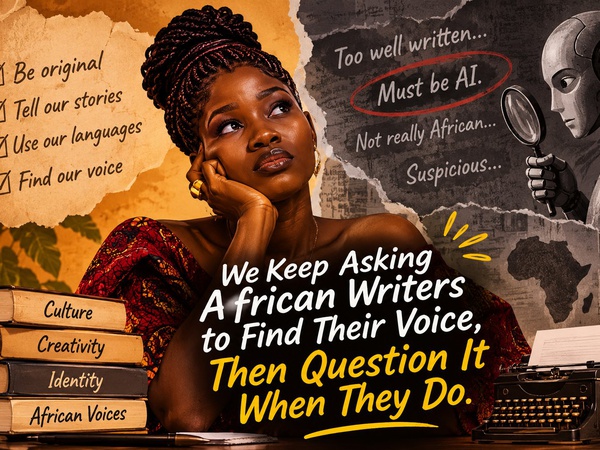
We encourage them to be original. We tell them to embrace their identity, tell their stories, preserve their culture and develop a voice of their own.
But what happens when that voice doesn't sound the way we're accustomed to hearing it?
Suddenly, the vocabulary is too sophisticated. The grammar is too perfect. The sentences are too well structured. And before we know it, someone is asking whether AI wrote the piece.
I find this particularly interesting because African writers have been dealing with questions about authenticity long before artificial intelligence became part of our everyday conversations.
For years, African stories have been judged against certain expectations. There's often an unspoken assumption about what African experiences should look like, what African characters should sound like and even what kind of language should be used to tell African stories.
But Africa is not one experience.
An African writer can tell a story about growing up in a rural community, just as another can write about navigating life in an expensive city. One can write in Pidgin, another in polished English, while someone else might weave Yoruba, Igbo, Hausa or another indigenous language into their work.
Which one is more African?
And why should one person's style be considered more authentic than another's?
I also think we need to have a conversation about the language we use. English might not have originated in Africa, but generations of Africans have made it part of their everyday expression. We've adapted it, played with it and infused it with our own experiences. Nigerian English, for instance, carries expressions and rhythms that are distinctly familiar to us.
Our proverbs, idioms, humour and indigenous expressions are not decorative additions to our intelligence. They are part of how we think, communicate and understand the world.
And this is where I think the AI conversation becomes complicated.
Of course, AI-generated writing exists. People do submit work they haven't written themselves, and originality matters. Writers deserve to have their effort recognised, and writing communities have every reason to protect that.
But we must be careful not to turn writing style into evidence of dishonesty.
A person using impressive vocabulary is not automatically using AI. A beautifully constructed sentence is not proof of artificial intelligence. Neither is a writer's ability to communicate in formal English.
At the same time, we shouldn't assume that every accusation of AI use is prejudice. Sometimes there are legitimate reasons to question authorship. The point is that suspicion should be supported by evidence, not stereotypes about how an African writer ought to sound.
Maybe we also need to reconsider what makes a voice truly ours.
I don't think originality means that every word, expression or idea must have originated entirely from us. Writers read other writers. We learn new words, borrow expressions, study different styles and are influenced by the people and environments around us.
But there's something no one else can entirely replicate; the particular combination of experiences, perspectives, memories and interpretations that informs how we express ourselves.
Two people can write about the same rainy afternoon and produce entirely different stories. Not necessarily because one has better vocabulary, but because they have different memories attached to the rain.
Two people can be given the same subject, the same words and the same prompt, yet produce entirely different arguments. Not because one is more intelligent than the other, but because they see the world differently.
That, to me, is part of what makes a voice personal. We all can't be the same
Maybe that's what we should be paying more attention to.
We cannot keep telling African writers to embrace their voice while expecting them to fit into an expected idea of what African writing should sound like.
We cannot celebrate originality only when it is familiar to us.
AI has introduced legitimate concerns about authorship, but it must not become another excuse to police how African people express their intelligence.
If we want African writers to find their voices, we must also learn to recognise that those voices will not all sound alike.
And maybe the better question isn't whether an African writer sounds too intelligent to be human. It's why we were ever comfortable assuming that intelligence had a particular sound in the first place.


 16