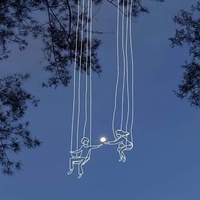



The light goes out, it always does and before the darkness fully settles, someone has already pulled the cord
That’s Nigeria.
I’ve been thinking about this for a while now, what is Nigerian culture?
Not the rites and traditions of the various ethnic groups, those are well documented, well understood.
I mean the bigger thing
The collective.
What do we all share underneath all of that? What makes someone Nigerian and not just Yoruba or Igbo or Hausa with a green passport?
I asked around, I looked it up.
The internet’s answer, more or less, is suffering.
And look, that’s not entirely wrong
There is real suffering here
Real dysfunction, pretending otherwise would be dishonest.
But there’s a difference between a partial truth and the whole truth, and what the world knows about Nigerians has always been partial.
The image is poverty, desperation, fraud.
A people defined by their worst moments and the worst among them. It’s the view from outside, and it was never curious enough to look deeper.
It’s not wrong, it’s just incomplete
Because there is so much more to us than our hardship.
Nigerians are contradictions walking.
We are proud and self deprecating at the same time
We are loud and we are creative
We are the hardest workers in the room and sometimes the most frustrating people in the room
We are shaped almost entirely by the environment we grew up in, not by anything inherent, not by nature, but by what life in this place does to a person over time.
And in that sense, in the full range of who we are; the good, the bad, the ugly, we are not so different from anyone else on earth
Except we are doing all of it while holding a broken country together with our bare hands.
Here is something the world’s image of Nigeria never accounts for.
Nigerians are consistently among the best performing immigrant populations in the United States, the United Kingdom, Canada
Doctors, Engineers, Academics, Athletes, Entrepreneurs.
The same people the world has written off as desperate or dangerous walk into foreign systems with every disadvantage imaginable and outperform people who had every head start
That doesn’t happen by accident, it’s a diagnosis.
The problem was never the people, it was the container.
Nigeria was not born, it was assembled.
Strangers drew lines through peoples who had little in common, handed them a flag, and called it a country.
We inherited a system that was never designed with us in mind and were told to call it home. Everything that followed,
The corruption, the collapsed infrastructure, the brain drain, the endless cycle of disappointment is not proof of a broken people. It is exactly what you would expect from a broken foundation.
And yet we keep building.
Nigeria has given the world its food, its music, its humor, its people.
Afrobeats didn’t ask anyone’s permission before it took over the world’s speakers.
Nollywood didn’t wait for funding before it became one of the largest film industries on earth.
Our writers have spent decades trying to make sense of this place not because anyone asked them to but because the question wouldn’t leave them alone.
Our immigrants go abroad and excel in systems that actually work and you realize…oh.
It was never them. It was never us.
But honesty cuts both ways
If we are going to talk about what Nigerians share, we have to talk about all of it
The good and the uncomfortable.
There is a docility in us that is hard to explain given how loudly we complain
Nigerians will debate a government policy on Twitter for a week, trend a hashtag for three days, and then quietly go back to living under the same policy unchanged.
We are outraged in public and resigned in private. Leadership has learned this about us and has been exploiting it for decades.
The political class loots openly, performs accountability in press conferences, and gets reelected.
Not because Nigerians are stupid
But because somewhere along the line we were taught that surviving the system is more realistic than changing it.
Then there is the “elder” problem
Respect for age is a value, but somehow it curdled into something else; a rule that authority cannot be questioned if it comes wrapped in grey hair or a title
Bad ideas get implemented because nobody in the room was willing to tell the big man he was wrong.
Mediocrity gets protected because challenging it is read as disrespect. We have confused deference with wisdom and paid for it at every level, from the family compound to the senate floor.
Money, in Nigeria, is not just a resource. It is a personality
Wealth confers automatic credibility: moral, intellectual, spiritual.
A rich man’s opinion carries more weight in a room than a poor man’s fact.
This is not unique to Nigeria, but it is acute here, because in a system where institutions fail and connections are everything, money is the closest thing to power that most people can access.
So it gets worshipped and the worship of it has made us suspicious of those who question how it was made.
The religious piece is the strangest contradiction. Nigeria is one of the most visibly religious nations on earth; churches on every street, mosques in every neighborhood, prayer as punctuation in daily conversation.
And yet there is surprisingly little spirituality underneath the performance.
Faith here is largely transactional
You give to get. You sow a seed, you expect a harvest. The pastor who drives a private jet is not a scandal, he is proof that the system works.
And directly alongside this sits a deep, unshakeable superstition. The same person who quotes scripture will consult a herbalist before a business meeting, or act in ways unbecoming of a believer.
Both feel entirely consistent to them, it is not hypocrisy exactly.
It is what happens when people live in so much uncertainty that they cannot afford to leave any spiritual option uncovered.
I want to be careful here…These are not character flaws baked into the Nigerian soul.
They are adaptations
Rational responses to an environment that has consistently punished trust, rewarded cynicism, and offered religion as the only reliable infrastructure.
You cannot build civic courage in people whose civic institutions have never protected them.
You cannot build accountability culture in a system where accountability has no teeth.
But they are real, and any honest portrait of Nigerian culture has to include them.
There is also much I have not touched
The political landscape deserves its own reckoning. The incompetence, the impunity, the performance of governance without its substance, the weaponized poverty…That is a longer conversation
This is not that essay.
What I can say is this
Ask what Nigerian culture actually is; not the food, not the festivals, not the ethnic traditions and even Nigerians go quiet.
I can’t fully answer it, and I am one.
We know what Black American culture looks like from the outside.
It’s coherent, it travels. The world understands it; the music, the language, the humor, the long history of resistance. It has a shape.
Nigerian national identity doesn’t have that shape yet. Not because the raw material isn’t there but because we haven’t yet told the story loudly enough to drown out everyone else’s version of it.
Every culture the world respects now had to build that story from scratch, usually under terrible conditions.
Black Americans invented jazz while being lynched. Japan built an aesthetic empire from the rubble of a war. They didn’t wait for things to get better. They made things the world couldn’t ignore and let those things speak first.
Nigeria is in the middle of that right now.
Which means Nigerian identity isn’t a monument. It’s a process, and the strange unnerving truth is that I am not watching this from outside.
None of us are.
We are inside it, living it, making it.
In the music we put into the world, in the arguments we keep having about this place, in the choice to stay or to leave, in the very act of asking a question nobody else was asking.
So what is Nigerian culture?
It is what happens when a people are handed a broken promise and decide to start anyway.
It is resilience that has stopped feeling like resilience and just feels like Tuesday.
It is the kind of joy that only makes sense when tomorrow isn’t guaranteed. It is big ambition in a small space.
It is a conversation that hasn’t finished yet.
It is the Petroleum Generator.
The power goes out as it always does, as it probably always will. The darkness comes in, and before anyone has had time to properly despair, someone has already walked outside and pulled the cord. Not because it’s fair. Not because this is how it should be. But because sitting in the dark was never really an option.
Nigerians do not sit in the dark (unless there’s another National grid failure heh~)
That’s the culture
Not the suffering
Not the scams
Not the borders someone else drew around us.
The refusal. The cord. The light coming back on.
We are not a broken people
We are an unfinished one
And there is a difference.


 293