WHY JUDGE...? HE'S ALSO HUMAN.
An uncomfortable reflection on the forgotten meaning of love — Blanç.
Ahem...
This is rather important, so I'm going to try to deliver it as precisely as possible, with as little sarcasm as humanly possible.
Which, considering my character is situated directly on top of a rather unfortunate SAR-CASM, might prove difficult.
Nevertheless, let's begin.
What is love, if I may ask?
Many of you would probably describe it as a strong, genuine and positive feeling of affection directed towards a person, a thing, or perhaps something that holds significant meaning to you.
And that's not an entirely incorrect definition.
Love is generally understood as a profound feeling of affection towards an entity. However, I think we've become so accustomed to associating love with particular relationships that we've gradually forgotten how much further the concept extends.
We associate love with the affection a partner has for their significant other, the devotion of a mother towards her child, or the emotional attachment between people who share something meaningful.
And while none of these interpretations is wrong, they are, perhaps, incomplete.
Because love isn't exclusively romantic. It isn't restricted to family, friendship, companionship or whatever beautifully complicated arrangement humans have decided to give a name to.
Sometimes, love is simply how you regard another human being.
And I think we've forgotten that.
The world today treats genuine affection almost like a scarce mineral. Something rare, something difficult to find, something that must be earned through an increasingly exhausting series of conditions.
Relationships have become seasonal contracts. Companionship has gradually developed into a give-and-take arrangement, and affection sometimes feels like a subscription service that expires once one party stops meeting the requirements.
Don't misunderstand me. There's absolutely nothing wrong with benefiting from the people around you. Human relationships should involve mutual support, consideration and reciprocity.
But when the entire foundation of a relationship is transactional, what exactly are we preserving?
Is it affection, or simply the convenience of having someone around?
Because there's a difference between appreciating someone for what they bring into your life and regarding them as though their entire existence is justified by what they can offer you.
One is appreciation.
The other is an invoice with emotional attachments.
And perhaps that's where we've lost something important.
I think our generation, and perhaps humanity in general, has gradually forgotten how to love beyond personal convenience. We've become increasingly concerned with what people deserve, what they've done, what they can offer, and whether their existence is sufficiently beneficial to warrant our kindness.
We judge so quickly that we sometimes forget the person standing before us.
And here's where I want to introduce someone I rather admired growing up.
Albert Einstein.
I was fascinated by him when I was younger, initially because of his intellectual contributions and the extraordinary way he approached the world. But as I grew older, I found myself appreciating something beyond his scientific achievements: his reflections on humanity, morality and how we ought to regard one another.
There's a particular idea I find especially meaningful:
To recognise the humanity of another person.
To understand that the individual standing before you, regardless of their circumstances, shortcomings, social standing or mistakes, is still a human being.
And that's where I find love in its simplest, perhaps most overlooked form.
To treat another person as human.
Not necessarily to treat them exactly as you treat yourself. Let's be honest, some of us have rather questionable relationships with our own wellbeing.
But to extend to another person the consideration, dignity and understanding that you would reasonably wish to receive.
To remember that the person you are judging has thoughts, fears, disappointments, insecurities and experiences that you may never fully understand.
That the person who made a mistake is not necessarily defined by that mistake.
That someone else's weakness doesn't automatically make them undeserving of kindness.
And that being human should, at the very least, be enough to qualify someone for basic human regard.
This doesn't mean excusing cruelty, tolerating abuse, abandoning personal boundaries or pretending that wrongdoing doesn't matter.
You can hold someone accountable without stripping them of their humanity.
You can disagree with someone without humiliating them.
You can walk away from someone without wishing to destroy them.
And you can recognise someone's imperfections without convincing yourself that they are somehow less deserving of compassion.
Perhaps that's the distinction we've failed to make.
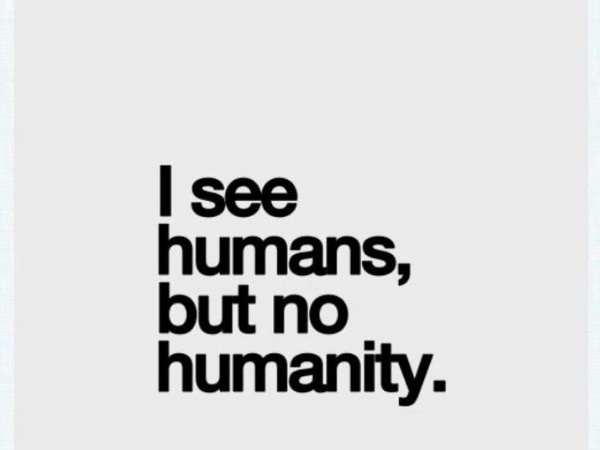
We've become very good at judging people by their actions, but considerably less interested in remembering that there is a person behind those actions.
So, the next time you find yourself looking at someone and wondering how they could possibly be that way, perhaps pause for a moment.
Not to excuse them.
Not to defend them.
But simply to remember something rather obvious that humanity somehow keeps forgetting:
He's also human.
And so are you.
Treat other humans... as humans.
— Blanç.


 10