Score |
82


Nonso Obi
 Student @ Nnamdi Azikiwe University,Awka.
Student @ Nnamdi Azikiwe University,Awka.



A PLACE IN HELL FOR ALL YOU LITTLE FUCKERS .
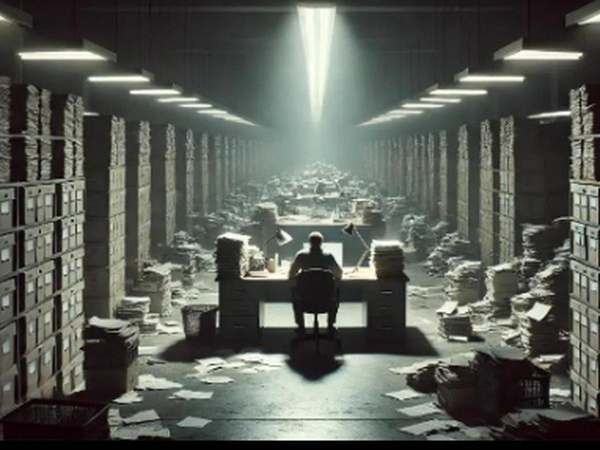
<p><span style="background-color: transparent;">The sign on the door was a lie. It said “Welcome” in a font trying too hard to be folksy. The o was a little smiley face. He hated it immediately.</span></p><p><span style="background-color: transparent;"><br/></span></p><p><span style="background-color: transparent;">Inside there was no fire, no brimstone. Just a waiting room: molded plastic chairs guaranteed to numb the ass in under ten minutes, the faint smell of stale coffee and regret, lighting so bad it felt personal. A desiccated spider plant sat on a low table. Next to it, a heavy book bound in something that felt like a cross between cheap leather and a dried-out tongue. No title.</span></p><p><img alt="" src="/media/inline_insight_image/1000235108.png"/></p><p><br/></p><p>The narrator arrived late. A tired clerk in a short-sleeved shirt who looked like he had processed too many forms slid a pen across the desk.</p><p><br/></p><p>“Start anywhere,” the clerk said. “There is no shortage.” <span style="background-color: transparent;">The pages were not paper. They were screens. And on them, a parade of little fuckers.</span></p><p><br/></p><p>He started with the fathers.</p><p><span style="background-color: transparent;">Here they are, entered alphabetically, the ones who left. Some for cigarettes, some for Lagos, some for the vague country called Elsewhere. All of them left because they could. That was the whole philosophy. Not that they had to. Only that the door existed and nobody had nailed it shut. One of them is teaching his kid to ride a bike, running alongside, pretending to let go. The kid wobbles, looks back, beaming. For a split second the father’s face is not proud. It is annoyed. The kid is slowing him down. He is already thinking about a flight, a new woman, a clean slate. He lets go for real. The kid falls. He does not go back. In the next frame he is in an airport bar ordering a Scotch, feeling a profound sense of relief. The chapter is titled “It Was Never About You”. Their children grew up reading the shape of an absence like braille. A place has been prepared for these men: a waiting room with no receptionist, where they sit for eternity wondering why no one has called their name.</span></p><p><br/></p><p>Next come the politicians. They get an entire wing. It is believed, though never proven, that the wing has air conditioning, which would be the only mercy in the building. These men took a country the way a child takes the last biscuit, hurriedly and with crumbs on the face, then gave a speech about sacrifice. One of them stands on a stage, flags behind him, perfect tie, talking about “the people.” His words are warm, fuzzy, meaningless. The screen flickers. Now he is in a back room counting stacks of cash from a corporation that is poisoning a river. He laughs. The laugh is the sound of a car alarm in a nursery. He signs a bill that will gut a school’s funding. “For the children,” he says. He believes it. That is the worst part. The narrator writes their names with a slow, almost tender hand. He is not an angry man. He is a thorough one.</p><p><br/></p><p>Students appear on page forty. The ones who ranked people by shoes. A girl with a trust fund and a smile that could curdle milk stands with friends in expensive, artfully distressed clothes. They mock a kid from the scholarship program. They do not use slurs. They are too smart for that. They use words like “interesting” and “a bit much” and “not really our sort.” They do not ruin his life. They chip away at it, day by day, with the quiet, relentless pressure of being better. Later a little plaque appears on a dorm-room door for the kid who killed himself. The girl walks past it on her way to a party. She does not even see it. The narrator has met this child at every age. He wore a school tie once and now wears a lanyard. Hell has assigned him a lifetime of group projects with himself.</p><p><br/></p><p>The mothers are harder. The narrator slows down here; the clerk glances up. These are the women who could have been soft and chose to be weather instead, who loved the way a landlord loves, by holding the keys. Control, dressed as sacrifice, served at every meal. A son is crying. He is fourteen. He has just found out his best friend left town. She holds him. “Shh, baby. You can’t be sad. You can’t show that. They’ll use it against you. Be strong. Be strong for me.” She is not comforting him. She is training him. She is teaching him that his own pain is a liability. She is a sculptor chiseling away everything that makes him human, leaving only a polished, controllable surface. She is doing it because it is the only power she has. The narrator hesitates, then writes the entry anyway, because the book does not make exceptions for hesitation. In the margin, smaller script: most of them were once someone’s children too. The clerk reads it and says nothing. The book, to its credit, lets it stand.</p><p><br/></p><p>Then the system, that great faceless machine. It takes decent people and teaches them to behave like idiots, then watches them fight each other over crumbs it dropped on purpose. Nobody can find the system to punish it. It has no address. It sends its regards by way of queues, forms, and a man named Mr. Ibe who is “not available.” It does not hate. It just processes. It grinds people down into numbers and outputs them as successes or failures. It breaks a man and then tells him to pull himself up by his bootstraps while it quietly saws off his legs. The man, broken, goes home and screams at his wife. The book shows it all with the dispassionate clarity of a nature documentary. The cycle. The stupid, pointless, tragic cycle. The narrator draws a long line under it and does not know what else to do.</p><p><img src="/media/inline_insight_image/1000235106.png"/></p><p>The judgers fill the next chapter. He gets through it quickly because they are everywhere, and because he is aware, faintly, of a draft in the room. These are people whose only talent is the verdict. Give them a stranger and a Tuesday and they will deliver a sentence by lunch. They have never once been wrong in their own minds. Their punishment is simple. They will be judged by exactly the standard they used, applied by someone with better lighting. One of them is a boss firing a man not for performance but because the man reminded him of his own failings. He enjoys the power. It is the only thing he is good at.</p><p><br/></p><p>Another page for those who weaponize their wounds. They take a real pain, a true and deserving pain, and sharpen it into a tool, then press it gently against someone kind. “After everything I’ve been through, you’d think you could do this one thing for me.” And they do. And he takes and takes and takes, a black hole in human shape. The narrator is careful here. Pain is not a crime. But what you do with it afterward, the ledger insists, is the whole matter.</p><p><br/></p><p>Then the entries he did not expect. Life itself, charged with being bittersweet and simultaneous: a baby’s first laugh overlaid with a soldier’s last breath, a wedding kiss overlaid with a funeral’s shovelful of dirt, a lottery win overlaid with a foreclosure notice. A funeral next door to a wedding with the same band playing at both. It does not care. It is just happening. The universe does not give a shit about your narrative. It is a cosmic Jackson Pollock and you are one of the splatters.</p><p><br/></p><p>The earth, charged with beauty, an offense so loud it feels personal. A shot from space of that gorgeous blue marble. Then it zooms in: rainforest burning, ice cap calving, mountain blown apart for coal, whale choking on a plastic bag. We suffer inside a sunset. We bury our dead under a sky that has the nerve to be blue. We think we are gods. We are just a bad tenant. The book calls it "The Insult of the View".</p><p><img alt="" src="/media/inline_insight_image/1000235111.png"/></p><p><br/></p><p>And finally the ones who play God: those who decided morality was a thing they owned and nature a thing they could rewrite, who ruined a river or a forest or a neighbor while quoting themselves.</p><p><br/></p><p>The narrator sets down the pen. His hand aches. The book is full, or nearly.</p><p><br/></p><p>“There’s one page left,” the clerk says, almost kindly. “Reserved.”</p><p><br/></p><p>It is blank except for the heading, already in his own handwriting:</p><p><span style="background-color: transparent;">"Those Who Kept the Book."</span></p><p><span style="background-color: transparent;">He laughs once, short and dry, the way a man laughs when the joke is on him and the timing is excellent. Then he looks up.</span></p><p><span style="background-color: transparent;">On the wall, next to a motivational poster of a cat hanging from a branch, a small framed sign: </span><span style="background-color: transparent;">You are here.</span></p><p><img alt="" src="/media/inline_insight_image/1000235105.png"/><span style="background-color: transparent;"></span></p><p><br/></p><p><img alt="" src="/media/inline_insight_image/1000235110.png"/></p><p>Around him the others sit staring straight ahead, faces a mixture of boredom and quiet despair. They are not waiting for their names to be called. They are the names. The fathers, the politicians, the mothers, the broken, the judgers, the users. <span style="background-color: transparent;">A tinny, bored voice comes over the intercom.</span></p><p><br/></p><p>“Now serving, number A-113. Number A-113.” <span style="background-color: transparent;">He looks down. In his hand is a little piece of paper with a number on it. </span><span style="background-color: transparent;">A-113.</span></p><p><span style="background-color: transparent;">He stands. The door at the far end of the room opens onto darkness. He starts walking. There is a place in hell f</span><span style="background-color: transparent;">or all you little fuckers. And we are all holding tickets.</span></p>


 33
33





Other insights from Nonso Obi








Contributor Points

Points-to-Coupons

Referral Earning

Insights for you.


All that I gave
Oh, hey there!It's me... again...You know, There's so much I want to saySo much I want ...
561 views
94 upvotes
94 comments



The Root of Evil.🌚
I like money.But they said it's the root of evil. 🙂Sorry, get your facts straight.The l...
285 views
77 upvotes
87 comments
The Manipulation.
"Mom started looking at me differently from that day.I remember it like the back of my ...
289 views
75 upvotes
90 comments




The 3AM World.
My favourite time of every day is between 1 a.m. and 4a.m.That's when the world is the ...
253 views
67 upvotes
72 comments

Drowning.
I can't breathe.I tried again.Nothing.My lungs burned.The water surrounded me, cold and...
254 views
61 upvotes
72 comments

Eden.
I came to this house very young, with one other.We were accepted so warmly.Everyone lov...
233 views
56 upvotes
66 comments