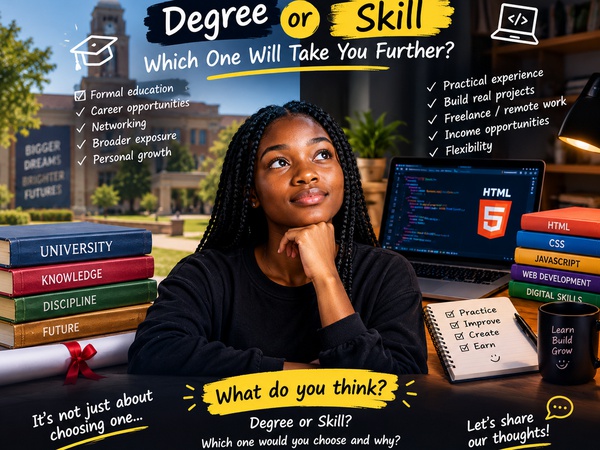
🎓 Degree or 💻 Skill — Which One Will Take You Further?
Let me ask you a question that I believe many young people have thought about:
If you had to choose between getting a university degree and learning a highly valuable skill, which one would you choose?
Before you answer, hear me out.
This isn't a post saying university is useless.
And it isn't saying everyone should forget education and learn a skill.
It's simply a conversation about something many young people are trying to figure out.
Because today, having a degree doesn't automatically guarantee that you'll get your dream job.
At the same time, having a skill doesn't automatically guarantee success either.
So where is the balance?
🎓 The Importance of a Degree
Let's start with university education.
A university degree can be extremely valuable.
For some professions, it's essential. If you want to become a doctor, lawyer, pharmacist, engineer, or enter certain professional fields, formal education is an important part of the journey.
University can also teach you things beyond your course.
You meet different people.
You learn how to work with others.
You develop communication and research skills.
You handle deadlines, assignments, presentations and examinations.
You may also build relationships that become valuable later in life.
So I wouldn't tell someone:
"Don't go to university. Just learn a skill."
That's too simple.
Education still matters.
But I also don't think we should tell young people:
"Once you get a degree, everything will automatically work out."
Life doesn't always work that way.
💻 The Power of Skills
Now let's talk about practical skills.
The world is changing quickly, and there are many skills today that can create opportunities.
Web development.
Graphic design.
Video editing.
Digital marketing.
UI/UX design.
Data analysis.
Cybersecurity.
Artificial intelligence.
Photography.
Content creation.
And many more.
One thing I personally like about learning a practical skill is that you can actually build something with it.
For example, I'm interested in websites and technology.
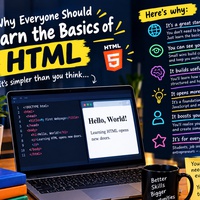
When you're learning HTML, you don't just memorize information. You can write some code and actually create a webpage.
You can build something, improve it, learn more technologies and eventually use those skills to solve problems for other people.
A practical skill can potentially become a source of income through employment, freelancing, business or other opportunities.
But there's something important we shouldn't forget.
⚠️ A Skill Isn't Magic
Social media sometimes makes learning skills look like a shortcut to instant wealth.
You might see:
"Learn this skill and start making ₦500,000 every month!"
It sounds great.
But there's usually more to the story.
Learning a skill doesn't mean you'll immediately make money.
You have to become good at it.
You have to practice.
You have to build experience.
You have to learn how to communicate with clients or employers.
You have to market yourself.
You will probably experience rejection and failure.
And you'll need to keep improving.
A skill is an asset, but you still have to develop and use that asset properly.
🤔 So Which One Is Better?
Personally, I don't think the answer has to be:
Degree OR Skill.
Why can't it be:
Degree AND Skill?
Imagine someone studying Computer Science while also learning web development.
A business student learning digital marketing.
An engineering student learning data analysis.
A communication student learning content creation.
An accounting student learning financial technology tools.
Now you have something powerful.
You have formal education and a practical ability.
You don't necessarily have to choose one and completely reject the other.
You can combine them.
And for many people, that could be a very smart approach.
🌱 Don't Wait Until You're Ready
Another problem I notice is that many people keep waiting.
"I'll learn a skill after university."
Then university ends.
"I'll learn when I get a job."
Then the job takes up all their time.
"I'll start next year."
And suddenly years have passed.
If there's a skill you're genuinely interested in, why not start gradually?
You don't need to become an expert immediately.
You don't even need to spend five hours every day.
Start with 30 minutes.
Watch a tutorial.
Practice.
Make a small project.
Make mistakes.
Try again.
Over time, those small efforts can become something significant.
💡 What Learning Technology Has Taught Me
For me, learning technology has taught me that you don't need to understand everything before you begin.
When I started learning HTML, I didn't suddenly understand how websites worked.
I started with simple things:
Headings.
Paragraphs.
Links.
Images.
Lists.
Forms.
Gradually, those individual concepts started making more sense.
Now I'm also teaching beginners some of these concepts.
And teaching has taught me another important lesson:
Sometimes you understand something better when you have to explain it to someone else.
It has pushed me to learn, practice and communicate better.
It has also shown me that everyone learns differently.
Some people understand quickly.
Others need more time.
Some people learn by reading.
Some learn by watching.
Others need to practice.
There's no single path.
🇳🇬 What About Nigeria?
This conversation becomes even more important when we look at Nigeria.
Many young Nigerians are trying to become financially independent.
Getting a good job can be competitive.
Businesses need customers.
Young people need opportunities.
And the internet has made it possible for people to learn skills from their phones or computers and potentially offer those skills to people far beyond their immediate environment.
That's powerful.
But we shouldn't pretend everyone has the same opportunities.
Not everyone has a laptop.
Not everyone has unlimited internet.
Not everyone has someone to guide them.
That's why I believe people should share knowledge whenever possible.
If you know something that can help someone else, teach them.
If someone is starting, encourage them.
If someone asks a question, don't make them feel stupid for not knowing.
Everyone who is good at something today was once a beginner.
🧠 Maybe the Real Question Is Different
Maybe the real question isn't:
"Degree or skill?"
Maybe the better question is:
"What combination of knowledge and skills will help me become valuable?"
Because at the end of the day, most of us want to solve problems, create opportunities, earn a living and build something we're proud of.
Some people will take the university route.
Some will become entrepreneurs.
Some will learn trades.
Some will become freelancers.
Some will work in technology.
Some will combine several paths.
There isn't one formula that works for everybody.
🔥 Your Turn
Now let's make this a real discussion.
If you were forced to choose only ONE:
A. 🎓 University Degree
You get the opportunity to complete university, but you don't deliberately spend those years learning another professional skill.
OR
B. 💻 Highly Valuable Skill
You skip university and spend those years becoming extremely good at a practical skill that can potentially generate income.
Which one would you choose?
And please don't just answer:
"Degree."
or
"Skill."
Tell us WHY.
Would your answer change if you already had a business?
Would it change if your family couldn't afford university?
Would it change if you knew exactly what career you wanted?
Would it change if you could do both?
I'm genuinely interested in hearing different perspectives.
Maybe someone reading the comments has an experience that will change another person's way of thinking.
Let's have a respectful conversation.
Degree 🎓 or Skill 💻 — which one would you choose, and why?
I'm reading the comments. 👇


 90