A woman takes a positive pregnancy test, feels a nagging ache low in her abdomen, and notices a little spotting. Most people would call this a minor early-pregnancy scare. Sometimes, though, it is the first sign of one of the most dangerous conditions in early pregnancy: an ectopic pregnancy. A skilled ultrasound examination can often tell the difference within minutes.
What Is an Ectopic Pregnancy?
In a normal pregnancy, the fertilised egg travels down the fallopian tube and settles into the lining of the womb. In an ectopic pregnancy, it implants somewhere else. That site can be the fallopian tube, the corner of the uterus, the cervix, the ovary, or the abdominal or pelvic cavity. Most are found in the fallopian tube.
These pregnancies cannot continue to term. They cannot be carried to term and eventually rupture or involute. A tube is not built to stretch like a womb, so as the pregnancy grows, the risk of rupture grows with it.
How Common and How Dangerous?
Ectopic pregnancy affects roughly 1 to 2 percent of all pregnancies. That sounds small, but it translates into a great many women. The danger is internal bleeding. Rupture can cause bleeding that is gradual or fast enough to cause hemorrhagic shock, and the later the rupture, the faster blood is lost.
The encouraging news is that outcomes have improved. Mortality has fallen by about half since the 1980s, and earlier detection has played a vital role. Better imaging is a big part of that story.
Warning Signs You Should Never Ignore
Symptoms vary, and some women have none until the tube ruptures. The most common symptoms of an unruptured ectopic pregnancy are first-trimester bleeding and abdominal pain.
Seek urgent medical care if you are pregnant or could be, and you have:
• Pain in the lower abdomen or pelvis, often on one side
• Vaginal bleeding or spotting that is unusual for you
• Shoulder-tip pain, which can occur when blood irritates the diaphragm
• Dizziness, fainting or extreme weakness
• Sudden, severe abdominal pain
Rupture may be signalled by sudden, severe pain followed by fainting or signs of shock. If this happens, go to an emergency department immediately and do not wait for it to pass.
Who Is at Higher Risk?
Anyone who can get pregnant can have an ectopic pregnancy, and many affected women have no risk factors at all. Even so, some factors raise the odds. They include pelvic inflammatory disease, smoking, fallopian tube surgery, a previous ectopic pregnancy and infertility. Pregnancy is less likely in women with tubal sterilisation or an IUD, but when it does happen, the chance of it being ectopic is higher.
Treated sexually transmitted infections, not smoking, and early antenatal booking all help lower the risk and the danger.
Where Ultrasound Comes In
When ectopic pregnancy is suspected, two tools work together: a blood test for the pregnancy hormone hCG, and an ultrasound scan.
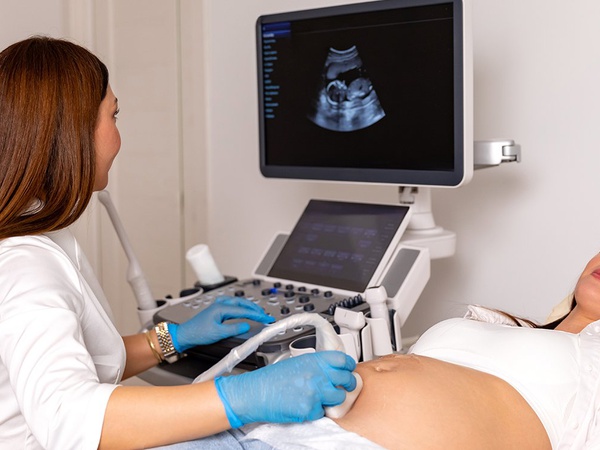
The transvaginal scan is the star. It is recommended over transabdominal scanning because it can directly show an ectopic mass. The probe sits close to the womb and tubes, giving a sharp, detailed view in early pregnancy.
A radiographer or sonographer looks for several things:
Is there a pregnancy inside the womb? A gestational sac with a yolk sac inside the uterus confirms an intrauterine pregnancy. That essentially rules out an ectopic, apart from the very rare case where both occur together.
Is there a mass beside the ovary? An ectopic pregnancy may appear as a ring-like structure or a mixed solid and fluid mass in the adnexa.
Is there free fluid? Echogenic fluid in the pouch behind the womb can suggest bleeding. In an emergency, this finding can change management quickly.
What does the womb look like? An empty womb with a positive pregnancy test raises concern.
Seeing a yolk sac or embryo outside the womb gives a definitive diagnosis, but most ectopic pregnancies do not reach that stage. That is why the scan is read alongside the blood test.
The Waiting Game: Pregnancy of Unknown Location
Sometimes the scan shows no pregnancy anywhere, because it is simply too early. This is called a pregnancy of unknown location. It does not mean nothing is wrong, and it does not mean something is. Doctors then repeat hCG tests, usually every 48 hours. In about 99 percent of healthy pregnancies inside the womb, hCG rises by around 50 percent in 48 hours. A slower rise or a fall raises concern and prompts more tests or scans.
Each centre also uses an hCG "discriminatory level", above which a normal pregnancy should be visible on scan. If hCG is above that level and no pregnancy is seen in the womb, ectopic pregnancy is strongly suggested. The exact level varies, and newer guidance has moved the threshold higher to avoid mistakenly ending a wanted pregnancy.
Treatment Options
Treatment depends on how stable the woman is, the hCG level and what the scan shows. Options include medication, surgery or careful watching. Methotrexate can dissolve a small, stable ectopic pregnancy without surgery. Keyhole surgery is used when there is rupture, heavy bleeding or a larger mass. Emergency surgery may be needed immediately if a woman is unstable.
Many women go on to have healthy pregnancies afterwards. Still, a history of one ectopic pregnancy carries about a 10 percent risk in later pregnancies. That is why early scans in future pregnancies are strongly advised.
Why Radiographers Matter
An ultrasound examination in suspected ectopic pregnancy is time-critical. A radiographer or sonographer who recognises an adnexal mass or free fluid, and alerts the clinical team without delay, can change the outcome. This is also a moment of deep fear and grief for many women, so clear communication, privacy and compassion are part of good practice.
The Takeaway
Early pregnancy pain and bleeding should never be brushed aside. Not every case is an ectopic pregnancy, but this is a condition where speed matters. A short scan, paired with a simple blood test, can reveal what is happening and guide life-saving treatment.
If you are pregnant or think you might be and feel one-sided pain, bleeding or faintness, seek medical care straight away.


 7