Score |
156







THE DANGER OF LOSING VALUE BECAUSE OF PERCENTAGE.
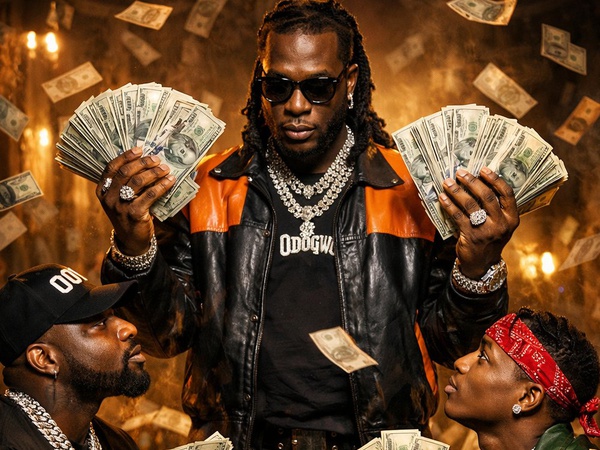
<p>Burna Boy Makes More Money From Music Than Wizkid and Davido Combined</p><p><br/></p><p>Yes, I said it.</p><p><br/></p><p>And before the Wizkid FC and 30 BG start dragging me, let's look at the numbers available to the public.</p><p><br/></p><p>As of Today September 4th, 2026, Burna Boy have 41.6 million Spotify monthly listeners.</p><p><br/></p><p>Wizkid have about 16.2 million.</p><p><br/></p><p>Davido have about 11.8 million.</p><p><br/></p><p>So Burna Boy had more monthly Spotify listeners than Wizkid and Davido combined, roughly 57.5M vs 28.6M.</p><p><br/></p><p>Then look at touring.</p><p><br/></p><p>Publicly compiled concert data puts Burna Boy's major concert grosses at more than $40.9 million, including reported grosses of approximately $6.15M at London Stadium, $4.53M at Stade de France, and $2.86M at Paris La Défense Arena.</p><p><br/></p><p>So if we're judging purely from the numbers that are publicly visible, you can make a very strong argument that Burna Boy currently generates more commercial activity from music than either Wizkid or Davido, and potentially more than both combined in some categories.</p><p><br/></p><p>But here is where the argument gets interesting.</p><p><br/></p><p>Revenue generated is not the same thing as money the artist keeps.</p><p><br/></p><p>None of us have seen the complete contracts between these artists and their record labels, distributors, publishers, managers, promoters or other business partners.</p><p><br/></p><p>We don't know every percentage.</p><p><br/></p><p>We don't know every recoupable expense.</p><p><br/></p><p>We don't know every advance.</p><p><br/></p><p>We don't know every ownership arrangement.</p><p><br/></p><p>And we certainly cannot calculate their actual take-home income from Spotify listeners and concert grosses alone.</p><p><br/></p><p>Burna Boy has had major international relationships involving Atlantic Records, while his African business has also involved arrangements with Empire. Public research even indicates that his Atlantic arrangement excluded Africa, meaning his African business remained under his team's control.</p><p><br/></p><p>Davido's Sony deal, meanwhile, was publicly reported as allowing him to retain rights to his music and performances.</p><p><br/></p><p>His later Nine+ Records partnership with UnitedMasters was also structured around artists retaining their masters and 100% of their royalties.</p><p><br/></p><p>So yes, Burna Boy may generate more money from music than Wizkid and Davido combined.</p><p><br/></p><p>But we cannot responsibly say that Burna Boy keeps more money than Wizkid and Davido combined.</p><p><br/></p><p>We don't have the contracts.</p><p><br/></p><p>And this brings me to the real lesson.</p><p><br/></p><p>THE DANGER OF LOSING VALUE BECAUSE OF PERCENTAGE</p><p><br/></p><p>One of the biggest mistakes I see artists make is obsessing over the percentage a record label will take instead of looking at the total value of the deal.</p><p><br/></p><p>An artist hears:</p><p><br/></p><p>"The label will take 60%."</p><p><br/></p><p>And immediately says:</p><p><br/></p><p>"No way! I'm not giving anybody 60% of my music."</p><p><br/></p><p>But what if that 60% comes with international marketing, distribution, radio promotion, playlist pitching, video financing, touring support, experienced executives, global relationships and access to audiences you couldn't reach alone?</p><p><br/></p><p>40% of $100,000 is 4 times bigger than 100% of $10,000.</p><p>with your 100% earning, you might still not earn a valuable amount because you don't have the infrastrucure to cross certain markets or market to bigger audience.</p><p><br/></p><p>The percentage isn't the deal.</p><p><br/></p><p>The value of what you're getting in exchange for that percentage is the deal.</p><p><br/></p><p>When you're signing a record deal or negotiating a new one, stop asking only:</p><p><br/></p><p>"What percentage are they taking?"</p><p><br/></p><p>Ask these questions instead:</p><p><br/></p><p>1. Will this deal expose me to new audiences and markets?</p><p><br/></p><p>2. Do I retain meaningful creative control?</p><p><br/></p><p>3. Who owns the master recordings?</p><p><br/></p><p>4. Who controls the rights to exploit those masters?</p><p><br/></p><p>5. What exactly is the label obligated to do for me?</p><p><br/></p><p>6. What happens if the label fails to perform its obligations?</p><p><br/></p><p>7. What expenses are recoupable?</p><p><br/></p><p>8. What are the term and options?</p><p><br/></p><p>9. What happens to my rights after the agreement ends?</p><p><br/></p><p>10. What other clauses could affect my career, income and freedom?</p><p><br/></p><p>Because a bad deal isn't necessarily the deal where the label takes the biggest percentage.</p><p><br/></p><p>Sometimes the worst deal is the one where you keep 100% of something that isn't growing.</p><p><br/></p><p>Don't negotiate percentages alone. Negotiate VALUE.</p><p><br/></p><p>And if you want to understand the business side of music, including record deals, royalties, publishing, masters, management, distribution and contract clauses, I run one-on-one and group Music Business Masterclasses for artists, managers, executives, labels and other industry professionals.</p><p><br/></p><p>The goal isn't just to get signed.</p><p><br/></p><p>The goal is to understand what you're signing.</p>


 18
18


Other insights from Obellaworldstar












Referral Earning

Points-to-Coupons

Insights for you.


Abeg
Is it a crime to want to be seenOkay there's supposed to be question mark there. Sorry,...
79 views
25 upvotes
26 comments
Guys, Tobi is married
You want to know how I know and how I figured out abi?Don't worry, follow me till the e...
101 views
22 upvotes
26 comments

Introduction
Welcome to my very first series here on **Twocents!** 🥳👏*...waits...*What are you doing...
146 views
20 upvotes
18 comments

The Bridge to Adulthood
I remember when I was in secondary school, my classmates and I had great dreams and pla...
1300 views
16 upvotes
21 comments
Yes, Tobi is married
Honestly guys, it's not as if I don't want to give you the full gist.So this is it.Guys...
83 views
21 upvotes
16 comments


I Remember Michael Scofield.
Early this morning I remembered Michael Scofield, not just for his sheer brilliance, bu...
1521 views
17 upvotes
15 comments