The Human Question — Episode 1
Today, billions of people walk this earth. We speak different languages, practise different religions, live in different environments and belong to different cultures.
Yet, underneath all that, we're all part of the same human story
But how did that story start?
Some people will of course say that God created the first man. Others will have a view based on evolution. Some will go back to the old creation stories, others will look to science, to the fossils and to genetics.
In this first episode of The Human Question, I want us to look at this carefully. Before we discuss what humanity has achieved, let first examine where humanity began.
BEFORE HUMANITY
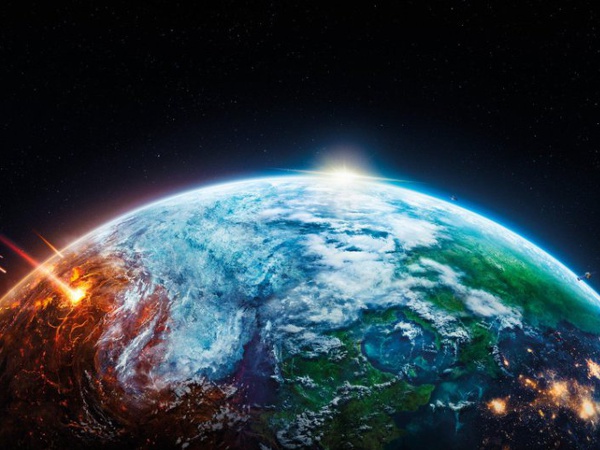
Scientists reckon the Earth formed some 4.5 billion years ago and there's evidence that life was on the planet billions of years ago. We, as modern human beings (Homo sapiens), are a much more recent arrival.
This distinction matters because the question of how the Earth formed is not the same as the question of how life began. And neither is the same as how human beings evolved.
Scientists are still working out how the first life forms arose. The evolutionary history of humankind on the other hand is very well established.
That brings us to one of the most discussed explanations of human origins.
WHAT DOES SCIENCE TELL US?
In 1859, Charles Darwin published On the Origin of Species. His work helped establish evolution by natural selection as a principal scientific explanation for how species change over time.
Later, in 1871, he published The Descent of Man, where he examined human evolution.
But what does evolution actually mean? It does not mean that one day a monkey suddenly gave birth to a human being. That is a common misunderstanding.
Humans did not descend from the monkeys or chimpanzees we see today. Rather, humans and other living apes share common ancestors from millions of years ago. Over long periods, different populations evolved along different branches.
Think about a family tree. You, your siblings, and your cousins may share grandparents, but that does not mean one of you came directly from another.
Evolution works through branching relationships across generations, although the biological process is much more complex.
The human family tree contains several ancient species. Some walked upright long before modern humans appeared. Others developed different physical characteristics, used tools and adapted to changing environments.
Our species, Homo sapiens, emerged in Africa approximately 300,000 years ago.
How do scientists know this?
They examine fossils, bones, teeth, ancient tools, footprints and genetic evidence. Each discovery provides another piece of information about our ancestors and their lives.
However, evolution was not a straight line leading directly to us. Several human species existed at different times, and some even lived alongside one another.
Today, Homo sapiens is the only surviving human species.
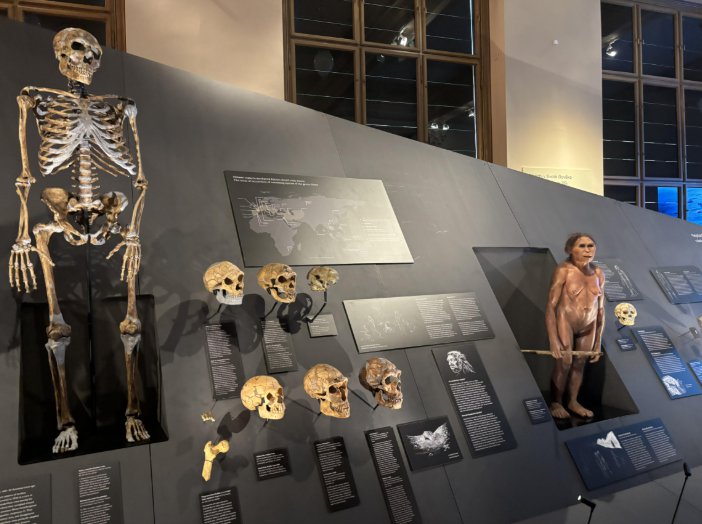
AFRICA: THE STORY BEGINS HERE
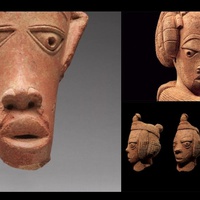
Africa is not a continent that later acquired human civilisation. Africa is at the very heart of the scientific story of human origins.
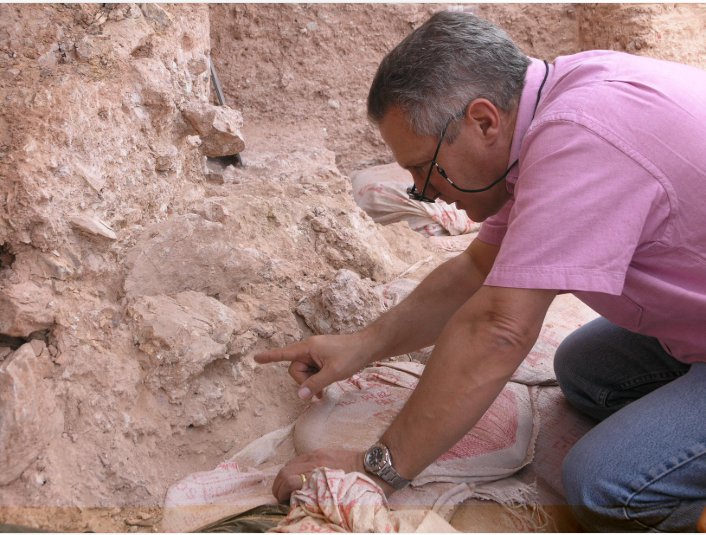
The oldest fossils we have that are attributable to us as a species are from Africa.
The Jebel Irhoud fossils in Morocco are a good example, dating to around 300k years ago and helping to establish the timing of the emergence of Homo sapiens.
Early humans eventually left Africa and spread out over many generations into different parts of the world.
As they encountered different environments the human populations that developed were physically different and adapted to the new conditions.
This helps to explain why humans today have such different skin colours, facial features and so on
Yet underneath all that, we're the same species and we share a common ancestry.
Sometimes, humans will use differences in appearance, nationality, language, etc to create divisions between themselves.
But if you go right back into our shared history you'll find that the story of humanity is far more interconnected than we tend to realise.
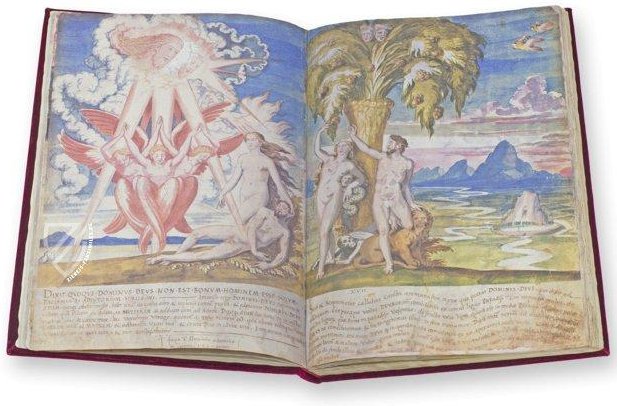
4. OTHER EXPLANATIONS: RELIGION AND PHILOSOPHY
In all the various religious traditions there have been explanations as to how human beings came to be.
In the Abrahamic traditions, the creation of Adam is of course a key element in the story of the origin of man.
Other cultures and traditional societies have their own creation narratives, explaining the relationship between human beings, the natural world, and the divine.
These stories represent different views on creation, on purpose, on identity and on where we fit in the universe..
Philosophers have also tackled the issue from another angle. Instead of just asking how the human body came about they've asked what it means to be human, whether human existence has a purpose and what exactly makes us human as opposed to all the other living things.
Here's where we need to be careful. We shouldn't be in any position to pretend that every explanation answers the same question in the same way.
- Scientific explanations rely on evidence that researchers can investigate and test.
- Religious explanations often involve faith, revelation and theological interpretation.
- Philosophy examines the assumptions, meanings and arguments behind our understanding of existence.
They may well answer related questions, but we mustn't confuse the methods and we mustn't pretend that every dispute has been resolved.
.
WHAT DOES OUR ORIGIN MEAN FOR US TODAY?
I think knowing where we come from should do more than just satisfy our curiosity. It should also inform our understanding of ourselves and of our place in relation to other human beings.
If humanity shares a common origin, why do we continue to treat differences as reasons to look down on one another?
If our ancestors survived through adaptation, cooperation and their ability to respond to difficult environments, what does that tell us about the importance of learning and working together?
And if Africa is such an important part of the story of human origins then how much attention are we actually paying to the study, the preservation and the communication of that story?
In my view, understanding our origins should make us more inquisitive rather than more arrogant.
It should make us more questioning of what we think, more willing to look at the evidence and more open to the possibility of new discoveries which might in fact enhance our understanding.
We should also bear in mind that science hasn't answered every question. There are still gaps in our knowledge. New fossils, new archaeological finds and new genetic data are all going to continue to refine our understanding of the past.
WHERE ARE WE GOING?
We've looked at the scientific explanations, the African origin of modern man, the various religious creation stories and the philosophical questions around existence.
But I want to finish with one more question. If we can work out where we came from, maybe we'll be more aware of where we're going.
Humanity has moved from small communities of hunter-gatherers to settlements, cities, nations and a technologically connected world.
We have developed languages, built institutions, created knowledge and transformed our environment.
Despite all that we've achieved we're still up against conflict, inequality, discrimination and all the questions that arise as to how we should be living together.
Knowing our origin is only the beginning. The bigger responsibility is deciding what we will do with the human story we have inherited.




 10