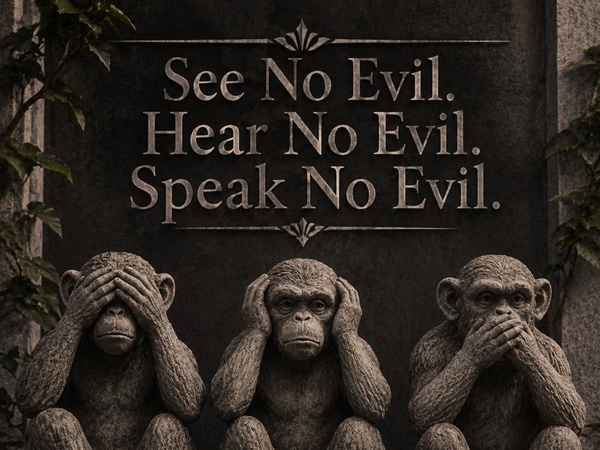
See No Evil. Hear No Evil. Speak No Evil.
I met three monkeys on my way home from school. The first had its hands over its eyes. "See no evil," it whispered, and the words echoed through the quiet afternoon.
The second had its hands over its ears, refusing to listen to anything I said. "Hear no evil," it told me before turning its back on me.
I looked towards the third monkey, desperate for just one of them to hear me out, to punish my perpetrators, to say something. But instead, it looked straight into my eyes, its hands firmly pressed over its mouth. It didn't speak. It didn't need to. I understood, right there and then, that I would never remain the same again.
I had expected monsters to look frightening. I never expected them to look so ordinary, and somehow, that made it worse. Isn't it strange how people can look so much like monkeys when humanity demands the most of them? People probably consider themselves decent, at least. But when I needed them to be human, they chose to be monkeys. They saw me, yet looked away. They heard my screams and cries, yet ignored me. And when the time came to hold my perpetrators accountable, they wouldn't let me speak.
"It's our culture," they said. Traditions that had been upheld for generations, as though the passage of time could somehow make cruelty acceptable.
And the crowd? They posted my videos everywhere. They claimed to sympathise with me, yet seemed more interested in the attention and following my suffering could bring them. They condemned what happened while contributing to my humiliation. They wanted everyone to see what had been done to me, but how many of them actually cared about what I was going through?
Perhaps the first monkey thought it could be seen as innocent as it had never physically assaulted, pulled or touched me. However, can one automatically assume that if no violence has occurred then innocence is present? People also fail to act in situations where they see injustice. Although not everybody will feel able to, and nobody should be asked to, put themselves in at-risk situations, there is still a difference between feeling unable to and being reluctant to help. People can seek help, report incidents and assist victims to seek safety – all without becoming victims themselves. A group should not be compelled to become secondary offenders merely because one person has already caused significant harm.
Then we come to the second monkey; the one that failed to listen. How many women have been questioned about their clothes, their location and/or behaviour by the individual who has assaulted them? How many have turned to their family for support only to be urged to maintain the family’s image? And how many have been advised to tolerate mistreatment in the interests of a relationship, forgiveness or religion?
Whilst tradition is often regarded with great reverence and is rarely open to challenge, who is empowered to determine which traditions should continue? Should we assume that because our grandparents engaged in an activity, or because an entire community has become used to engaging in an activity, that it is automatically appropriate? Culture should work to uphold a sense of self, along with values and relationships. It should not however, become a medium for inhumanity. Although not all traditions are negative, challenging inhumanity does not equate to challenging an entire culture. Rather, it is about acknowledging that no culture should allow its practices to override the respect and security of those it influences. Merely because an action has been carried out for many years does not legitimise it.
What of the third monkey? Arguably, this is the most pernicious type of monkey as it does not perpetrate violence itself. However, it comprehends the influence of its voice and deliberately employs it to suppress another’s. This could involve a family member who advises a victim not to report an assault, an older member of a family who prioritises the family’s image, a community leader who prefers to resolve a major offence discreetly, or an authority figure who fails to take a victim’s complaint seriously. Whilst silence can result from fear or feelings of powerlessness, it is extremely different for someone who ought to receive justice to be deliberately silenced. Furthermore, those who use their position to suppress victims and/or defend offenders are not just failing to address inhumanity; they are actively furthering it.
Even those establishments that should be supporting us need to be accountable. Although interpersonal relationships may mean that violence against women is seen as a private family issue, this does not justify such violence. Police must investigate allegations, and the judicial system must ensure that offenders are held accountable in accordance with the law. Community and religious bodies should support victims rather than exchange them for the maintenance of an image. Although it may be essential to arrest some offenders, what occurs when those who supported them escape sanction? And what occurs when future victims are met with the same justifications, bullying and lack of support?
Whilst people can and should support victims, they should not override them. Although sharing film footage of assaults can gain media attention and arouse anger, has thought been given to the impact on the victim of having to share her most personal experiences? Is it really essential to reveal such intimate details to others in order to raise awareness? Victims should be allowed control over how their experience is disseminated. Just because an incident has received media coverage, does not imply that a victim’s experience belongs to the wider public. Ideally, those who campaign for victims will reinforce their respect, not undermine it.
I do not think that all individuals who observed my ordeal should be equally accountable for it. Primarily, those who perpetrated violence are answerable for their behaviour. Nevertheless, others too should be held accountable. These include those who instigate, hide or suppress violence and those who bully victims and/or hinder the pursuit of justice. Unwillingness to act due to a lack of knowledge is distinct from knowingly facilitating the suppression of information. We need to be able to discern between these two scenarios so that they are not utilised as reasons for complacency.
Therefore, what constitutes just justice? Offenders should face the repercussions of their behaviour. Victims should feel confident in coming forward to report violence without experiencing mockery or facing reprisals. Furthermore, families and communities should value support over image. Establishments must fulfil their roles and individuals must comprehend their duties. Victims should also continue to enjoy confidentiality, respect and autonomy. In determining if justice has been served, we should not solely consider the quantity of arrests and reports. Equally, we should evaluate whether victims are secure, listened to and recognised as important human beings – regardless of the context of their experience.
I ponder what might have transpired if the first monkey had opened its eyes, the second unblocked its ears and the third had taken its fingers from its lips. Perhaps then somebody would have assisted, listened and/or spoken appropriately. Although I cannot alter the decisions of these monkeys, society can decide not to replicate them.
Whilst the hands that carry out violence can indeed perpetuate it, on occasions it is the hands that close someone’s eyes, plug their ears and clench their lips which prevent justice from ever being served.



 22