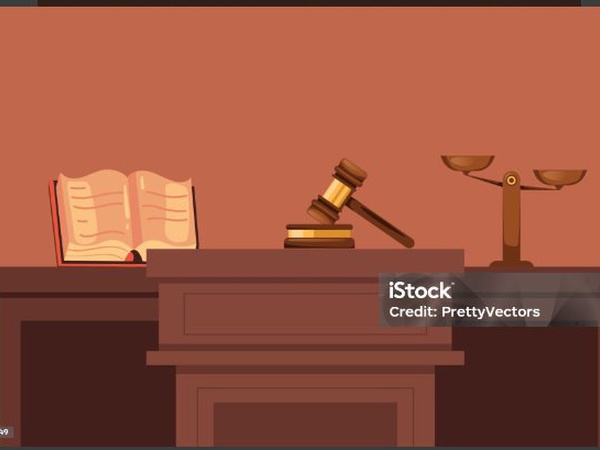
A large courtroom, The Twocents Court. At the centre front of the room is the Judge's desk, elevated on a high platform. On the left side is the witness stand.
In the lower front of the Judge's desk sits the Court Clerk. On the left sits the Prosecuting Counsel and, on the right, the Defence Counsel.
The atmosphere is serious. Papers are being arranged as the lawyers prepare for the proceedings. The public gallery is filled with expectant spectators, eager to witness the courtroom drama.
COURT CLERK: (Rises to his feet.) All rise!
The Judge enters and takes his seat.
COURT CLERK: This Honourable Court is now in session. Presiding is His Lordship, Justice Cyrus Majebi.
JUDGE: Please be seated.
(To the Court Clerk)
Call the case before the court.
COURT CLERK: My Lord, the case before this court today is The People and AI versus the African Writer. The case number is 2026/TC/1911
The accused is charged with intellectual dishonesty and the pretence of creativity in relation to a piece of writing for which the African Writer is being accused by the People.
JUDGE: Alright. Counsels, introduce yourselves for the record.
PROSECUTING COUNSEL: (Rises respectfully.) Thank you, My Lord. Barrister Samuel Olanrewaju of the reputable A.D.U and Sons, appearing for the plaintiff.
DEFENCE COUNSEL: (Rises.) My Lord, Barrister John Oyinloye, Barrister and Solicitor of the Supreme Court, appearing for the defendant.
JUDGE: Very well then. Let us proceed. Prosecuting Counsel, can we have your opening statement?
PROSECUTING COUNSEL: (Rises.)
Thank you, Your Esteemed Lordship.
My Lord, we are not gathered here today to prosecute intelligence or criminalise eloquence. Rather, we aim to put a check on algorithm-dictated brilliance hiding under the guise of creativity.
We have before us an essay with impeccable grammar and expressions that appear too perfect to be called accidental.
In the age when a machine can write like a human, how do we know when a human is writing like a machine?
This is not asking this Honourable Court to condemn brilliance, but to examine it. And unfortunately, when this brilliance stems from an African voice, the question becomes even more delicate.
I trust the fair judgement of this Honourable Court.
Thank you, My Lord.
JUDGE: Defence Counsel?
DEFENCE COUNSEL: (Rises, clears his throat.)
I appreciate this, My Lord.
Writing is a form of art that can be a talent, but can also be developed through intentional training. It is also common knowledge that whatever you show consistency in will yield proficiency and efficiency, as efficient and well articulated as the prosecution's opening statement.
Now I have a question: When are we investigating the authorship of that statement?
After all, it was also eloquent, with carefully constructed grammar that also "seems to flawless to be called accidental".
My Lord, the defence acknowledges the ability of AI, or better still, as the prosecution calls it, a machine. True, a machine may imitate a voice, but it should not become the standard by which every creativity is judged.
This Honourable Court will be just in delivering a proper verdict in this case.
Thank you, My Lord.
JUDGE: Are there any witnesses from the counsels?
DEFENCE COUNSEL: Yes, My Lord!
Before that, if you permit me, I want to take this Honourable Court down a quick memory lane.
My client, a 22-year-old Nigerian writer, stands accused of intellectual dishonesty, which can only be established through an examination of his written work.
However, My Lord, it would interest this Honourable Court to know that African creativity has historically been questioned whenever it contradicts certain people's expectations of what Africa should look like.
To this effect, I would like to call my witness to the stand.
COURT CLERK: The defence may call its witness.
DEFENCE COUNSEL: My Lord, the defence calls Chimamanda Ngozi Adichie to the witness stand.
COURT CLERK: Chimamanda Ngozi Adichie, please approach the witness box.
Chimamanda emerges from the public gallery and walks towards the witness box.
COURT CLERK: Do you swear to tell the truth before this Honourable Court?
CHIMAMANDA: I do.
COURT CLERK: Please take your stand in the dock.
DEFENCE COUNSEL: Mrs Adichie, you are an award-winning Nigerian writer, novelist and essayist, correct?
CHIMAMANDA: Yes, that is correct.
DEFENCE COUNSEL: In your TED Talk titled The Danger of a Single Story, you spoke publicly about an experience you had with an American roommate when you first travelled to the United States at the age of nineteen. Could you tell this court what happened?
CHIMAMANDA: Certainly. My American roommate was shocked by me. She asked where I had learnt to speak English so well and was confused when I explained that Nigeria had English as its official language.
She also asked if she could listen to what she called my "tribal music." She was consequently disappointed when I played her a tape of Mariah Carey.
DEFENCE COUNSEL: And how did those experiences make you feel?
CHIMAMANDA: What struck me was that she had felt sorry for me even before she saw me. Her default position towards me, as an African, was a kind of patronising, well-meaning pity.
DEFENCE COUNSEL: How Pathetic. Did you also experience a similar assumption in the literary world?
CHIMAMANDA: Yes. During my time at Johns Hopkins University, where I pursued a Master's degree in Creative Writing, a professor questioned whether my novel, Purple Hibiscus, was authentically African literature.
DEFENCE COUNSEL: What was the basis of that question?
CHIMAMANDA: The professor questioned the authenticity of the novel because its characters were educated, middle-class Africans who drove cars and were not starving. It seemed that the professor had a particular expectation of what an African story should look like.
DEFENCE COUNSEL: So, despite being a Nigerian writer telling a Nigerian story, the authenticity of your work was questioned because it did not fit that expectation?
CHIMAMANDA: Yes.
DEFENCE COUNSEL: Interesting.
My Lord, this obviously tells us that African creativity can be judged against expectations that do not reflect the diversity of African experiences. My Lord, there is no single way to be African, and there should be no single way an African writer is expected to sound!
(Turns to the witness stand)
Thank you, Mrs Adichie.
JUDGE: Cross examination?
PROSECUTING COUNSEL: Yes, My Lord.
The prosecutor rises and approaches the witness box.
PROSECUTING COUNSEL: Mrs Adichie, your experience with your American roommate happened before the present controversy surrounding AI-generated writing, did it not?
CHIMAMANDA: Yes.
PROSECUTING COUNSEL: And the professor's comments about Purple Hibiscus at Johns Hopkins University were also unrelated to artificial intelligence?
CHIMAMANDA: Yes.
PROSECUTING COUNSEL: Thank you. Now, as a veteran in the writing field, would you agree that AI can generate sophisticated essays, stories and even poetry?
CHIMAMANDA: Yes, it can.
PROSECUTING COUNSEL: And if someone presents substantially AI-generated work as entirely their own, that raises a legitimate question of intellectual honesty, does it not?
CHIMAMANDA: Yes it does.
PROSECUTING COUNSEL: Thank you.
(Bows to the judge)
No further questions, My Lord.
JUDGE: The witness may step down. Defence Counsel? You may proceed.
DEFENCE COUNSEL: My Lord, speaking of cultural value in an African work which has also been indirectly questioned by the prosecution, I would like to invite AI to the witness dock.
COURT CLERK: AI, please proceed to the witness stand.
AI approaches the witness stand.
DEFENCE COUNSEL: AI, Do you acknowledge that Native Intelligence existed before you?
AI: Yes.
DEFENCE COUNSEL: Are you capable of generating a proverb?
AI: Yes.
DEFENCE COUNSEL: Are you also capable of understanding the lived experience behind that proverb?
AI: No.
DEFENCE COUNSEL: Interesting.
(Turns towards the Judge)
My Lord, the witness speaks for itself.
Intelligence did not begin with computers. Africa already had oral storytellers and philosophers before AI.
Intelligence does not become valid only when it is recognised by technology. We had an AI before AI.
African Intelligence existed before Artificial Intelligence.
JUDGE: Prosecuting Counsel, would you like to cross-examine the witness?
PROSECUTING COUNSEL: Yes, My Lord.
(He rises)
AI, are there prompts that have required you to generate a story?
AI: Yes, countless ones.
PROSECUTING COUNSEL: Judging from the region, where do you get these prompts the most?
AI: From Africa.
(The prosecutor faces the Judge)
PROSECUTING COUNSEL: My Lord, the prosecution does not disregard the intelligence of Africa. But I must remind this Honourable Court that the reason we are having this case is due to the rising rush to use AI-generated work to compete with actual creativity.
This, My Lord, is only causing confusion!
Should it get to a point where we nominate AI-generated works for awards over authentic writers before we take action?
SILENCE
I do not believe so, My Lord.
JUDGE: Any closing arguments from the counsels?
DEFENCE COUNSEL: Yes My Lord.
JUDGE: You may proceed.
DEFENCE COUNSEL: (Adjusts his wig) Thank you, Your Lordship.
The defence does not deny that AI-generated plagiarism and the people who engage in it are a genuine problem. However, the existence of dishonest writers does not justify treating every brilliant writer like my client as a suspect.
The solution to plagiarism is evidence-based investigation, not prejudice!
And by investigation, I mean, My Lord, that just as we have generative AI models, we also have AI detection tools that are programmed to detect AI-generated works.
However, the distinguishing question that still remains is this: What makes a voice truly one's own?
My Lord, a voice is not merely the arrangement of vocabulary. It is the experience behind it, the interpretation of life and the unique way of connecting ideas.
My Lord, a machine can put sentences together. But it cannot solely provide a lived human experience or possess the personal convictions behind the words. It cannot live through the observations and experiences that give those words their meaning!
I rest my case.
JUDGE: Prosecuting Counsel?
PROSECUTING COUNSEL: I appreciate this, My Lord.
We are here not to question beautiful writing because the accused is African. We are here because artificial intelligence, consumed mostly by Africans, has made it increasingly difficult to distinguish original human work from generated content.
If we stop questioning authorship, what happens to the writers who actually do the work?
It is also fair to note that the suspicion of African writing stems largely from its patronization of laziness rather than effort.
This is a reasonable concern.
That would be all, My Lord.
The Judge looks through the papers before him. He pauses briefly, then addresses the courtroom.
JUDGE: Having listened to both sides of the argument and reviewed all the evidence and witnesses as presented,
THIS IS MY JUDGEMENT.
This is not a case that will be judged as guilty or not.
Native Intelligence is real and, in fact, should be appreciated and respected.
However, the bastardization of authenticity should not be neglected. It should be investigated by all means. Rather than resort to speculation, let evidence lead, and all who are found guilty should be discouraged and brought to book.
Moreover, African Intelligence should not be generalised as bogus. There are excellent English writers as well as Pidgin writers, regardless of the technique used.
The legal Latin maxim says,
"Salus Populi Suprema Lex" — the essence of the law is for the welfare of the community.
The African voice is part of this community and should not have accusatory fingers pointed at it merely for being excellent.
This court therefore holds that questions of authorship must be determined by evidence, not assumptions.
The court shall rise.
COURT CLERK: COURT!
Everyone rises as the Judge exits.



 40