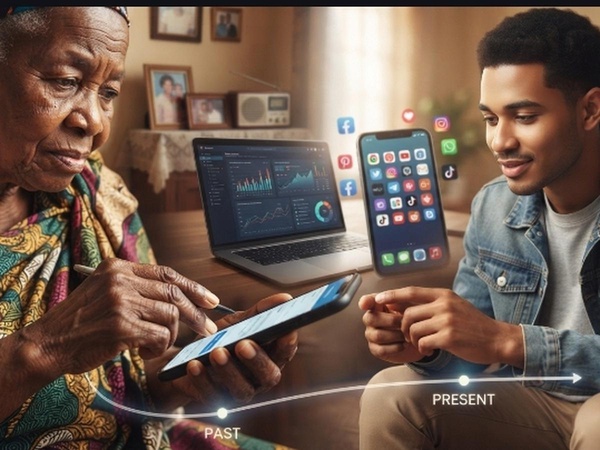
Have you ever had to explain something to an older person that seemed so simple to you?
“Come and show me how to do this.”
“Where do I press?”
“Is this where I will put my phone number?”
“Which one is the password again?
You just look at them and wonder:
How can this be difficult?
You have explained it.
You explain it again.
Then again.
And somehow, thirty minutes later, you are explaining the same thing for the fourth time.
You might even get frustrated. 😂😭
“I have told you this before. This thing is simple.”
But maybe it isn't simple to them.
Think about it.
Our parents and the people who came before us grew up in a completely different world.
There was no WhatsApp.
No online application.
No Google Form.
No NIN field waiting for you to fill it.
No “click the link in the bio.”
No email notification telling you that your application has been received.
Some did not grow up with computers.
Some did not have the opportunity to go far in school.
And even for those who did, technology was not the system they were trained in.
Then our generation came.
The computer age.
The internet.
Social media.
Everything became faster.
And because many of us grew up around these things, we began to call them simple.
My mother can ask me to help her log into OPay, and I might be wondering:
“Mummy, what is difficult here? Just enter your password.”
Then she is confused, “Which password?”
Her UBA password? Her Facebook password? Her OPay password?
Sometimes, she doesn't even know that each account has its own password.
And that is when I remember that I know these things just because I have lived in this system.
It also reminds me of when we were children.
Our parents would tell us:
“Don't do this.”
“Don't follow that person.”
“Don't spend all your time outside.”
“Take your education seriously.”
“This thing you are doing can affect your future.”
And we would look at them like:
What is this person even saying?
To us, they were interfering with our present.
To them, they were protecting our future.
They had lived longer than us.
They had seen things we had not seen.
They had walked roads we were only beginning to discover.
So sometimes, what sounded like unnecessary advice was simply experience speaking to innocence.
And now, interestingly, the same thing happens in reverse.
They are trying to understand our present.
We are trying to understand their past.
Sometimes I tell my mother about a scholarship and her first response is:
“No, is not a scam?”
And inside me, I am like:
“Mummy! Must everything be scam? This is a scholarship!”
But then I understand where that fear comes from.
They have seen people lose money.
They have seen people get deceived.
They grew up in a time when the common understanding was that if you wanted something, you worked for it.
So when someone says, “You can get this opportunity without paying,” suspicion may come before excitement.
Meanwhile, we have grown up in a world where an opportunity can literally arrive through a link on your phone.
Neither side is necessarily foolish.
We are simply products of different times.
That is why I have started to think differently about the word “old-fashioned.”
Maybe people are not always old-fashioned or old school.
Maybe the world simply moved faster than their opportunity to catch up with it.
That distinction matters.
Because when an older person asks you how to use an application, explain it.
When they ask again, explain it again.
When they don't understand, come down to their level.
Don't make them feel stupid for not knowing what you know.
You know it because you were exposed to it.
You learned it somewhere.
Someone probably explained something to you too.
And please remember this:
One day, it will be our turn.
Today, we are the ones saying:
“It's just an app.”
“Just click here.”
“Just press this.”
“It's easy.”
But technology will not stop moving because we have finally caught up.
Something new will come.
Something our children may understand in five seconds.
Something we may stare at for ten minutes.
And we will probably say:
“Please, come and show me how this works.”
And they may laugh.
They may wonder how their parents don't understand something so simple.
Just like we sometimes do today.
That is the irony of time.
What is obvious to one generation can become foreign to another.
Every generation eventually becomes unfamiliar with the world that comes after it.
The things our parents once considered new eventually became normal.
The things we consider normal today will eventually become old.
And the things our children will consider normal may one day leave us asking questions.
That is how time moves without asking whether we are ready.
So before you get angry because your mother doesn't know how to use an application, or your father doesn't understand something you think is obvious, remember:
You were once the one who needed someone to explain the obvious to you.
You were once the child asking:
“Daddy, how do I do this?”
“Mummy, what does this mean?”
“Why can't I do this?”
And they explained.
Maybe they didn't explain perfectly.
Maybe they got angry sometimes.
Maybe they had to repeat themselves.
But they still taught you.
Now, life has put you on the other side.
You have become the one with the knowledge.
Use it well.
Teach without insulting.
Correct without humiliating.
Explain without making someone feel small.
Because knowledge is not supposed to make us look down on people.
It is supposed to make us useful to them.
The phone may be in their hands.
The knowledge may be in ours.
Tomorrow, the situation may be reversed.
And when that day comes, I hope someone will be patient enough to tell us:
“Don't worry. I'll show you.”
Because one day, we will be the ones asking.
One day, the world will move beyond what we know.
One day, something that looks incredibly simple to the next generation may leave us completely confused.
So, if your mother calls you for the tenth time to ask how to do something on her phone, breathe.
If your father asks you to check an alert you think he should understand by now, check it.
If an older person needs you to explain something that seems painfully obvious, teach them.
After all, you are giving them a bridge into a world that changed while they were busy living.
Someday, someone will build that same bridge for you.
May we never become so advanced that we forget where we came from.
And may we always remember:
Every generation is a beginner in the world that comes next. 🇳🇬🌍
Have a peaceful day, and be kind to those who are still learning their way through this changing world.


 133