Score |
224


Emilia's Pen

 Accountant @ Jomas Shelters Limited



TREATING POISON WITH POISON
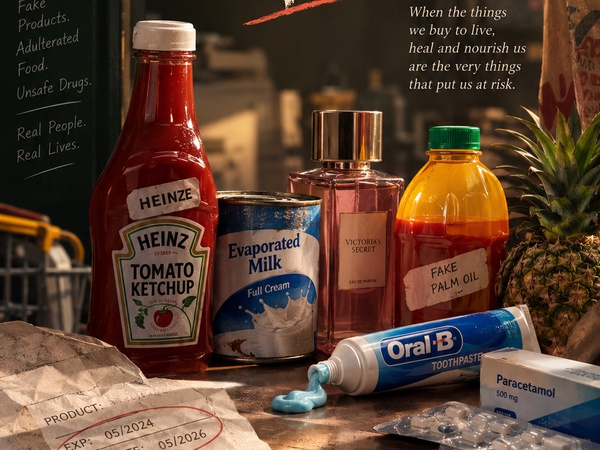
<p>TREATING POISON WITH POISON</p><p><br/></p><p>The country has gotten out of hand.</p><p><br/></p><p>The rate at which adulterated food, counterfeit products and potentially unsafe drinks are being sold is alarming. And the worst part? Sometimes, you don't even know what you're buying until it's too late.</p><p><br/></p><p>Want a bottle of ketchup? Sure.</p><p><br/></p><p>Heads to the supermarket and buys a bottle of Heinz ketchup. Uses it for about two weeks, decides to clean the fridge and checks the same bottle of ketchup, only to discover that it's <strong>Heinze</strong> and not Heinz.</p><p><br/></p><p>Want some evaporated milk? Buys a tin from the corner shop, heads home to use it, only to discover that it's curdled.</p><p><br/></p><p>Out of toothpaste? Heads to the market to buy Oral-B toothpaste. Squeezes it at home and discovers that the colour is light blue instead of crystal blue.</p><p><br/></p><p>You have palm oil at home? Use it to paint a portrait when you realise it's fake, so the red dye doesn't go to waste.</p><p><br/></p><p>Want to take a shower? Proceeds to discover that the brand you've been using for ages doesn't make that particular scent or, worse, doesn't even ship to Nigeria.</p><p><br/></p><p>How much did you get your Victoria's Secret perfume?</p><p><br/></p><p>₦5k?</p><p><br/></p><p>Chai. Only God knows what you're spraying.</p><p><br/></p><p>Feel like eating beans? Sure. Just prepare to spend hours in the toilet if what you've eaten doesn't agree with your system.</p><p><br/></p><p>And these are just a few examples of the things people worry about when buying everyday products in Nigeria.</p><p><br/></p><p>You may think you're safe because you buy from trusted shops and supermarkets. But have you ever wondered what happens when a product expires on the shelf?</p><p><br/></p><p>If you said it would be thrown away because that's the right thing to do, here's a pin 📍 to burst your bubble.</p><p><br/></p><p>There have been reports of expired products being relabelled with new dates and returned to circulation. The process can involve removing or altering the original date markings and stamping new ones over them.</p><p><br/></p><p>There.</p><p><br/></p><p>Good as new.</p><p><br/></p><p>Except it isn't.</p><p><br/></p><p>The product hasn't magically become safe because somebody changed the date on its packaging. The contents haven't been restored, and whatever risks came with the expired product haven't disappeared.</p><p><br/></p><p>But somebody has found a way to make a profit from it.</p><p><br/></p><p>People are being wicked to each other, and when the consequences of this wickedness arrive, we turn to poison.</p><p><br/></p><p>I mean, medicine.</p><p><br/></p><p>Fake drugs everywhere. Even the paracetamol you reach for when you develop a headache from thinking about all these things could be counterfeit.</p><p><br/></p><p>And when it comes to antibiotics, the consequences of poor-quality or counterfeit products can go beyond wasting money. They can mean treatment failure, prolonged illness and, in some cases, contribute to the wider problem of antimicrobial resistance.</p><p><br/></p><p>Imagine being sick, spending money you can barely afford on medication, taking it faithfully and expecting to get better, only to discover that the medicine itself is part of the problem.</p><p><br/></p><p>You're trying to get well, but you don't even know whether what you're taking can help you.</p><p><br/></p><p>And worst of all, the institutions meant to regulate these products sometimes seem to be on DND.</p><p><br/></p><p>Saw a video of fruit sellers rubbing colouring onto pineapples, beside a very nasty black puddle and a disgusting well.</p><p><br/></p><p>I was in the market last week and saw Irish potatoes that were as big as sweet potatoes.</p><p><br/></p><p>Now, I'm not saying that the size of a potato automatically means something is wrong with it. Produce naturally varies in size, and appearance alone isn't evidence of adulteration.</p><p><br/></p><p>But that's the problem, isn't it?</p><p><br/></p><p>We've become so suspicious of the things we buy that even ordinary things can make us wonder what exactly we're taking home.</p><p><br/></p><p>When did people get so wicked? When did the lives of others become so insignificant? And why does it sometimes feel as though the authorities are silent?</p><p><br/></p><p>Must people die like chickens before anything is done?</p><p><br/></p><p>And even when something is done, will it be enough to prevent the next person from doing the same thing?</p><p><br/></p><p>This country has become something else.</p><p><br/></p><p>And when I hear people say wickedness comes from the government, I get so upset because the people we call the government were once ordinary people.</p><p><br/></p><p>They didn't emerge from some mysterious institution with wickedness already programmed into them. They were once members of our communities, people who lived among us, people who made choices and learned what they could get away with.</p><p><br/></p><p>So let me ask:</p><p><br/></p><p>Did the government ask you to sell fake products?</p><p><br/></p><p>Did they make you advertise unsafe drugs?</p><p><br/></p><p>Did they force you to remove an expiry date and replace it with a new one?</p><p><br/></p><p>Did they ask you to compromise another person's health so you could make a few extra naira?</p><p><br/></p><p>Yes, poor governance and weak enforcement can create opportunities for these things to happen. Regulatory institutions have a responsibility to inspect products, investigate complaints, punish offenders and protect consumers.</p><p><br/></p><p>But the existence of an opportunity is not the same as being forced to take it.</p><p><br/></p><p>You still made a choice.</p><p><br/></p><p>And somebody else may have to live with the consequences of that choice.</p><p><br/></p><p>That's what makes this particularly upsetting. You don't always know who is responsible. You don't always know which product is genuine. You don't always know whether the person selling to you knows what they're selling.</p><p><br/></p><p>Sometimes, the packaging looks right. The shop looks trustworthy. The product is familiar. You've used it before.</p><p><br/></p><p>So you buy it.</p><p><br/></p><p>Because what other choice do you have? You still need to eat. You still need to bathe. You still need to brush your teeth. You still need medication when you're sick.</p><p><br/></p><p>These aren't luxuries. They're ordinary parts of living.</p><p><br/></p><p>Yet we've reached a point where buying ordinary necessities can come with an unreasonable amount of uncertainty.</p><p><br/></p><p>And the burden falls on the consumer to investigate everything.</p><p><br/></p><p>Check the seal. Check the batch number. Check the expiry date. Verify the seller. Look for the registration number. Report suspicious products.</p><p><br/></p><p>And yes, we should take reasonable precautions. We should report suspicious products to the relevant authorities, including NAFDAC where appropriate. We should avoid products that appear tampered with and seek medical advice if we suspect that something we've consumed has made us ill.</p><p><br/></p><p>But why should the responsibility of protecting ourselves fall almost entirely on us?</p><p><br/></p><p>What happens to the person who doesn't know what to check?</p><p><br/></p><p>What happens to the person who cannot afford to throw away a product they have already paid for?</p><p><br/></p><p>What happens to the person who buys medicine from a seller they trust because they have no easy access to a reliable pharmacy?</p><p><br/></p><p>What happens to the person who becomes ill and cannot afford to investigate why?</p><p><br/></p><p>We cannot keep telling people to be careful while ignoring those who deliberately put them at risk.</p><p><br/></p><p>We cannot keep telling consumers to buy from trusted sellers when counterfeit products can enter legitimate supply chains.</p><p><br/></p><p>And we cannot keep blaming the government for everything while pretending that individual greed has nothing to do with it.</p><p><br/></p><p>Both can be true.</p><p><br/></p><p>The government can fail in its responsibility to protect the public, and ordinary people can choose to exploit that failure.</p><p><br/></p><p>One does not excuse the other.</p><p><br/></p><p>Today, we are treating the poison in us with the poison manufactured for us.</p><p><br/></p><p>We buy food hoping it will nourish us. We buy medicine hoping it will heal us. We buy products we've trusted for years, only to find ourselves questioning whether we can trust them anymore.</p><p><br/></p><p>And the people responsible?</p><p><br/></p><p>Some are counting their profits.</p><p><br/></p><p>Some are looking the other way.</p><p><br/></p><p>And the rest of us are left hoping that whatever we bought today won't be the thing that sends us to the hospital tomorrow.</p><p><br/></p><p>Unfortunately, I have become a victim on several occasions.</p><p><br/></p><p>And that is what makes this more than a frustrating story about shopping in Nigeria.</p><p><br/></p><p>It's about having to question whether staying alive should be this complicated.</p>


 19





Other insights from Emilia's Pen








Contributor Points

Points-to-Coupons

Referral Earning

Insights for you.


He was not just a walking red flag, h...
He Was a Red CanopyIn the heart of Abuja, where the sun painted the city gold and the h...
631 views
13 upvotes
21 comments


Tight purse strings: trying to mainta...
Tight Purse StringsChinedu stared at his phone, the banking app's balance glaring back ...
529 views
17 upvotes
14 comments

Agreement Is the New Thinking
Agreement is easy.It keeps conversations smooth.It keeps you included.It keeps things c...
331 views
17 upvotes
18 comments





























