Score |
71


Reuben Esther Chidera
 Student,writer, Graphics Designer @ Federal university,Oye Ekiti



WE ARE PRODUCING GRADUATES, BUT ARE WE TRULY EDUCATING PEOPLE?
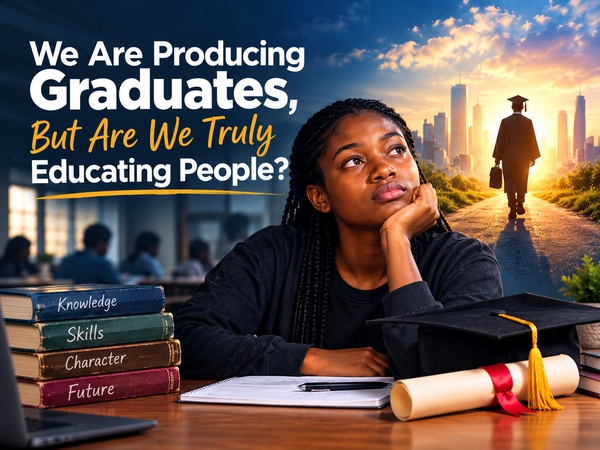
WE ARE PRODUCING GRADUATES, BUT ARE WE TRULY EDUCATING PEOPLE?<p><br/></p><p>There is something deeply concerning about a system that can teach a student how to pass an examination but struggles to teach them how to solve a real-life problem.</p><p><br/></p><p>We have become so obsessed with grades, certificates, and academic achievements that we sometimes forget to ask the most important question: What exactly are we preparing these students for?</p><p><br/></p><p>A student can spend years in school, memorize countless definitions, pass examinations with impressive scores, and graduate with a beautiful certificate, yet step into the real world feeling unprepared for the very challenges education was supposed to help them overcome.</p><p><br/></p><p>Does this mean education is useless? Absolutely not.</p><p><br/></p><p>Education remains one of the most powerful tools for personal growth and societal development. It opens minds, challenges ignorance, creates opportunities, and gives people the ability to question the world around them.</p><p><br/></p><p>But somewhere along the way, we seem to have confused being educated with being able to prove that we attended school.</p><p><br/></p><p>And there is a difference.</p><p><br/></p><p>True education should teach us how to think, not merely what to remember. It should cultivate curiosity, creativity, integrity, problem-solving skills, and the courage to challenge ideas when necessary. It should prepare us not only to earn a living but also to understand life, contribute to society, and make informed decisions.</p><p><br/></p><p>Yet, for many students, the reality is far from this ideal.</p><p><br/></p><p>Some struggle to afford textbooks, transportation, accommodation, and even food, while carrying the weight of expectations from families who see education as their greatest hope for a better future.</p><p><br/></p><p>Some attend lectures exhausted, not because they lack ambition, but because surviving and studying have become competing responsibilities.</p><p><br/></p><p>Others graduate into a world where opportunities are scarce, where practical skills are demanded but rarely developed adequately, and where years of academic effort do not always translate into financial stability.</p><p><br/></p><p>Then we ask why young people are frustrated.</p><p><br/></p><p>We tell them that education is the key to success, but we rarely discuss what happens when they obtain the key and discover that the door is still locked.</p><p><br/></p><p>Perhaps the problem is not that education has lost its value. Perhaps the problem is that we have placed too much responsibility on certificates and too little on the quality, relevance, and purpose of learning.</p><p><br/></p><p>A certificate can show that someone has completed a programme of study. It cannot, by itself, measure wisdom, creativity, compassion, discipline, or the ability to solve problems.</p><p><br/></p><p>And a person without a university degree is not automatically ignorant, just as a person with several degrees is not automatically wise.</p><p><br/></p><p>We must stop measuring the worth of human beings solely by the qualifications they possess.</p><p><br/></p><p>More importantly, we must begin to examine the kind of education we are providing, the opportunities available to learners, and the society waiting for them after graduation.</p><p><br/></p><p>Because education should not merely produce people who know the right answers to examination questions. It should produce people who can ask the right questions when the answers are no longer provided.</p><p><br/></p><p>It should not simply teach students how to compete for success. It should equip them with the knowledge and character to create meaningful opportunities, solve problems, and contribute to the progress of their communities.</p><p><br/></p><p>Perhaps the greatest failure of education is not when a student fails an examination, but when a student passes every examination and still leaves school unprepared to think independently, apply knowledge, or navigate the world beyond the classroom.</p><p><br/></p><p>So, before we celebrate the number of graduates our institutions produce, perhaps we should ask ourselves a more important question:</p><p><br/></p><p>Are we building minds, or are we simply awarding certificates?</p><p><br/></p><p>Because the future of a nation depends not only on how many people attend school, but also on what they learn, what they become, and what they can do with that knowledge.</p><p><br/></p><p>And until we begin to measure education by more than grades and certificates, we may continue to celebrate academic success while overlooking the very purpose of education itself.</p><p><br/></p><p>Education should be more than a qualification we carry. It should be a transformation we demonstrate.</p><p><br/></p><p>What do you think? Is our education system truly preparing students for life, or has the pursuit of certificates overshadowed the purpose of learning?</p>


 4


Other insights from Reuben Esther Chidera







Contributor Points

Points-to-Coupons

Referral Earning

Insights for you.


Let's Forikori
Honestly, I have been hearing "Olodo Uprising" for the longest time, and I think it's h...
240 views
36 upvotes
30 comments


My journey:From the Gates of UniAbuja...
The dust of Gwagwalada hung in the air, a familiar yet distinct scent that marked the b...
458 views
27 upvotes
39 comments


HOW PETTY THEY CAN BE
I've always enjoyed Spotify and other streaming services, I mean if nothing I get to co...
713 views
35 upvotes
25 comments

I won guys
I won English guys. I had done all the typing and guess what I lost it. Don't worry I'm...
145 views
24 upvotes
25 comments
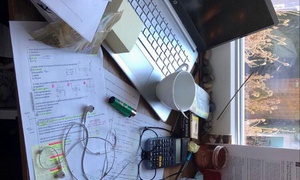

The Final Stretch
Burning Candles, Sweaty Eyes and a Packed Brain. 😭A packed brain that has refused to ac...
84 views
26 upvotes
28 comments


LIFE OF A FUTURE DIPLOMAT (I GUESS) T...
Okay, hi.My name is Nomshu, but most people here know me as Grace, and I’m a student of...
420 views
25 upvotes
88 comments


A WORD IS ENOUGH FOR THE WISE
There is something extremely powerful about words, they hold power most never pay atten...
2337 views
17 upvotes
21 comments

I am Olodo
Insult me however you like, but don't think you are insulting me when you call me **Olo...
161 views
19 upvotes
22 comments
School is a scam
The concept of education has been debated for centuries, and its true meaning has been ...
769 views
19 upvotes
23 comments

The Bridge to Adulthood
I remember when I was in secondary school, my classmates and I had great dreams and pla...
1350 views
17 upvotes
22 comments

































