Score |
126


Quareeb Jagun
 Content Writer @ University of Ilorin
Content Writer @ University of Ilorin



What Happened to the Nigerian Student Who Built a Robot in 1971?
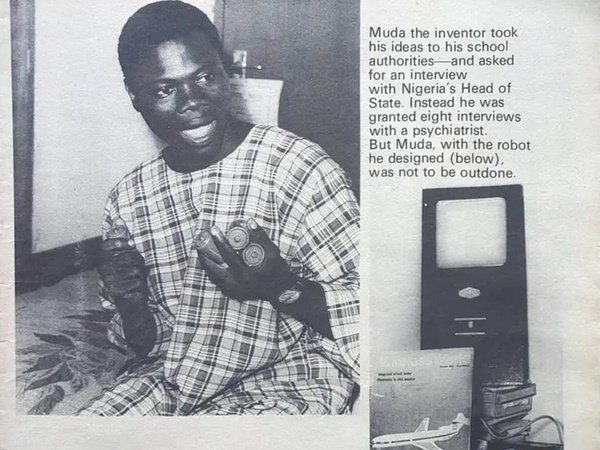
<p>Imagine being 20 years old, sitting somewhere in Nigeria in 1971, surrounded by wires and batteries, trying to build a machine that could answer a simple question:</p><p><br/></p><p>“Is the boss available?”</p><p><br/></p><p>Now suppose that you took the invention seriously and wished to show it to Nigeria's Head of State.</p><p><br/></p><p>And instead of someone asking you, "How does it work?"</p><p>You are sent for a mental health check.</p><p><br/></p><p>The following is the account of Mudashiru Ayeni, a young student from Nigeria who is generally known as Muda.</p><p><br/></p><p>More than 50 years later, his story has resurfaced from old Nigerian archival records, and it raises a question that is bigger than the invention itself:</p><blockquote>What should we do when it comes to people whose ideas are ahead of our current understanding?</blockquote><p><br/></p><p>The machine called Mudagraph</p><p>The surviving accounts indicate that Ayeni was fascinated by electronics and enjoyed carrying out experiments with machines.</p><p><br/></p><p>In 1971 he is said to have constructed a battery-operated device known as the Mudagraph, which was also called the Receptograph.</p><p><br/></p><p>What it was designed to do was quite practical.</p><p><br/></p><p>A visitor had the possibility of interacting with the machine, and the machine could tell you whether the person they wished to see was available, busy or away.</p><p><br/></p><p>At the present time, that might seem to be a simple thing.</p><p><br/></p><p>We now live in a world where customer service is automated, with chatbots, voice assistants and AI systems capable of carrying on conversations in just a few seconds.</p><p><br/></p><p>But if you put that same idea into Nigeria in 1971.</p><p><br/></p><p>A young student was trying to automate some of the work which is normally carried out by a human receptionist.</p><p><br/></p><p>That was unusual.</p><p><br/></p><p>Apparently, Ayeni firmly believed in what he had built.</p><p><br/></p><p>Then came the strange par, the reports drawn from the earlier account state that Ayeni wished to show his invention to Yakubu Gowon, who was the Head of State of Nigeria at that time.</p><p><br/></p><p>Rather than receiving the demonstration he had asked for, he was allegedly subjected to a psychiatric evaluation.</p><p><br/></p><p>Another later account states that he made a number of visits before finally being certified as mentally sound.</p><p><br/></p><p>He is also said to have written a letter to his school's principal outlining the part that young Africans should play in the development of the continent.</p><p><br/></p><p>It was reported that he was finally expelled from classes and got rid of his place at school.</p><p>Take that for a moment.</p><p><br/></p><p>A young individual had an idea.</p><p>The idea was unusual.</p><p>People did not get it.</p><p>And instead of the first question being:</p><p>Demonstrate what you've built.</p><p><br/></p><p>The question became:</p><blockquote>“Is this person okay?”</blockquote><p><br/></p><p>It is there that this story becomes greater than Mudashiru Ayeni.</p><p>Someone eventually listened</p><p><br/></p><p>That was not the end of the story.</p><p>Later reports stated that Ayeni finally arrived in Aminu Kano, who was at that time the Federal Commissioner for Communications.</p><p><br/></p><p>It is said that Kano listened to him and encouraged his work.</p><p>It was also said that certain businessmen had shown an interest in the invention.</p><p><br/></p><p>However, later on the trail grows unclear. There is no well-documented account of a large company coming out of the invention, no renowned technology empire linked to his name, and no clear public information about what ultimately became of Ayeni.</p><p><br/></p><p>And maybe that is the most sad thing of all.</p><p><br/></p><p>It doesn't have to be that his machine marked the beginning of a technological revolution.</p><p><br/></p><p>Yet it appears that we know insufficient things about the young man who built it.</p><p><br/></p><p>But let's be careful with the story</p><p><br/></p><p>There's another point that is important here.</p><p>We must not treat Ayeni as a mythical 'African AI inventor' merely because the story has an impressive sound.</p><p>The machine was not modern artificial intelligence.</p><p>It was said to be an automated office device that was battery-powered and had preset replies.</p><p><br/></p><p>What is important is that a young man from Nigeria was considering the subject of automation, technology and how to solve ordinary problems at a time when such ideas were not very common.</p><p>It deserves to be remembered accurately.</p><p><br/></p><p>According to <a class="tc-blue" href="https://Archivi.ng" rel="noopener noreferrer" target="_blank">Archivi.ng </a>, the story originated in an old archival record and has since become one of the most widely shared Nigerian history stories that it has brought back.</p><p><br/></p><p>What then can we learn from Mudashiru Ayeni?</p><p>1. You shouldn't kill an idea just because it sounds odd.</p><p>Some ideas need to be looked at before you judge them.</p><p>Young people need those who will ask questions.</p><p>Sometimes the difference between a forgotten idea and a developed idea is simply having someone say:</p><p><br/></p><p>“Show me.”</p><p><br/></p><p>3. Innovation needs documentation.</p><p>Should someone produce something remarkable but no one write down about it, then the story will disappear along with them.</p><p><br/></p><p>Since ancient times Africans have imagined the future.</p><p><br/></p><p>The story of our technology did not start with today's startups, smartphones or tech hubs.</p><p>Before today's various systems were developed, there were already people carrying out experiments.</p><p><br/></p><p>We must keep our own history.</p><p>Since if we don't record our innovators, it will be someone many years later who has to rediscover them by means of old newspapers and fragmented memories.</p><p><br/></p><p>Perhaps the most important question is not whether Mudashiru Ayeni was 'ahead of his time'.</p><p><br/></p><p>Maybe it is this:</p><p>What number of other young people did we never take the time to understand their ideas?</p><p><br/></p><p>At some place today there could be another young person sitting down with wires, a laptop, a notebook, and a strange idea or a prototype which no one yet understands.</p><p>Before we laugh.</p><p>Before we dismiss them.</p><p>Until we inform them that it won't work.</p><p>Maybe we should simply ask:</p><p><br/></p><p>Tell me about what you've built.</p><p><br/></p>


 13
13


Other insights from Quareeb Jagun












Contributor Points

Points-to-Coupons

Referral Earning

Insights for you.


Drums Before Guns
Before we had tanks, we had talking drums. Before we had political parties, we had prai...
264 views
30 upvotes
27 comments

Classism in a third-world country is ...
If you've ever driven through Abuja, you'd see the absurd theater of our class wars. A ...
439 views
20 upvotes
27 comments

Tight purse strings: trying to mainta...
Tight Purse StringsChinedu stared at his phone, the banking app's balance glaring back ...
497 views
17 upvotes
14 comments


The Fallen Giant: A lament for Nigeri...
Oh My Country NigeriaOh My Country Nigeria, your soil drinks the tears of toddlers, l...
199 views
18 upvotes
18 comments


We Are All Olodo's
/oh-loh-doh/ A Nigerian slang used to describe someone who is dull, slow to grasp conce...
155 views
20 upvotes
20 comments

THIS IS NIGERIA- NOT ALL OF IT
Popo stop me I fear dem wan to shoot meSearch my bags like say He wan to loot meComot m...
396 views
15 upvotes
19 comments


Olodo Must Go! Or Must He?
The Big Celeb runs for dear life.The mob is faster.“See him there!”“Him wan try run. Ca...
143 views
21 upvotes
17 comments


A CASE FOR JANUARY.
The hype of December is the very sponsor of the dread of January. But upon closer exami...
1009 views
16 upvotes
15 comments


Lagos..... The Agbero uprising.
In Lagos, Looking Rich Is Becoming a Security RiskThere is a new kind of anxiety that c...
140 views
17 upvotes
18 comments


Dear Chicken, Beware of Christmas
My mum is approaching the empty nest phase of life. My dad doesn’t live in Nigeria, so ...
371 views
12 upvotes
20 comments