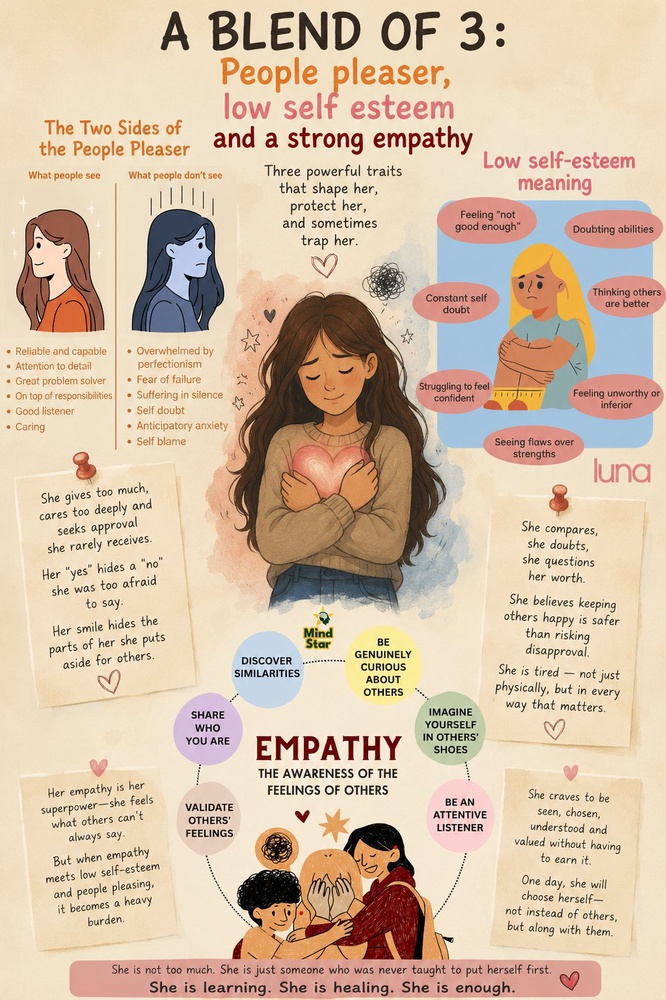
She is a blend of three:
A people pleaser,
low self-esteem,
and strong empathy.
These three cloak her instantly,
built into the way she sees the world
through a different lens.
Hyper-aware of the people around her, especially emotionally,
she senses feelings in a person’s tone,
their body, their speech, their movements, and voice.
The slightest disappointment—she absorbs.
The slightest fulfillment—she feels.
The slightest disapproval is her undoing.
So when she senses others’ moods, needs, and expectations,
she places them above her,
like a trophy she cleans to shine.
She tries to solve their feelings
just to receive that shiny approval
and enjoy the absence of disappointment.
She senses both the good and bad in people.
Her environment shaped her into these three
a weapon against her,
and sometimes a blessing when it saves her.
When she smiles and undermines her feelings
to avoid hurting another,
when she says yes
to what she would have said no to
if not for them
She wants to be pleasing,
to hear, “Yes, she is a great person.”
She fears absence,
fears not being felt.
She prefers the positivity she brings to others
because it makes her feel good.
She believes keeping others happy
is safer than risking disapproval.
These three have brought her pain,
but she doesn’t stop.
It’s like a drug—hard to swallow,
but something she feels she needs.
When “no” weighs on her lips,
guilt sets in,
and so she says yes.
Because deep down,
as that “no” lingers,
loneliness and resentment creep in.
She knows many are her friends,
but few truly see her.
So why risk losing another?
She knows she gives too much,
but she doesn’t know how to stop.
Few recognize what she does.
A deep craving to be seen,
chosen,
understood,
and valued without having to earn it
engulfs her
so she continues.
She is built on these three.
Empathy could have been her strength,
but mixed with low self-esteem
and people-pleasing,
it turns her into someone
who gives too much
with no gratitude
and no love for herself.
She says she can’t live without them.
But has she ever stopped to ask
if they can live without her?
She should ask herself:
When was the last time
she did something for herself
without guilt?
She says she can’t live without them
but is it because
she built her life like a wall
around them?
She knows the answers,
but won’t face them
because they scare her.
The thought of caring for herself
terrifies her.
She is tired
not physical tiredness,
but every kind of tired.
The kind that comes from always adjusting,
always giving,
always second-guessing.
Her empathy could have been a strength,
but now all three traits trap her
in a cycle she struggles to escape.
But no
this is not where she ends.


 247