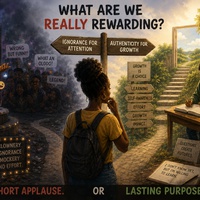
The Japa Dilemma: When Leaving Becomes the First Step to Becoming
There is a particular kind of patriotism we have become accustomed to demanding from Nigerians.
Stay.
Stay when the lights go out.
Stay when transportation becomes a daily struggle.
Stay when hospitals cannot provide what patients need.
Stay when the degree you spent years earning cannot guarantee you employment.
Stay when your salary barely reflects the years you spent studying.
Stay when opportunity seems to belong to the person with the right connection rather than the person with the right ability.
Stay, because Nigeria needs you.
But I have begun to wonder:
What happens when the person Nigeria needs has to leave Nigeria before they can become the person Nigeria needs?
For many Nigerians, leaving is not about hating Nigeria.
Sometimes, it is simply about wanting a life that works.
It is about wanting your education to mean something. Wanting your work to be fairly rewarded. Wanting to compete in a system where what you know can matter as much as who you know. Wanting reliable electricity, transportation, healthcare, education and employment.
Wanting to wake up and feel that the effort you are putting into your future actually has somewhere to go.
When a system repeatedly makes a young person feel that they cannot build the life they want where they are, can we really be surprised when they start looking elsewhere?
Perhaps the more uncomfortable question is not:
“Why are Nigerians leaving?”
It is:
“What are we asking Nigerians to stay for?”
I am studying nursing, a profession that has become closely associated with Japa.
Many people enter nursing because they genuinely want to care for others. There is something deeply human about choosing a profession where another person's life, comfort or recovery can sometimes depend on what you know and what you do.
But there is also a practical reality.
A nursing qualification can open doors outside Nigeria.
Nigeria needs nurses.
Yet some Nigerian nurses eventually leave in search of better pay, better working conditions, professional development and a more sustainable future.
And then we call them unpatriotic.
I struggle with that.
Because I do not think patriotism should require someone to sacrifice their entire future simply to prove that they love their country.
A young Nigerian who is unemployed, underpaid and struggling to find a path forward cannot reasonably be expected to carry the weight of national development simply because they were born here.
We tell young people to build Nigeria.
But sometimes, Nigeria has not given them the tools to build anything.
And when you put the possibilities of staying and leaving beside each other, the scale can feel painfully unequal.
That does not mean that everyone who leaves Nigeria will succeed.
Japa is not a magic ticket.
People struggle abroad too.
They experience loneliness, homesickness, discrimination, financial pressure and the reality of starting again somewhere unfamiliar.
Leaving home does not automatically make life easy.
But leaving can still offer a person access to opportunities that may be harder to find at home.
So the decision is not always:
“Do I love Nigeria enough to stay?”
Sometimes it is simply:
“Where do I have a better chance of becoming the person I am working so hard to become?”
And sometimes, the honest answer is somewhere else.
Does loving Nigeria mean you have to stay?
Does a Nigerian have a responsibility to stay and help build the country?
I do not believe a Nigerian has a responsibility to remain in Nigeria simply because they are Nigerian.
That does not mean Nigeria does not need its people.
It means that a person's right to build a life for themselves should not disappear because their country needs development.
A young graduate who cannot find employment is allowed to look elsewhere.
A nurse who cannot earn enough to live is allowed to seek better working conditions.
A parent who wants security and opportunity for their children is allowed to pursue them.
A young person who wants to build a career is allowed to choose the environment in which they believe they have a better chance of succeeding.
These people have lives too.
They have parents.
They have children.
They have bills.
They have dreams.
They have spent years working toward something.
Sometimes, I think we forget that when we talk about patriotism.
We talk about Nigeria as though every Nigerian has an unlimited supply of strength and sacrifice.
But people get tired.
People need to eat.
People need somewhere to live.
People need to support their families.
People need to have dreams that go beyond simply surviving.
A person who is struggling just to survive cannot reasonably be expected to solve the problems of an entire country.
You cannot build a country effectively when you have not been given the opportunity to build your own life.
So no, I do not believe Nigerians must stay in Nigeria to prove that they are patriotic.
They can leave.
But leaving does not mean responsibility disappears.
It means the responsibility takes another form.
Is leaving simply a rational decision when the system repeatedly fails you?
Sometimes, yes.
There is nothing inherently unpatriotic about choosing an environment where your skills, education and labour have a better chance of producing the life you want.
Think about a young Nigerian who spends years studying nursing.
They learn how to care for patients. They learn anatomy, pharmacology, physiology and clinical skills. They graduate with knowledge they hope will allow them to build a career.
But then they enter a system where they may face difficult working conditions, inadequate remuneration and limited opportunities for professional growth.
Then another country says:
“We need nurses.”
Suddenly, that same qualification has a wider place to be used.
Why would we be surprised when the nurse considers leaving?
That decision does not automatically mean they stopped caring about Nigeria.
Sometimes it simply means they are trying to give their potential a place to grow.
Sometimes leaving does not mean giving up on yourself. It means refusing to give up on yourself.
Japa becomes rational for some people because they are not necessarily choosing between Nigeria and another country.
They are choosing between the life they can realistically build here and the life they believe they have a better chance of building somewhere else.
And sometimes, the honest answer is somewhere else.
Are we losing the very people who are capable of helping Nigeria?
Yes. But we also need to ask why.
This is where the issue becomes uncomfortable.
Nigeria risks losing doctors, nurses, engineers, researchers, teachers, entrepreneurs, academics, technology professionals and many other skilled people who could contribute to its development.
Health-worker migration, for example, is a documented challenge across Africa, with employment conditions, remuneration and opportunities influencing decisions about migration.
So yes, we are losing people who could potentially help build Nigeria.
But I do not think the conversation should end there.
We should ask:
What would have happened to those people if they had stayed?
Would they have received the same opportunities?
Would their skills have been rewarded?
Would they have been able to develop their expertise?
Would they have been able to earn enough to create businesses, support their families or invest in their communities?
Would they have had the freedom to become the people we now say Nigeria needs?
Or would some of them have spent years trying to survive in the same conditions they were expected to fix?
That is the contradiction.
Nigeria may lose the person who leaves.
But the person who leaves may also become someone they would not have had the opportunity to become if they had stayed.
Sometimes leaving does not mean giving up on yourself.
It means refusing to watch your potential remain trapped in circumstances you cannot control.
The painful part is that some Nigerians feel they have to leave before they can become everything they are capable of becoming.
Is it unfair to place the burden of national development on ordinary citizens?
Yes.
National development cannot rest on the shoulders of one young graduate, one nurse, one teacher or one unemployed citizen.
Ordinary Nigerians have responsibilities too.
A person has to eat.
A person has to pay rent.
A person has to take care of their family.
A person has to think about their children's future.
A person has to build something for themselves.
We cannot tell someone who is struggling to survive that they must sacrifice their own future for the sake of national development.
There is something unfair about demanding sacrifice from people who have not been given the resources with which to make that sacrifice meaningful.
Patriotism should make people want to contribute.
It should not shame them for wanting a better life.
If Nigeria wants its young people to stay, then Nigeria also has to give young people reasons to believe they can build something here.
How much should patriotism actually demand from an individual?
This is probably the hardest question for me.
Because I do believe patriotism should demand something.
I just do not think it should demand everything.
If I leave Nigeria, I should not suddenly act as though Nigeria never existed.
If I become successful somewhere else, I should remember where I came from.
I should talk about my country honestly.
I should support people at home when I can.
I should help someone coming behind me.
If I have the resources to invest, I should consider investing.
If I have knowledge that could help, I should share it.
And perhaps, one day, I may return.
But I should not have to return before I am ready simply to prove that I love Nigeria.
You cannot pour from an empty cup.
Sometimes, you have to become stable yourself before you have anything meaningful to give someone else.
And this is where I think the burden of patriotism really begins:
after opportunity.
What happens after Japa?
Suppose I leave Nigeria.
Suppose another country gives me the opportunity to study, work, develop my skills and build a stable life.
Suppose I become the nurse, doctor, engineer, researcher, entrepreneur, teacher or writer I always wanted to become.
What then?
This is the part of the conversation that I think we often miss.
Because yes, I should remember Nigeria.
But I should also remember the country that gave me the opportunity to become who I am.
If another country welcomes me, educates me, employs me, protects my rights and gives me room to grow, I should contribute to that society too.
Gratitude matters.
I should not arrive somewhere else, receive opportunities, build a life and then behave as though the society that helped me grow owes me nothing and deserves nothing from me.
If another country gives me something Nigeria could not give me at that particular point in my life, I should appreciate it.
I should work.
I should contribute.
I should respect the society I have become part of.
And I can still remember Nigeria.
I can build the country that gave me an opportunity without abandoning the country that gave me my beginning.
I can belong somewhere else without pretending that Nigeria did not shape me.
I can build a life abroad and still support someone in Nigeria.
I can invest in Nigeria.
I can mentor Nigerians.
I can support healthcare or education.
I can create employment.
I can share knowledge.
I can return one day.
Or I can contribute from wherever I am.
That, to me, is where patriotism becomes more complicated than simply asking whether someone stayed or left.
Where you live does not automatically determine whether you care. What you do with what you have matters too.
So, what do we do after Japa?
Perhaps this is the question we should be asking more often.
Not simply:
“Why did you leave?”
But:
“What did you become after you left?”
Did you use the opportunity to build yourself?
Did you use your success to help someone else?
Did you remember the people who remained?
Did you contribute to the society that gave you your opportunity?
Did you ever look back at Nigeria and ask what you could do with everything you had gained?
Because I think we sometimes make the mistake of treating leaving and patriotism as opposites.
They are not necessarily.
A person can leave Nigeria and still love Nigeria.
A person can live abroad and still invest in Nigeria.
A person can build a life elsewhere and still create opportunities for Nigerians.
A person can become successful abroad and eventually return home.
And a person can remain abroad permanently and still contribute meaningfully to the country they came from.
At the same time, someone can stay in Nigeria and contribute very little.
So perhaps geography alone cannot be the measure of patriotism.
Perhaps what matters more is what a person does with their opportunities.
The real burden of patriotism
Perhaps we have been asking the wrong question.
Perhaps patriotism should not simply ask:
“Did you stay?”
Perhaps it should ask:
“Now that you have become capable, what will you do with your capacity?”
If I leave because Nigeria could not provide the opportunity I needed, I should not automatically be condemned for choosing to survive and grow.
But if I become successful somewhere else, I also should not forget that success gives me the ability to do more.
Not necessarily the obligation to return.
But the ability to contribute.
To help.
To remember.
To give someone else a chance.
That is where I find the middle ground in the Japa dilemma.
We should not romanticise staying.
We should not romanticise leaving either.
Leaving has costs.
Staying has costs too.
The difference is that, for many Nigerians, the opportunities available elsewhere can make those costs feel worth taking.
And perhaps that is what we need to be honest about.
People do not always leave because they stopped loving Nigeria.
Sometimes they leave because they are tired of watching their potential sit still.
Sometimes they leave because they want their years of education to lead somewhere.
Sometimes they leave because they want their children to have opportunities they did not have.
Sometimes they leave because they simply want a chance.
And I do not think wanting a chance should make anyone a traitor.
But I also do not think Japa should be the end of the conversation.
Because if I leave Nigeria and become successful, what happens then?
Do I forget the people who are still struggling?
Do I forget the country I came from?
Or do I use some of what I have gained to make somebody else's road a little easier?
That choice matters.
Because the person who leaves Nigeria today may become the person who has enough knowledge, resources, experience and opportunity to help Nigeria tomorrow.
But they could not become that person until they had the opportunity to become themselves first.
If Nigeria wants its young people to stay, it must give them reasons to stay.
If it wants them to return, it must give them something worth returning to.
And if they leave, perhaps we should not ask only:
“Why did they abandon us?”
We should also ask:
“What did we fail to give them before they left?”
Nigeria has enormous human potential.
But the strength of a nation cannot be measured simply by how many of its citizens remain physically within its borders.
A country is also built by the knowledge its people gain, the opportunities they create, the communities they support and the things they choose to give back.
Maybe the greatest tragedy of Japa is not simply that Nigerians are leaving.
Maybe it is that so many Nigerians feel they must leave before they can become everything they were capable of becoming.
And maybe the hope is that, wherever they go, they do not forget where they came from.
That they appreciate where they are.
That they contribute to the country that gave them a chance.
And that, when they have enough to give, they give someone else a chance too.
Because patriotism should not simply be:
“Stay for Nigeria.”
Perhaps it should be:
“Become. Contribute. Remember.”
And if Japa is sometimes the road a Nigerian must take to become, then perhaps the question is no longer whether leaving is patriotic.
Perhaps the real question is:
What will we do with everything we became after we left?




 84