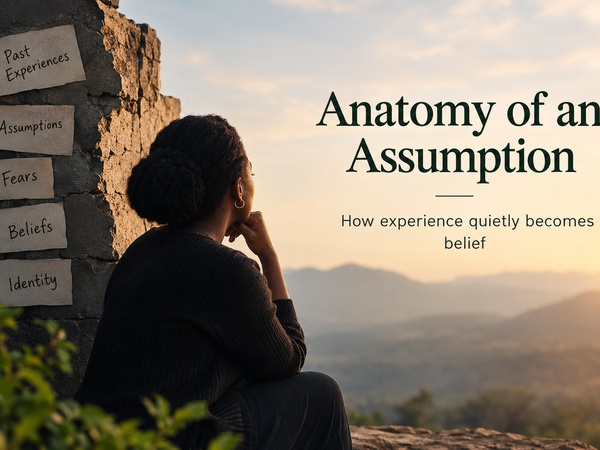
When yesterday's conclusions begin shaping tomorrow's decisions.
Perhaps one of the most dangerous things about an unexamined belief is that it rarely stays with us.
We carry it forward.
We pass it on.
We build decisions around it.
Sometimes, we even build relationships around it.
And because we have lived with it for so long, we stop seeing it as a belief.
We simply call it reality.
The Things We Pass On
We create hatred, live with it, and sometimes teach it to people who never experienced the original wound.
We inherit fear from those before us and hand it to our children in the name of protection.
We allow unresolved emotions to become paranoia, then call it personality.
We become accustomed to bitterness and call it strength.
We mistake our survival mechanisms for permanent characteristics.
And suddenly, someone else is carrying a burden they never chose.
This is why examining ourselves matters.
Not every fence we inherited needs to remain standing.
Not every belief that protected us in one season will serve us in another.
Some beliefs are born from wisdom.
Others are born from wounds.
And if we never examine them, we may spend years defending something that was never meant to become a permanent part of us.
Look Beneath the Surface
Perhaps we need to become more curious about ourselves.
When something triggers us, instead of immediately defending the reaction, perhaps we can pause.
Why did that affect me so deeply?
What exactly am I afraid of?
When did I start believing this?
Is this conviction or fear?
Is this wisdom or an old wound speaking?
Is this really my belief, or did I inherit it?
These questions are not accusations.
They are invitations.
Invitations to look beneath the surface.
Proverbs 4:23 says:
«“Keep thy heart with all diligence; for out of it are the issues of life.”»
Perhaps keeping our hearts does not only mean guarding what enters them.
Perhaps it also means examining what has already settled there.
Our assumptions.
Our fears.
Our expectations.
Our interpretations.
Our invisible fences.
Some may need strengthening.
Some may need repair.
And some may simply need to come down.
Healing Does Not End With the Wound
I think we sometimes imagine healing as reaching the point where something no longer hurts.
But what if healing also means examining what the hurt taught us?
Because sometimes the wound closes while the belief remains.
You may no longer be angry with the person, yet still believe that nobody can be trusted.
You may have forgiven your past, yet continue making present decisions based on it.
You may have moved on from the experience, yet still allow it to define what you think is possible for you.
The pain may be gone.
The fence remains.
And perhaps this is why renewing the mind is such an important part of spiritual growth.
Romans 12:2 doesn't simply tell us to endure life differently.
It tells us to be transformed by the renewing of our minds.
There are thoughts that need to be challenged.
There are beliefs that need to be unlearned.
There are assumptions that need to be surrendered.
And there are things we may need God to help us see differently.
James 1:5 says:
«“If any of you lack wisdom, let him ask of God.”»
Sometimes we can examine ourselves and find the answer.
Sometimes we need prayer.
Sometimes we need wise counsel.
Sometimes we need honest conversations.
And sometimes, we simply need the humility to admit:
Maybe I have been wrong about this.
We Don't Have to Carry Everything Forward
We don't have to carry every conclusion we have ever made into the future.
Some beliefs served a purpose in one season but become prisons in another.
Some fences protected us once but are now keeping us from walking into places we are free to enter.
This brings me back to the choir.
The lesson was never that I should join the choir.
I may or may not.
The lesson was realizing that I had made a permanent decision based on a temporary version of myself.
The girl who stood behind that microphone years ago was not the same person sitting in church years later.
Yet I had allowed her experience to make decisions for me.
And I wonder how often we do the same.
How many things have we decided about ourselves because of who we once were?
How many people have we judged because of what someone else did to us?
How many opportunities have we rejected because failure once embarrassed us?
How many relationships have we approached with suspicion because someone from our past broke our trust?
How many “I can't” statements are actually “I once got hurt”?
Maybe maturity is not just knowing what we believe.
Maybe it is also having the courage to ask why we believe it.
To trace the belief back to its roots.
To separate the experience from the interpretation.
To separate the wound from the identity.
To separate wisdom from fear.
And to be willing to change our minds when we discover that what once protected us is now limiting us.
Perhaps the goal isn't to tear down every fence.
Perhaps it is simply to walk around our own hearts and ask:
Why is this fence here?
And if the reason no longer exists,
why am I still living behind it?


 99