Education Is More Than Passing Exams
Daniel was the kind of student everyone thought had it figured out.
He attended his lectures.
He submitted his assignments.
He sat in the front row whenever he could.
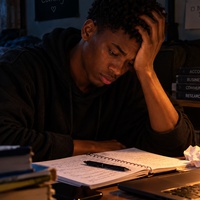
He stayed up late reading, even when his eyes were begging him to sleep.
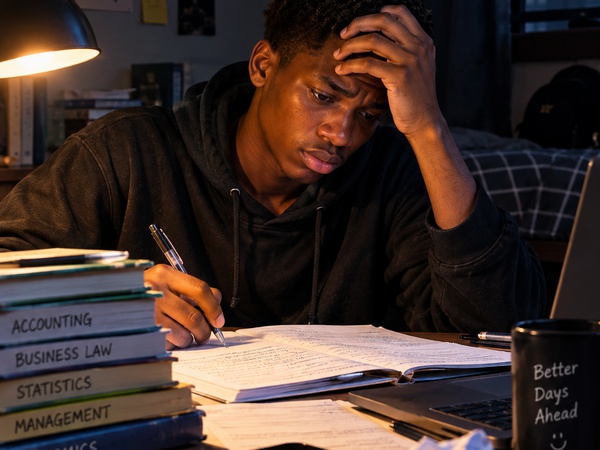
And when examination week came, he disappeared into his books.
To everyone around him, Daniel was simply a serious student.
But nobody knew what happened after he closed his books.
Some nights, he studied with an empty stomach.
Some mornings, he came to class thinking about the money he still owed.
Sometimes, he sat through lectures pretending to understand, while his mind was somewhere else entirely.
But he kept going.
Because he had learned one thing very early:
Nobody wants to hear excuses from a student.
They want results.
Then came the examination.
Daniel sat down, collected his question paper and turned the first page.
He knew the questions.
He had studied them.
He had practiced them.
Yet, for a few seconds, his mind went completely blank.
His heart started beating faster.
He looked around.
Everyone seemed to be writing.
What if I fail?
What will my parents say?
What will people think?
He took a deep breath and started writing.
Three hours later, he submitted his paper.
He walked out of the hall exhausted, but relieved.
Weeks later, the results came out.
Daniel passed.
Not just passed.
He did exceptionally well.
His parents were proud.
His friends celebrated him.
Someone even told him,
“You are really intelligent.”
Daniel smiled.
But that night, when everyone had gone to sleep, he sat alone on his bed and stared at his result.
For some reason, he wasn't celebrating.
Instead, he asked himself a question he had never thought to ask before:
“What exactly am I being educated for?”
He knew how to memorize.
He knew how to reproduce what a lecturer had taught him.
He knew how to write an examination under pressure.
But he didn't know how to deal with failure.
He didn't know how to manage money.
He didn't know how to communicate when he was hurt.
He didn't know how to handle rejection.
He didn't know how to make difficult decisions without someone telling him what the correct answer was.
And suddenly, something became clear.
Maybe education was never supposed to end with a certificate.
We have somehow turned education into a race.
Who graduated first?
Who got the highest CGPA?
Who got the best result?
Who finished with first class?
Who got the certificate?
And yes, those achievements matter.
There is nothing wrong with being proud of them.
But somewhere along the way, we started measuring the whole person with numbers on a result sheet.
And that's where we miss something important.
Because life doesn't always give you questions you have seen before.
There is no textbook for losing someone you love.
No past question for heartbreak.
No lecturer to tell you what to do when your plans collapse.
No marking scheme for deciding whether to start again after failure.
No grade for choosing kindness when nobody is watching.
No certificate for learning how to survive difficult seasons without losing yourself.
Those are lessons too.
Education should teach us how to think, not just what to remember.
It should make us curious.
It should teach us how to ask questions.
How to solve problems.
How to listen.
How to communicate.
How to disagree without disrespecting people.
How to learn from our mistakes.
How to turn knowledge into something useful.
How to stand back up when life knocks us down.
Because what is the point of knowing the answer to every examination question if we don't know what to do when life asks us a question we have never seen before?
And maybe that's why we need to stop looking at students who struggle academically and immediately call them failures.
A student can struggle with mathematics and still be brilliant at creating things.
Another can struggle with memorization and still have an incredible ability to solve real-life problems.
Someone else may not be the best in class but may become an excellent entrepreneur, artist, teacher, leader, designer or innovator.
People are more than their grades.
A certificate can tell us what someone studied.
A result can tell us how they performed in an examination.
But neither one can completely tell us who they are becoming.
Daniel eventually understood this.
His education wasn't just the lectures he attended or the examinations he passed.
It was also the courage he developed while struggling.
The discipline he learned.
The mistakes he made.
The people he met.
The questions he began asking.
And the person he was slowly becoming.
Maybe that is what education should really be about.
Not simply creating people who can pass exams...
but creating people who can think, create, adapt, contribute, and live meaningfully.
Because one day, the examination hall will close.
The question papers will disappear.
The results will become memories.
The certificates will gather dust.
And life will hand you a completely different kind of examination.
There will be no options A, B, C or D.
Just you...
your choices...
and the consequences that follow.
So perhaps the question we should ask isn't only:
“What grade did you get?”
Maybe we should also ask:
“What kind of person is your education helping you become?”
Because education should not only prepare you to pass an exam.
It should prepare you to face life.


 85