Mò fẹ́ kí ara mi gbọ́ mi.
Before the world gives me a name,
let my own soul remember mine.
Before applause,
before titles,
before the mouths of strangers decide my worth,
let me hear
the sound
I have always carried.
...
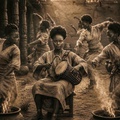
Èmi ni ìlù.
I am the drum.
Not because I am loud.
But because silence has never been my home.
I was carved from wounded wood,
stretched by patient hands,
tightened by fire,
until pain itself
learned how to sing.
...
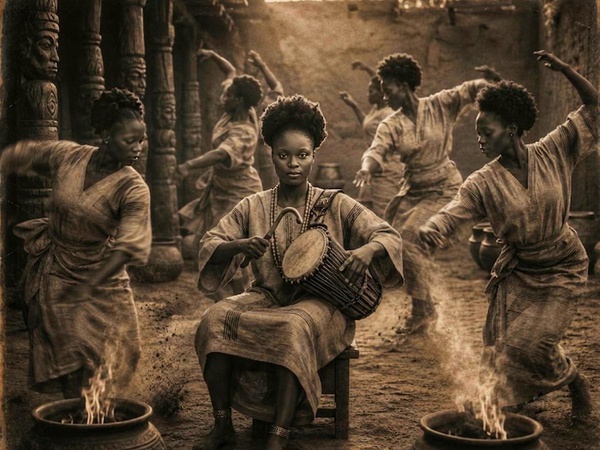
The feast began before sunrise.
They brought wine.
They brought yam.
The pots sang over open fire.
Children chased the morning through red earth,
their feet teaching dust
how to dance.
The elders arrived,
their stories tucked beneath their tongues.
Then someone asked,
"Who remembered the drum?"
The courtyard fell still.
For even joy
knows its place.
It does not begin
until rhythm
gives it permission.
...
Strike me,
and I speak.
Carry me,
and I announce arrival.
Leave me in a corner,
and I wait,
not in bitterness,
but in certainty.
For every village remembers
where it kept
its heartbeat.
...
Some believed
that hiding the drum
would silence the song.
They forgot.
Rhythm
is stubborn.
It escapes through palms.
It escapes through footsteps.
It escapes through children
who have never seen
the old dances,
yet somehow
know exactly
where to place their feet.
You may hide the drum.
But you cannot imprison
its rhythm.
...
When a child enters the world,
they look for me.
When lovers become one,
they call for me.
When warriors return,
I speak before they do.
When kings wear crowns,
my voice reaches the people
before their faces ever can.
Even grief
borrows my heartbeat.
For sorrow,
too,
refuses
to bury its dead
in silence.
...
I am the talking drum
of my fathers.
The whisper
of my mothers.
The echo
of those whose names
were never written,
yet still live
inside every rhythm
I carry.
Their breath
did not leave the earth.
It became sound.
And I...
I became
its keeper.
...
Some looked at me
and saw only wood.
Others saw rope.
Some saw skin
pulled too tightly.
None of them
heard the stories
sleeping beneath my surface.
Not everything sacred
announces itself.
Some things
wait
for listening ears.
...
There were days
I doubted my own sound.
Days
I mistook quietness
for absence.
Days
I believed
the world
had forgotten me.
Then somewhere,
beyond my seeing,
someone danced
to a rhythm
I thought
had died.
And I remembered.
The drum
does not chase ears.
Its sound
finds them.
...
Call me forgotten.
Time remembers.
Call me ordinary.
Tradition disagrees.
Call me small.
Then watch
how whole villages
change direction
at the sound
of my voice.
...
For what is a people
without remembrance?
What is dancing
without rhythm?
What is celebration
without something
strong enough
to gather strangers
into one heartbeat?
...
So today,
I do not wait
for another mouth
to tell me
who I am.
I have listened
to my own echo.
I have heard
my ancestors
answer back.
And that...
is enough.
Mò fẹ́ kí ara mi gbọ́ mi.
Let my soul hear me.
The rest...
will follow.



 288