There are some people you meet in life and forget.
And there are some people you see repeatedly without knowing that, years later, their story will teach you something about life.
When I was in secondary school, there was a man I used to see almost every morning on my way to school.
My school was not far from where he usually stayed.
He was not an old man. He was educated.
He had gone to university and had qualifications.
At that point in his life, things were simply not working for him.
He struggled.
Sometimes, he needed help.
But there was something different about him.
He was always willing to help others with what he had.
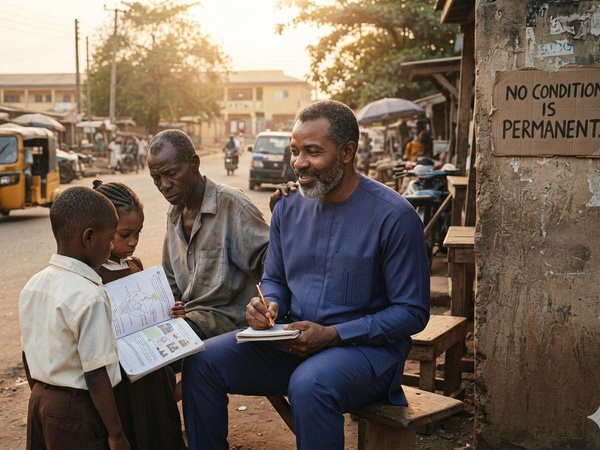
If children in the neighbourhood were struggling with their assignments, he would sit with them and explain.
If there was community work, he would show up. He did not say, “I am poor, so I cannot contribute.”
He contributed his time.
He contributed his knowledge.
He contributed himself.
And the children liked him.
Some parents began noticing that their children understood certain things better after spending time with him.
People started asking questions.
“You went to school?”
“Yes.”
“What did you study?”
They began to realise that the man they had seen sitting by the roadside was not empty.
He had knowledge.
He had ability.
He simply had not found the opportunity to turn those things into a stable life.
Then there was another man in that same neighbourhood.
Around that time, he was one of the people everyone looked up to.
He had money.
He had expensive cars.
He went to parties, clubs and lived a lifestyle that made people believe he had figured life out.
Some parents would even look at him and say, “I want my child to become successful like this man.”
But money had changed the way he saw people.
When the struggling man came to him for help, he could insult him.
Sometimes, he would tell people not to give him money.
“Let him go and work.”
“I worked for my money.”
“He should stop begging.”
The words were painful.
The man would walk away.
Sometimes he would sit somewhere quietly, and you could see that the words had hurt him.
But he kept going.
He kept helping the children.
He kept showing up when the community needed people.
Eventually, someone saw what others had overlooked.
That connection became an opportunity.
The man got work.
Then another opportunity came.
His situation began to change.
He improved himself.
He worked.
He became more confident.
He started earning.
He took better care of himself.
The same man people once saw as someone who needed help was gradually becoming someone who could help others.
Years passed.
And then life did what life sometimes does.
The rich man who once had everything began to lose things.
His business went down.
The lifestyle became difficult to maintain.
The cars disappeared.
The money became a problem.
The things he once spent freely on were no longer there.
People who used to surround him began disappearing too.
Eventually, he needed help.
Somehow, the person he had once looked down on was now in a position to give it.
*The former beggar had become a giver.*
*The former giver had become the one asking.*
That is where the story becomes bigger than the two men.
Because when the man who had once insulted him eventually came to ask for help, he could have reminded him of everything.
He could have said:
“You remember when you told people not to give me money?”
“You remember when you called me lazy?”
“You remember when you chased me away?”
But he didn't.
He simply asked what he needed.
And he helped.
That part of the story stays with me.
Sometimes, the greatest evidence that you have changed is not that you now have more money.
It is that having more money has not made you become the person who once made your difficult days harder.
**No condition is permanent.**
The person asking for help today may be the person giving help tomorrow.
The person giving today may need help tomorrow.
And poverty does not always mean laziness.
Wealth does not always mean wisdom.
A person's present condition cannot tell you everything about their ability, their history, or where their life is going.
So if you have money today, use it with kindness.
If you have influence, use it to open a door for someone.
If you have knowledge, share it.
If someone comes to you for help, don't automatically assume that they are lazy, unserious or responsible for every difficulty they are facing.
Sometimes, people are fighting circumstances you know nothing about.
If you are the one struggling today, don't let your present situation convince you that you have nothing to offer.
You may have knowledge.
You may have a skill.
You may have an idea.
You may just need one person to notice what you can do.
I still think about that man sometimes.
Not because he became rich.
But because when life finally gave him the opportunity to become the person who could give:
he did not use his new position to punish the people who once looked down on him.
Perhaps that is the kind of success worth having.
Not just having enough to give.
But having enough character to remember what it felt like to need.


 97