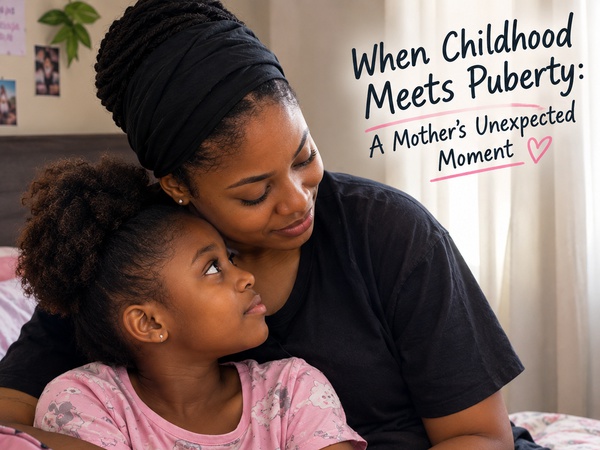
When Childhood Meets Puberty: A Mother’s Unexpected Moment
This morning, I realised my little baby is not as little as I still imagine her to be. 🥹
She started her period.
My first reaction was honestly, “Wait… already?” 😭
She’ll be 10 in December.
Ten!
I looked at her and suddenly remembered the little girl who still enjoys playing, watching cartoons, doing her homework, and disturbing everyone in the house. 😂
In my mind, I still had time.
I thought there would be a few more years before I had to sit her down and explain periods, sanitary pads, body changes, and all the things that come with puberty.
But this morning, her body reminded me that children don't always grow according to the timetable we create in our heads.
I won't lie—I was caught off guard.
A part of me wanted to protect her from growing up so quickly. Another part of me knew that what she needed wasn't a worried mother; she needed a calm mother who could guide her.
So I sat with her.
I explained that menstruation is a normal part of growing up. I made sure she knew she wasn't sick, injured, or dirty. I showed her how to use a pad and explained that she could always talk to me whenever she felt confused or uncomfortable.
And while I was talking to her, something struck me.
Maybe the most important thing isn't how early or late puberty comes. It's whether our children are prepared when it does.
That's where we, as parents, need to do better.
Don't wait until your daughter sees blood before explaining menstruation.
Start the conversation gradually.
Tell her that her body will change as she grows. Let her know that breasts may develop, body hair may appear, and eventually, she may begin having periods.
Teach her what menstruation means in words she can understand.
Show her how to use sanitary pads instead of simply telling her to “figure it out.”
Keep a few pads and spare underwear in her school bag because sometimes these things happen when mummy isn't around.
And please, don't make her feel ashamed.
A period isn't dirty.
It isn't something that makes a girl suddenly become an adult.
And it certainly isn't something she should be afraid to talk about.
Let your daughter ask questions—even the awkward ones.
Because if she can't talk to you about her changing body, she will eventually look for answers somewhere else.
And the conversation shouldn't end after her first period.
As she grows, we should gradually talk about personal hygiene, body boundaries, emotions, relationships, consent, and taking care of herself.
Today, I'm still looking at my little baby and thinking, “How did you grow up this fast?” 🥹❤️
But perhaps motherhood isn't about keeping our children little forever.
It's about preparing them for every new stage while reminding them:
“You are growing, but you will never have to figure it all out alone.”
Parents, let's start these conversations before our children need them.
Because sometimes, preparing a child is one of the quietest and most powerful ways to love them. ❤️


 134