Score |
231


Thatdarkwriter

 Fashion model/crochet artist @ Lagos State University
Fashion model/crochet artist @ Lagos State University



Religion: The authority without a face
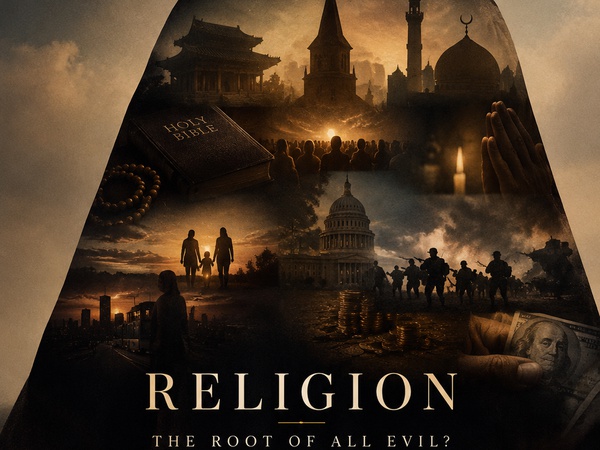
<p><br/></p><p>Religion can be a source of comfort, community, and strength. A place where people turn for meaning when life feels uncertain. But that same comfort can also shape the way people behave, the choices they consider acceptable, and the rules they believe others should follow. You’d think money is the root of all evil until you meet religion.</p><p>There is something fascinating about an entity with no single face, body, or voice, yet it commands the attention, loyalty, fear, and obedience of billions of people.<br/></p><p>Think about it.<br/></p><p>Really think about it</p><p>Religion can influence what you eat, what you wear, who you marry, who you love, how you raise your children, how you vote, and even how you feel about yourself.<br/></p><p>You do not always have to be a believer to feel that influence. You can leave a religion and still carry the shame it taught you. You can reject its teachings and still question your own morality because of them. You can live in a society where decisions about your life are shaped by what others believe God wants.<br/></p><p>That is power.<br/></p><p>Not always the power to force you, but the power to shape what you choose before you even realise you are choosing.<br/></p><p>It often begins personally. A rule becomes a habit. A warning becomes guilt. A teaching becomes an inner voice that tells you what is acceptable, shameful, pure, or sinful.<br/></p><p>“You didn’t go to church today. You’re a sinner.”<br/></p><p>Nobody has to stand over you while you make a decision. You may already be thinking about the punishment, shame, disappointment, or eternal consequences that could follow if you make the “wrong” choice.<br/></p><p>Sometimes, nobody even has to tell you that you are wrong. You have simply been taught that questioning itself is wrong.<br/></p><p>Before anyone thinks I am attacking religion, let me be clear: I am not arguing against the existence of God, and I am not saying every religious person is gullible or every religious leader is a fraud.<br/></p><p>People find comfort, hope, community, and strength in religion. For many, faith is deeply personal, and that deserves respect.<br/></p><p>But respecting what religion means to people does not mean we should ignore what it does in society. Those are two different conversations, yet we often treat them as one.<br/></p><p>Question a religious institution, and someone may call it an attack on their faith. Question a religious leader, and someone may accuse you of disrespecting God. Ask why a rule exists or who benefits from it, and suddenly the conversation is no longer about your question. It becomes about your character, your intentions, or the state of your soul.<br/></p><p>Convenient, isn’t it?<br/></p><p>Once an idea is wrapped in religion, questioning it can be treated as an offence. It gains a kind of authority that can make even a harmful idea seem automatically right.<br/></p><p>That is how personal belief can become social control. Religion can turn beliefs into rules, rules into expectations, and expectations into standards by which entire communities judge one another.<br/></p><p>Picture a Monday morning on a crowded bus. You are trying to get to work when someone stands up and starts preaching loudly. You cannot complain without being made to feel as though you are committing a sin.<br/></p><p>The preacher has no official authority over anyone on that bus. They do not own it, employ the passengers, or have the right to expect everyone to share their beliefs. Yet the atmosphere can still make people afraid to disagree, especially when disagreement is treated as resistance to God.<br/></p><p>It is a small, ordinary moment, but it reveals something important: authority does not always depend on formal power. Sometimes it depends on the fear of appearing immoral, disrespectful, or condemned.<br/></p><p>So how much of our obedience comes from what someone can physically do to us, and how much comes from what we have been taught to fear?<br/></p><p>That question goes far beyond a bus.<br/></p><p>It follows us into our homes, schools, relationships, workplaces, politics, and laws. It appears wherever beliefs are given enough power to decide what people are allowed to question, whom they are allowed to love, how they are expected to behave, and which choices are considered legitimate.<br/></p><p>At that point, religion is no longer only a private belief. It has become part of the structure of everyday life.<br/></p><p>Power does not always wear a uniform or sit in a government office. Sometimes it arrives as tradition. Sometimes it speaks from a pulpit. Sometimes it is repeated by a parent who truly believes they are doing what is best.<br/></p><p>And sometimes it becomes so normal that people stop seeing it as power at all.<br/></p><p><br/></p><p>They simply call it the way things are.</p><p><br/></p><p>But how did it get that way? Who shaped these rules? How did private beliefs become public expectations? And what happens when people stop questioning the authority behind them?</p><p><br/></p><p>To understand that, we have to look beyond individual faith and examine the history, institutions, and power structures that helped religion become more than <a class="tc-blue external-link" href="https://belief.sometimes" rel="noopener noreferrer" target="_blank">belief.sometimes </a> it becomes so normal that people stop seeing it as power at all.</p><br/>


 17
17


More in this series
More insights from Thatdarkwriter







Contributor Points
Points-to-Coupons

Referral Earning
Insights for you.


POV: That Old Serpent
"And I will put enmity Between you and the woman, And between your seed and her Seed;He...
399 views
45 upvotes
35 comments

My Body: God's Temple
My pastor doesn't know the difference between my last thought and my current, but what ...
405 views
36 upvotes
46 comments
POV: Being Mary For Easter
"Hail Mary, full of grace, the Lord is with you. Blessed are you among women and blesse...
347 views
40 upvotes
32 comments

between me and God
There are things I have asked You for so many times that I am beginning to feel embarra...
172 views
29 upvotes
33 comments
POV: Judas Iscariot
"And truly the Son of Man goes as it has been determined, but woe to that man by whom H...
394 views
40 upvotes
24 comments


WHISPERS OF FREEDOM: WE MOVE.
That night, my father brought the lamb inside.Hope stood in the house with us and follo...
159 views
28 upvotes
29 comments

Steeze
About two decades ago, I had a memorable experience. I still remember it vividly. My fr...
129 views
21 upvotes
25 comments

THE UNHEARD POV: Joseph On Easter.
PROLOGUE…Some question my presence…They ask, “Where was Joseph at the crucifixion?”Many...
315 views
17 upvotes
17 comments

The Overlooked Controversy: Unpacking...
Atheism, a topic of intense debate, remains surprisingly overlooked in public discussio...
668 views
32 upvotes
19 comments
Raise Da Roof
There were four brothers. Actually, they aren’t related by blood, maybe something else....
103 views
19 upvotes
22 comments