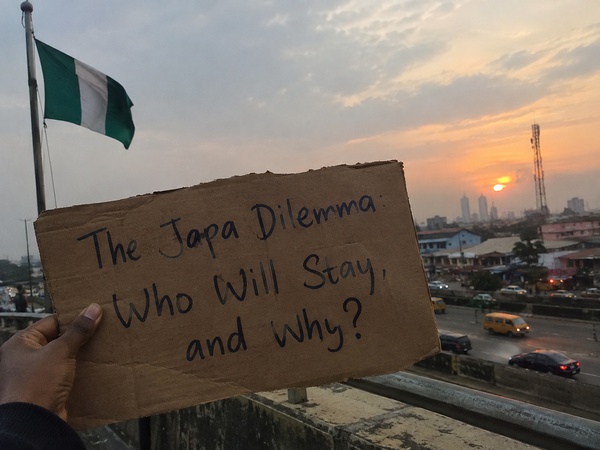
Everytime a Nigerian says, "I want to japa" somebody somewhere respond
"If everybody leaves, na who go remain?"
"Who go fix Nigeria?"
A reasonable question it is .
But then, we need to ask ourselves,
"If everybody stays, who takes responsibility for making staying worth it?"
For years, we have been taught to love our country, believe and remain "loyally" committed to our country.
And that is commended as PATRIOTISM.
It is quite a good thing loving something despite its imperfections . But are we to associate "endurance' with patriotism ?
Do we turn our love to a personal goal and achievement?
Nigeria has almost the brightest, hardworking and most creative people in the world . Emphasis on the YOUTHS . They are one of the most intelligent and energetic humans in the world .
And with all of these, they live in a place where basic systems are unreliable - electricity, jobs employment, healthcare, education and other necessary infrastructure
So when a young graduate looks at another country and thinks, “Maybe I can build the life I want there,” is that necessarily betrayal?
I don't think so.
Sometimes, Japa is not a rejection of Nigeria. It is a search for possibility.
A doctor who leaves for better working conditions is not automatically someone who hates Nigeria.
A student who dreams of studying, working and eventually building a stable life elsewhere is not automatically unpatriotic.
People have dreams .
And fulfilling that dream is not a badge to being unpatriotic neither does the dream makes one a illegitimate because he or she was born in Nigeria
We should note also that, Nigerians abroad can still make contributions without compulsorily returning back to the country.
They can contribute through investments, businesses and creating opportunities for those back home
So perhaps we need to stop treating those that intend to JAPA or already did ,as them being *UNPATRIOTIC*
You can be in another country and still love your country.
You can stay in your country and still criticize it
Nigeria is 66.
At 66, perhaps the country should not only ask its children, “What will you do for me?”
Perhaps we should finally be asking:
“What have we built that will make our children want to stay?”
Because if leaving is the dream of millions of young Nigerians, maybe the conversation should not only be about why they want to leave.
Maybe we should also ask why staying has become so difficult to imagine.
And perhaps that is the real Japa dilemma.



 147