Score |
30


Amorr
 Student @ Obafemi Awolowo University
Student @ Obafemi Awolowo University



THE STIGMA MUST GO!!!
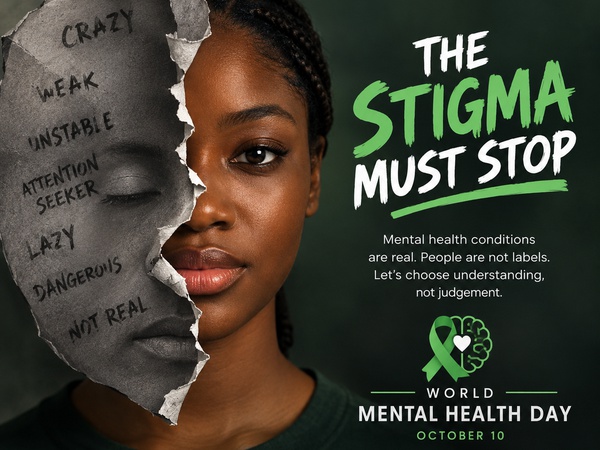
<p>SPEAKING UP CREATES REAL CHANGE</p><p><br/></p><p>As someone who has experienced poor mental health myself, I understand what it means to not be okay. I know what it feels like to be overwhelmed by so many thoughts, feelings and emotions at the same time.</p><p><br/></p><p>When a person is going through a lot, it takes a lot to even consider sharing those feelings with other people.</p><p><br/></p><p>So, does sharing our mental health stories publicly create real change, or does it carry risks that outweigh the benefits?</p><p><br/></p><p>I am a supporter of people who open up because I know what it took for them to speak up in the first place.</p><p><br/></p><p>In the age of social media, a space where people share almost every part of themselves, where young people come online and say what is on their minds, I believe sharing our mental health stories can create real change.</p><p><br/></p><p>In 2025, a study on the public disclosure of mental health problems on social media, involving 803 adults, found that 74.97% of participants reported reduced stigma around the perception that people with mental health problems were “weak or not really sick,” while 78.33% reported reduced perceptions that people with mental health problems were dangerous or unpredictable. Among participants who observed comments on mental health disclosures, 69.51% reported seeing other users make similar disclosures.</p><p><br/></p><p>The study was conducted by researchers affiliated with the University of Melbourne, including the Centre for Mental Health and Community Wellbeing and the Nossal Institute for Global Health, including Zhang and colleagues.</p><p><br/></p><p>There is also the concept of reciprocal self-disclosure: the idea that when one person shares something personal, it can encourage another person to share something personal in return.</p><p><br/></p><p>This matters because one person's courage to speak can become another person's permission to speak.</p><p><br/></p><p>The evidence suggests that publicly sharing mental health stories can contribute to real change, even if that change is gradual. But there is another side to this argument. There is also evidence that publicly sharing mental health stories can carry serious risks.</p><p><br/></p><p>That does not mean we should remain silent.</p><p><br/></p><p>It means we have to learn how to speak, how to listen and how to respond.</p><p><br/></p><p>THE STIGMA MUST GO</p><p><br/></p><p>The stigma that forces people to remain silent even when they are slowly falling apart has to end.</p><p><br/></p><p>People need to speak up when it matters.</p><p><br/></p><p>No more:</p><p><br/></p><p>“It is happening to everyone. It is not only you.”</p><p><br/></p><p>“My dear, everyone has problems they are facing.”</p><p><br/></p><p>“Just pray. You will be fine.”</p><p><br/></p><p>“Ah, the devil is at work.”</p><p><br/></p><p>The biggest problem this country has faced, and continues to face, no matter how small some people might consider it, is ignorance.</p><p><br/></p><p>Because when we say “mental health,” what exactly are we talking about?</p><p><br/></p><p>Why is it that when someone comes to you to talk about their emotional or psychological well-being, the first assumption is that they are simply reacting to how difficult life in Nigeria is?</p><p><br/></p><p>Many people fail to understand what poor mental health can actually involve. They reduce it to stress, financial difficulties or the general hardship of living in Nigeria.</p><p><br/></p><p>But psychological distress can be much more complex than that.</p><p><br/></p><p>When someone comes to you and tells you that they are struggling with their mental health, do not assume that they are simply looking for somewhere to complain about their problems.</p><p><br/></p><p>Whatever they are telling you may be much bigger than the problem you can see.</p><p><br/></p><p>People experience mental-health difficulties in different ways. Some may experience persistent anxiety or depression. Some may withdraw from society and build walls around themselves. Some may struggle with thoughts of self-harm or suicide. Others may experience conditions that profoundly affect their perception, behaviour, relationships or sense of self.</p><p><br/></p><p>So stop saying:</p><p><br/></p><p>“Everyone is going through one thing or the other.”</p><p><br/></p><p>Not because it is completely untrue, but because it is only a partial truth.</p><p><br/></p><p>Yes, everyone experiences difficulties.</p><p><br/></p><p>But not everyone's difficulties affect them in the same way.</p><p><br/></p><p>And when we use the struggles of everyone else to dismiss the suffering of one person, we are no longer offering comfort. We are teaching that person to remain silent.</p><p><br/></p><p>So please, let's stop the stigma.</p><p><br/></p><p>THE REALITY</p><p><br/></p><p>Publicly sharing mental health stories can create real change.</p><p><br/></p><p>But as beneficial as social media can be to this change, it can also become one of the biggest factors hindering that very change.</p><p><br/></p><p>WHO/Europe has highlighted that media coverage of mental health can have positive effects, including reducing stigma and encouraging people to seek help. However, media coverage can also cause harm when stories reinforce harmful stereotypes, sensationalise self-harm or suicide, or oversimplify complex mental-health situations.</p><p><br/></p><p>And this is where the reality becomes complicated.</p><p><br/></p><p>The purpose of publicly sharing mental health stories is to change how people understand mental health, challenge stigma and make it easier for people to seek help.</p><p><br/></p><p>But we live in an age where almost everything can become a trend.</p><p><br/></p><p>People follow trends for likes.</p><p><br/></p><p>People share stories for followers.</p><p><br/></p><p>People sometimes turn other people's pain into content.</p><p><br/></p><p>Sincerity can disappear beneath performance.</p><p><br/></p><p>And when that happens, the same platform that gives someone a voice can also expose them to judgement, ridicule, misinformation, exploitation and even further psychological harm.</p><p><br/></p><p>So the question is not simply whether we should share our stories.</p><p><br/></p><p>The question is what happens after we share them.</p><p><br/></p><p>Do we listen?</p><p><br/></p><p>Do we believe people?</p><p><br/></p><p>Do we encourage them to seek appropriate help?</p><p><br/></p><p>Do we protect their privacy?</p><p><br/></p><p>Do we challenge the stigma that made them afraid to speak in the first place?</p><p><br/></p><p>Or do we watch, comment, scroll and move on?</p><p><br/></p><p>Real change cannot happen through hashtags alone.</p><p><br/></p><p>It cannot happen simply because one person's story receives thousands of views.</p><p><br/></p><p>It happens when those stories change the way we respond to people in the real world.</p><p><br/></p><p>When we stop dismissing someone because “everyone has problems.”</p><p><br/></p><p>When we stop treating mental illness as weakness.</p><p><br/></p><p>When we stop turning someone's pain into entertainment.</p><p><br/></p><p>When we make room for people to speak without immediately judging them.</p><p><br/></p><p>And when we fight not only for the right to tell our stories, but also for the care, dignity and support that should follow when we do.</p><p><br/></p><p>Publicly sharing our mental health stories can create real change.</p><p><br/></p><p>But the story cannot end with the post.</p><p><br/></p><p>The real change begins with what we do after we hear it.</p><p><br/></p><p>REAL VOICES. REAL CHANGE.</p>
Competition entry
|
WORLD MENTAL HEALTH DAY: REAL VOICES, REAL CHANGE - SHOULD WE SHARE OUR STORIES?


 11
11


Other insights from Amorr






Contributor Points

Points-to-Coupons

Referral Earning

Insights for you.



Silence: The things we don't say.🥺
I walked out of my house, shutting the door behind me, and moved to the terrace.I neede...
254 views
60 upvotes
64 comments
Suicide: The Permanent Solution.
“Did you regret it?”“You know…”I hesitated.“What happened?”A heavy sigh was the first r...
269 views
51 upvotes
54 comments

Suicide: The Nigerian perspective.
As we all know, this month, September is Suicide Prevention Month.Today, I'll be talkin...
167 views
46 upvotes
66 comments


2 a.m.
Maybe it's all the nights I spent not sleepingOr all the days I sat thinkingOf how I've...
270 views
52 upvotes
50 comments
Yours in the Empty
Losing a father is one thing,Losing a best friend is another.Losing the "head" is one t...
418 views
60 upvotes
44 comments


I’m Skinny, and So What?
What if I told you that I have cried more over my own arms than over any guy who has ev...
237 views
49 upvotes
51 comments


Shocking Generosity.
Dear Mr. Smith,Good afternoon, sir. I hope this letter meets you well.I write to profus...
136 views
46 upvotes
43 comments


After Alhaji
"Kai, yarinyar nan ta yi sa'a ƙwarai.""Wallahi. Alhaji Ibrahim da kansa zai aura ta.""T...
292 views
37 upvotes
44 comments


One step forward, Three steps back
I'm tired...But not for the reason you're thinking How much more must life take?How muc...
448 views
51 upvotes
41 comments