Score |
76


Galton
 Student @ University of Lagos
Student @ University of Lagos



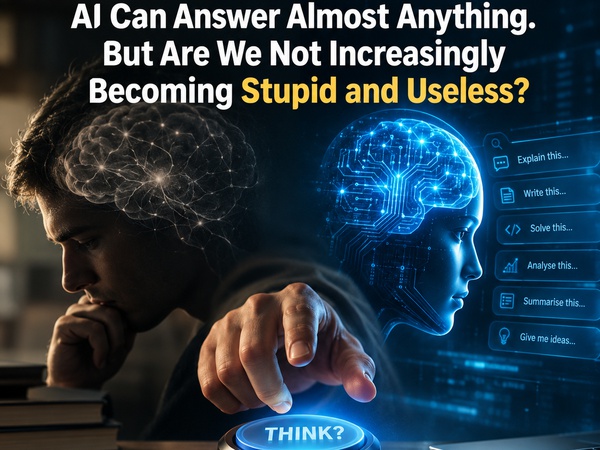
AI Can Answer Almost Anything. But Are We Not Increasingly Becoming Stupid and Useless?
<p>The more artificial intelligence learns to think for us, the more important it becomes that we remember how to think for ourselves.</p><p><br/></p><p>There is something strange happening.</p><p><br/></p><p>We are living in a time when a person with a smartphone can access more information in seconds than previous generations could access in weeks. Artificial intelligence can explain difficult subjects, write essays, solve mathematical problems, generate ideas, analyse documents, write computer code and even argue both sides of a debate.</p><p><br/></p><p>Yet, somehow, having access to all this intelligence does not necessarily mean we are becoming more intelligent.</p><p><br/></p><p>Maybe the uncomfortable question is this:</p><p><br/></p><p>As AI becomes better at thinking, are we becoming worse at it?</p><p><br/></p><p>We are becoming very good at asking machines to think</p><p><br/></p><p>Consider how quickly our behaviour is changing.</p><p><br/></p><p>Someone receives an assignment and immediately asks AI to answer it.</p><p><br/></p><p>Someone encounters a difficult word and asks AI for its meaning.</p><p><br/></p><p>Someone has an argument and asks AI who is right.</p><p><br/></p><p>Someone has an idea and asks AI to develop it.</p><p><br/></p><p>Someone needs to write an email and asks AI to write it.</p><p><br/></p><p>Someone encounters a technical problem and asks AI for the solution before attempting to understand the problem.</p><p><br/></p><p>None of these things is inherently wrong.</p><p><br/></p><p>The problem begins when using AI stops being assistance and becomes substitution.</p><p><br/></p><p>There is a difference between using AI to improve your thinking and using AI because you no longer want to think.</p><p><br/></p><p>That difference could determine whether AI becomes one of humanity's greatest tools or one of our greatest intellectual crutches.</p><p><br/></p><p>The evidence is beginning to raise questions</p><p><br/></p><p>A 2025 study published in the proceedings of the ACM CHI Conference surveyed 319 knowledge workers and collected 936 examples of their real world generative AI use.</p><p><br/></p><p>The researchers found that greater confidence in AI was associated with less reported critical thinking effort. They also found that AI changed the nature of critical thinking. Instead of generating ideas and solving problems from scratch, people increasingly spent their effort verifying and integrating AI generated responses.</p><p><br/></p><p>That distinction is important.</p><p><br/></p><p>Checking an answer is not always the same as knowing how to arrive at the answer.</p><p><br/></p><p>If AI consistently gives us the first draft, the first idea, the first solution and the first explanation, we may gradually lose opportunities to practise generating those things ourselves.</p><p><br/></p><p>And skills that are not exercised can deteriorate.</p><p><br/></p><p>Another 2025 study involving 666 participants reported a negative relationship between frequent AI tool use and critical thinking performance, with cognitive offloading playing a mediating role. However, that study was observational in nature, so it should not be interpreted as proof that AI use itself causes people to become less intelligent.</p><p><br/></p><p>That distinction matters because the story is not as simple as saying AI makes people stupid.</p><p><br/></p><p>AI can actually make us better</p><p><br/></p><p>This is where the conversation becomes more interesting.</p><p><br/></p><p>AI is not inherently anti intelligence.</p><p><br/></p><p>A 2025 quasi experimental study involving 240 first year university students found that structured AI assisted writing, where students were required to critique, analyse and reflect on AI outputs, was associated with greater improvements in critical thinking assessments than traditional instruction in that study.</p><p><br/></p><p>A separate field experiment involving 758 knowledge workers found that AI assistance improved performance on many of the tested knowledge tasks. Workers using GPT 4 completed more tasks, completed them faster and produced higher quality solutions on the tasks within the study's AI capability range.</p><p><br/></p><p>So AI clearly has the potential to make people more productive.</p><p><br/></p><p>The question is what we do with the productivity it gives us.</p><p><br/></p><p>Do we use the extra capacity to think about harder problems?</p><p><br/></p><p>Or do we simply use AI to avoid thinking altogether?</p><p><br/></p><p>The danger is not ignorance. It is intellectual laziness.</p><p><br/></p><p>Imagine two students.</p><p><br/></p><p>The first student asks AI:</p><p><br/></p><p>«“Give me the answer.”»</p><p><br/></p><p>The second asks:</p><p><br/></p><p>«“Here is how I approached the problem. Show me where my reasoning fails.”»</p><p><br/></p><p>Both are using AI.</p><p><br/></p><p>But they are developing completely different relationships with it.</p><p><br/></p><p>The first is outsourcing the thinking.</p><p><br/></p><p>The second is using the machine as an intellectual opponent.</p><p><br/></p><p>That difference is enormous.</p><p><br/></p><p>If we constantly ask AI to formulate our thoughts, we may eventually become uncomfortable when we have to formulate them ourselves.</p><p><br/></p><p>If we constantly ask AI to solve our problems, unfamiliar problems may begin to feel impossible without it.</p><p><br/></p><p>If we constantly ask AI to explain everything, we may stop developing the patience required to struggle with difficult ideas.</p><p><br/></p><p>And that struggle matters.</p><p><br/></p><p>Learning is not always supposed to feel effortless.</p><p><br/></p><p>Sometimes the frustration, confusion and failed attempts are precisely what force the brain to build understanding.</p><p><br/></p><p>The most dangerous AI mistake may be believing it because it sounds intelligent</p><p><br/></p><p>AI can produce remarkably convincing answers.</p><p><br/></p><p>That is both its strength and its danger.</p><p><br/></p><p>A polished answer can create the impression that the underlying reasoning must also be sound.</p><p><br/></p><p>But an AI system can be confidently wrong.</p><p><br/></p><p>It can misunderstand a question.</p><p><br/></p><p>It can accept a false premise.</p><p><br/></p><p>It can produce a fabricated citation.</p><p><br/></p><p>It can make a calculation error.</p><p><br/></p><p>It can give an answer that sounds sophisticated while completely missing the point.</p><p><br/></p><p>The person using it therefore needs something the machine cannot simply provide:</p><p><br/></p><p>judgment.</p><p><br/></p><p>You need enough knowledge to question the answer.</p><p><br/></p><p>You need enough reasoning ability to notice contradictions.</p><p><br/></p><p>You need enough curiosity to verify the claim.</p><p><br/></p><p>And you need enough confidence to tell the machine:</p><p><br/></p><p>“No. That doesn't make sense.”</p><p><br/></p><p>This is where “stupid and useless” becomes a serious question</p><p><br/></p><p>Calling humans “stupid and useless” sounds deliberately harsh.</p><p><br/></p><p>But perhaps that is exactly why the phrase deserves examination.</p><p><br/></p><p>Imagine a future worker who cannot write without AI.</p><p><br/></p><p>Cannot research without AI.</p><p><br/></p><p>Cannot analyse without AI.</p><p><br/></p><p>Cannot solve unfamiliar problems without AI.</p><p><br/></p><p>Cannot distinguish a convincing answer from a correct one without AI.</p><p><br/></p><p>What happens when the AI is unavailable?</p><p><br/></p><p>The person may still possess qualifications, certificates and access to enormous amounts of information.</p><p><br/></p><p>But how much can they actually do independently?</p><p><br/></p><p>That is the uncomfortable part.</p><p><br/></p><p>A person can have access to extraordinary intelligence and still become intellectually dependent.</p><p><br/></p><p>And dependence is not the same thing as intelligence.</p><p><br/></p><p>We should not reject AI. We should refuse to surrender our brains to it.</p><p><br/></p><p>The answer is not to return to a world without AI.</p><p><br/></p><p>That is neither realistic nor desirable.</p><p><br/></p><p>AI can help us learn faster, work faster and solve problems that would previously have consumed enormous amounts of time.</p><p><br/></p><p>But we need boundaries.</p><p><br/></p><p>Sometimes, solve the problem yourself before asking AI.</p><p><br/></p><p>Sometimes, write the first draft without it.</p><p><br/></p><p>Sometimes, read the source instead of asking for a summary.</p><p><br/></p><p>Sometimes, argue with the answer.</p><p><br/></p><p>Ask AI to challenge your assumptions rather than simply confirming them.</p><p><br/></p><p>Use it as a tutor, critic, researcher and collaborator.</p><p><br/></p><p>Not as a replacement for your own mind.</p><p><br/></p><p>Because the ultimate question of the AI age may not be whether machines become smarter than humans.</p><p><br/></p><p>They probably will, in many areas.</p><p><br/></p><p>The more important question is whether humans will remain capable of thinking when the machines are not thinking for them.</p><p><br/></p><p>AI can answer almost anything.</p><p><br/></p><p>But if we eventually stop asking “Why?”, “How?”, “Is this true?” and “Does this make sense?”, then we may discover an uncomfortable paradox:</p><p><br/></p><p>We built machines to make humanity more capable, only to become less capable ourselves.</p><p><br/></p><p>The future should not belong to people who can do everything without AI.</p><p><br/></p><p>Nor should it belong to people who can do nothing without it.</p><p><br/></p><p>It should belong to people who know when to use artificial intelligence and when to use their own.</p>


 57
57


Other insights from Galton












Contributor Points

Points-to-Coupons

Referral Earning

Insights for you.


My Unpopular opinions of Social Media.
I Really Hate Social MediaWait, hear me out.I'm not saying this from a place of pride o...
241 views
33 upvotes
40 comments


Meet Amina the AI
Well yes, the image attached to this post was created with DALLE. After some interestin...
1475 views
19 upvotes
12 comments

If You Can’t Beat Them, Join Them
I didn’t experience the “before.” Before landlines, before phones, before mobile money—...
322 views
28 upvotes
25 comments


Grandpa lied (A little)
"Grandpa said, farming pays and not even your AI can take that away" that was my cousin...
337 views
25 upvotes
26 comments


Social Media vs Reality – Let’s Be Fo...
Let’s talk. Be honest, have you ever looked at someone’s Instagram story and immediatel...
442 views
15 upvotes
15 comments

Are we becoming who we are, or who we...
We are shaped long before we realize itby things we do not question,by voices we do not...
307 views
19 upvotes
20 comments


Three (3) reasons why AI is losing to...
This article explains how Google's new policy affects AI-written content and flagging g...
843 views
18 upvotes
18 comments


Over sharing with a bot : it's not th...
Lately I’ve realized my most stable relationship might actually be with ChatGPT. 😭 I co...
467 views
16 upvotes
16 comments

The Impact Of Social Media vs Books: ...
A social media personality emerged on the internet months ago and a basic small toy tha...
387 views
19 upvotes
15 comments

Tech is the New White Collar Job
Tech is the New White Collar Job
Tech is the new currency; with tech, you can say cr...
1067 views
17 upvotes
11 comments