Score |
53


Galton
 Student @ University of Lagos
Student @ University of Lagos



AI Is Hungry for Electricity. The Next Tech War May Be Fought on the Power Grid.
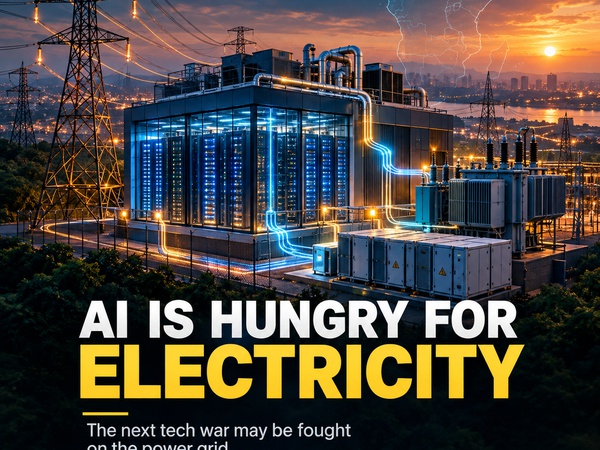
<p>The AI revolution looks digital. Its biggest problem may be painfully physical.</p><p><br/></p><p>When people talk about the artificial intelligence race, the conversation usually revolves around chips, models, data and computing power.</p><p><br/></p><p>NVIDIA. OpenAI. Google. Microsoft. Anthropic.</p><p><br/></p><p>We talk about who has the smartest model, the fastest GPU or the largest data centre.</p><p><br/></p><p>But underneath all that intelligence is something surprisingly ordinary:</p><p><br/></p><p>Electricity.</p><p><br/></p><p>And AI is becoming very, very hungry for it.</p><p><br/></p><p>The hidden cost of asking a machine to think</p><p><br/></p><p>The International Energy Agency reported in 2026 that global electricity consumption from data centres increased by 17% in 2025. AI-focused data centres grew even faster, with electricity consumption rising by 50% in the same year.</p><p><br/></p><p>That is happening while engineers are simultaneously making AI systems more energy-efficient.</p><p><br/></p><p>This sounds contradictory, but it isn't.</p><p><br/></p><p>AI is becoming cheaper to run per task while people are asking it to perform increasingly demanding tasks—and using it far more frequently.</p><p><br/></p><p>A simple text query is one thing.</p><p><br/></p><p>Generating video, running an AI agent through multiple steps, processing large datasets or performing complex reasoning can require dramatically more computing power.</p><p><br/></p><p>The IEA notes that some emerging AI applications can consume hundreds or even thousands of times more energy per query than simple text generation.</p><p><br/></p><p>So the question isn't simply:</p><p><br/></p><p>How intelligent can AI become?</p><p><br/></p><p>There is another question hiding underneath it:</p><p><br/></p><p>How much electricity can we provide for that intelligence?</p><p><br/></p><p>The data centre is becoming an energy problem</p><p><br/></p><p>The world's biggest technology companies are spending enormous amounts of money building the infrastructure required for AI.</p><p><br/></p><p>The IEA says the capital expenditure of five major technology companies exceeded $400 billion in 2025 and is expected to increase by another 75% in 2026.</p><p><br/></p><p>Those investments don't exist in some weightless digital universe.</p><p><br/></p><p>They require land.</p><p><br/></p><p>They require servers.</p><p><br/></p><p>They require cooling.</p><p><br/></p><p>They require transformers.</p><p><br/></p><p>They require transmission infrastructure.</p><p><br/></p><p>And above everything else, they require electricity.</p><p><br/></p><p>The IEA expects global data-centre electricity consumption to roughly double by 2030, while electricity consumption from AI-focused data centres could roughly triple.</p><p><br/></p><p>Suddenly, the AI race starts looking less like a software competition and more like an infrastructure competition.</p><p><br/></p><p>The companies building tomorrow's AI aren't only competing for better algorithms.</p><p><br/></p><p>They are also competing for access to power.</p><p><br/></p><p>The engineering bottleneck nobody puts on the billboard</p><p><br/></p><p>There is an interesting irony here.</p><p><br/></p><p>The world spent years making computing increasingly invisible.</p><p><br/></p><p>You don't need to know where a server is located to send a message. You don't need to see the cables carrying your data. You don't need to understand semiconductor fabrication to ask an AI chatbot a question.</p><p><br/></p><p>But AI is pulling the physical world back into the conversation.</p><p><br/></p><p>The IEA has already identified bottlenecks involving equipment such as transformers and gas turbines, alongside constraints involving chips, grid connections and regulatory approvals.</p><p><br/></p><p>That means electrical engineers, power-system specialists, energy developers, cooling engineers, automation experts and infrastructure planners are becoming part of the AI story whether or not they write a single line of machine-learning code.</p><p><br/></p><p>The future AI engineer may not be sitting alone behind a laptop.</p><p><br/></p><p>Some will be working around substations.</p><p><br/></p><p>Some will be designing cooling systems.</p><p><br/></p><p>Some will be building battery-storage systems.</p><p><br/></p><p>Some will be improving power electronics.</p><p><br/></p><p>Some will be designing smarter grids.</p><p><br/></p><p>Some will be figuring out how to keep a data centre running when the grid doesn't cooperate.</p><p><br/></p><p>That last problem should sound particularly familiar in Nigeria.</p><p><br/></p><p>Nigeria's AI ambition has an electricity question attached to it</p><p><br/></p><p>Nigeria has a young population, a growing technology ecosystem and increasing interest in artificial intelligence.</p><p><br/></p><p>But there is a physical constraint we cannot simply code our way around.</p><p><br/></p><p>According to the World Bank's latest available data, 62.5% of Nigeria's population had access to electricity in 2024.</p><p><br/></p><p>And access is not the same thing as reliable supply.</p><p><br/></p><p>The World Bank's 2026 analysis of electricity access in Nigeria notes that grid unreliability remains a defining problem, with households reporting frequent and prolonged outages.</p><p><br/></p><p>That creates a strange technological paradox.</p><p><br/></p><p>A Nigerian can use one of the world's most sophisticated AI systems from a smartphone while sitting in a country where millions of people still lack electricity access.</p><p><br/></p><p>We can download an AI application in seconds.</p><p><br/></p><p>But powering the physical infrastructure behind advanced AI is a much harder problem.</p><p><br/></p><p>And that distinction matters.</p><p><br/></p><p>Because AI isn't merely a software revolution.</p><p><br/></p><p>It is also an energy revolution.</p><p><br/></p><p>This could actually be an opportunity</p><p><br/></p><p>There is a temptation to look at these numbers and conclude that the energy demand of AI is simply another problem the world has to solve.</p><p><br/></p><p>But problems of this scale also create industries.</p><p><br/></p><p>Data centres need reliable power.</p><p><br/></p><p>Power systems need better monitoring.</p><p><br/></p><p>Microgrids need intelligent control.</p><p><br/></p><p>Solar systems need better storage.</p><p><br/></p><p>Batteries need better management.</p><p><br/></p><p>Transformers need to be deployed and maintained.</p><p><br/></p><p>Cooling systems need to become more efficient.</p><p><br/></p><p>Electricity demand needs to be predicted.</p><p><br/></p><p>Machines need to communicate with one another.</p><p><br/></p><p>And all of those systems need engineers.</p><p><br/></p><p>This is where the AI conversation becomes much more interesting for countries such as Nigeria.</p><p><br/></p><p>Perhaps the opportunity isn't simply to become another country that consumes AI products created elsewhere.</p><p><br/></p><p>Perhaps part of the opportunity is to build the infrastructure that allows the next generation of technology to operate here.</p><p><br/></p><p>That could mean renewable energy.</p><p><br/></p><p>It could mean mini-grids.</p><p><br/></p><p>It could mean battery storage.</p><p><br/></p><p>It could mean automation.</p><p><br/></p><p>It could mean power electronics.</p><p><br/></p><p>It could mean smarter distribution networks.</p><p><br/></p><p>It could mean locally designed systems that make unreliable electricity less disruptive to businesses and communities.</p><p><br/></p><p>AI may therefore create demand far beyond the companies that actually build AI models.</p><p><br/></p><p>The race is getting bigger</p><p><br/></p><p>The IEA says technology companies accounted for around 40% of corporate renewable-power purchase agreements signed in 2025. It also reports growing interest in nuclear and geothermal power as possible sources of electricity for data centres.</p><p><br/></p><p>That tells us something important.</p><p><br/></p><p>The AI industry is beginning to influence the energy industry.</p><p><br/></p><p>And the energy industry, in turn, could determine how quickly AI expands.</p><p><br/></p><p>This is a feedback loop.</p><p><br/></p><p>More capable AI creates more demand.</p><p><br/></p><p>More demand requires more computing.</p><p><br/></p><p>More computing requires more data centres.</p><p><br/></p><p>More data centres require more electricity.</p><p><br/></p><p>More electricity requires generation, transmission, storage and distribution infrastructure.</p><p><br/></p><p>And building that infrastructure requires engineers, capital and time.</p><p><br/></p><p>The chatbot is only the visible part.</p><p><br/></p><p>Behind it is an enormous machine.</p><p><br/></p><p>The next technology giants may not all look like software companies</p><p><br/></p><p>For years, the technology industry taught us to think of innovation primarily in terms of software.</p><p><br/></p><p>Now the boundary is changing.</p><p><br/></p><p>A company developing a better battery-management system could become part of the AI economy.</p><p><br/></p><p>A company developing more efficient cooling could become part of the AI economy.</p><p><br/></p><p>A company improving grid forecasting could become part of the AI economy.</p><p><br/></p><p>A company developing automated energy systems could become part of the AI economy.</p><p><br/></p><p>The line between technology and infrastructure is becoming increasingly difficult to draw.</p><p><br/></p><p>And that is precisely why electrical engineering, energy systems and automation deserve more attention in conversations about the future of AI.</p><p><br/></p><p>The uncomfortable question</p><p><br/></p><p>There is one question we should probably ask before celebrating every new AI breakthrough:</p><p><br/></p><p>Where will the electricity come from?</p><p><br/></p><p>Not metaphorically.</p><p><br/></p><p>Literally.</p><p><br/></p><p>Because the future of artificial intelligence will not exist only inside algorithms.</p><p><br/></p><p>It will exist inside power plants, substations, transformers, batteries, cables, cooling systems and data centres.</p><p><br/></p><p>The IEA expects data-centre electricity consumption to roughly double by 2030.</p><p><br/></p><p>That means the AI revolution is quietly becoming an electrical-engineering problem.</p><p><br/></p><p>And perhaps that is one of the biggest technology stories hiding in plain sight.</p><p><br/></p><p>The companies that build the smartest machines may get the headlines.</p><p><br/></p><p>But the people who figure out how to power, cool, connect and control those machines may determine how far the revolution can actually go.</p><p><br/></p><p>AI may be the brain of the next technological era.</p><p><br/></p><p>But electricity will still be its bloodstream.</p>


 39
39


Other insights from Galton












Contributor Points

Points-to-Coupons

Referral Earning

Insights for you.


My Unpopular opinions of Social Media.
I Really Hate Social MediaWait, hear me out.I'm not saying this from a place of pride o...
251 views
33 upvotes
40 comments

New York City bans AI for children.
AI is a very powerful tool.But should young children have unrestricted access to it?On ...
106 views
29 upvotes
34 comments


Meet Amina the AI
Well yes, the image attached to this post was created with DALLE. After some interestin...
1490 views
20 upvotes
12 comments

If You Can’t Beat Them, Join Them
I didn’t experience the “before.” Before landlines, before phones, before mobile money—...
340 views
28 upvotes
25 comments

Grandpa lied (A little)
"Grandpa said, farming pays and not even your AI can take that away" that was my cousin...
345 views
25 upvotes
26 comments


Social Media vs Reality – Let’s Be Fo...
Let’s talk. Be honest, have you ever looked at someone’s Instagram story and immediatel...
454 views
15 upvotes
15 comments


Are we becoming who we are, or who we...
We are shaped long before we realize itby things we do not question,by voices we do not...
322 views
19 upvotes
20 comments


Three (3) reasons why AI is losing to...
This article explains how Google's new policy affects AI-written content and flagging g...
859 views
18 upvotes
18 comments


Over sharing with a bot : it's not th...
Lately I’ve realized my most stable relationship might actually be with ChatGPT. 😭 I co...
477 views
16 upvotes
16 comments

The Impact Of Social Media vs Books: ...
A social media personality emerged on the internet months ago and a basic small toy tha...
405 views
19 upvotes
15 comments