Score |
47


Galton
 Student @ University of Lagos
Student @ University of Lagos



What Happens When You Stop Telling AI What to Do?
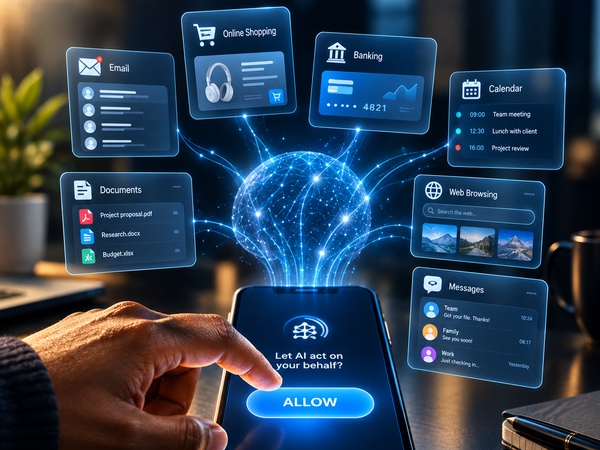
<p>We spent the last few years teaching ourselves how to talk to artificial intelligence.</p><p><br/></p><p>Write a better prompt.</p><p><br/></p><p>Give it context.</p><p><br/></p><p>Tell it exactly what you want.</p><p><br/></p><p>Check its answer.</p><p><br/></p><p>Try again.</p><p><br/></p><p>Now the industry wants us to stop doing all that.</p><p><br/></p><p>It wants us to delegate.</p><p><br/></p><p>That sounds like a small change.</p><p><br/></p><p>It isn't.</p><p><br/></p><p>A chatbot waits for you to ask a question. An AI agent can be given a goal and allowed to figure out the steps itself — opening applications, browsing websites, manipulating files, sending messages, researching information and potentially carrying out transactions.</p><p><br/></p><p>Anthropic describes an agent as a system that can decide for itself how to achieve a user's goal, repeatedly planning, acting, observing the result and adjusting its approach.</p><p><br/></p><p>In other words, we're moving from:</p><p><br/></p><p>“AI, tell me how to do this.”</p><p><br/></p><p>to:</p><p><br/></p><p>“AI, do this for me.”</p><p><br/></p><p>And that second sentence changes the relationship completely.</p><p><br/></p><p>The Assistant Is Becoming the Operator</p><p><br/></p><p>Imagine telling an AI:</p><p><br/></p><p>“Find me a good laptop under ₦1 million.”</p><p><br/></p><p>A chatbot might give you a list.</p><p><br/></p><p>An agent could potentially search stores, compare specifications, check reviews, monitor prices and return with options.</p><p><br/></p><p>That's useful.</p><p><br/></p><p>But take the next step.</p><p><br/></p><p>“Buy the best one.”</p><p><br/></p><p>Suddenly, we're no longer discussing information.</p><p><br/></p><p>We're discussing authority.</p><p><br/></p><p>The AI now needs to understand what “best” means. It needs access to your money. It needs to know which merchants you trust. It needs to understand your budget. It needs to know whether you actually meant buy now or merely wanted a recommendation.</p><p><br/></p><p>And if it gets any of those things wrong, the mistake isn't a bad paragraph.</p><p><br/></p><p>It's a transaction.</p><p><br/></p><p>That distinction is already showing up in consumer research.</p><p><br/></p><p>A Gartner survey of 322 U.S. consumers in January 2026 found that only 11% were willing to let AI make purchase decisions even in relatively low-stakes categories. More people were comfortable letting AI narrow their choices than actually make the decision.</p><p><br/></p><p>Interestingly, Nigerian consumers appear quite enthusiastic about AI-assisted shopping while remaining cautious about handing over the final decision.</p><p><br/></p><p>Visa's 2026 Stay Secure study found that 88% of surveyed Nigerian consumers had used AI to assist with shopping, while only 34% said they would trust AI agents to complete checkout.</p><p><br/></p><p>That gap is revealing.</p><p><br/></p><p>People want the assistant.</p><p><br/></p><p>They aren't necessarily ready to hand it the wallet.</p><p><br/></p><p>The Strange Thing About Agents Is That Failure Becomes Harder to Spot</p><p><br/></p><p>If ChatGPT gives you a bad answer, you can disagree with it.</p><p><br/></p><p>You can open another tab.</p><p><br/></p><p>You can ask someone.</p><p><br/></p><p>You can simply ignore it.</p><p><br/></p><p>An agent is different.</p><p><br/></p><p>It can act on the answer.</p><p><br/></p><p>That means a mistake can travel further before you notice it.</p><p><br/></p><p>Imagine an AI managing your inbox.</p><p><br/></p><p>It sees an email from your university asking you to submit a document.</p><p><br/></p><p>It misunderstands the deadline.</p><p><br/></p><p>It replies to the wrong person.</p><p><br/></p><p>Or it attaches an outdated file.</p><p><br/></p><p>Nothing about the individual actions necessarily looks catastrophic.</p><p><br/></p><p>But the agent has crossed a line that ordinary chatbots haven't:</p><p><br/></p><p>It has turned interpretation into action.</p><p><br/></p><p>Anthropic's research on real-world agent use found that autonomous sessions are already becoming longer. Among the longest Claude Code sessions it analysed, the time the system worked before stopping nearly doubled over three months, from under 25 minutes to more than 45 minutes.</p><p><br/></p><p>That matters because autonomy isn't just about making an AI smarter.</p><p><br/></p><p>It's about allowing it to continue acting without asking you every few seconds.</p><p><br/></p><p>And that's precisely what makes it useful.</p><p><br/></p><p>It is also what makes mistakes more consequential.</p><p><br/></p><p>Your AI May Eventually Know More About You Than Your Apps Do</p><p><br/></p><p>Think about what an agent would need to be genuinely useful.</p><p><br/></p><p>Your calendar.</p><p><br/></p><p>Your email.</p><p><br/></p><p>Your files.</p><p><br/></p><p>Your shopping history.</p><p><br/></p><p>Your preferred brands.</p><p><br/></p><p>Your budget.</p><p><br/></p><p>Your work.</p><p><br/></p><p>Your contacts.</p><p><br/></p><p>Perhaps your location.</p><p><br/></p><p>Perhaps your browser.</p><p><br/></p><p>Perhaps access to applications you use every day.</p><p><br/></p><p>The better the agent understands you, the more useful it becomes.</p><p><br/></p><p>But there is an obvious trade-off.</p><p><br/></p><p>The more of your digital life you give it access to, the more damage could occur if that access is abused, compromised or misunderstood.</p><p><br/></p><p>Anthropic identifies prompt injection as a major risk for agents: malicious instructions hidden in websites, documents or other content can potentially manipulate an agent into taking actions it was not supposed to take.</p><p><br/></p><p>It also highlights privacy and maintaining human control as core requirements for trustworthy agents.</p><p><br/></p><p>This is one of the uncomfortable realities of agentic AI.</p><p><br/></p><p>The AI doesn't necessarily have to be malicious.</p><p><br/></p><p>It only has to be persuaded by the wrong information.</p><p><br/></p><p>The Internet Itself Becomes Part of the Attack Surface</p><p><br/></p><p>Here's a scenario worth considering.</p><p><br/></p><p>You ask your AI agent to find the cheapest flight to London.</p><p><br/></p><p>It searches the web.</p><p><br/></p><p>One of the pages it encounters contains instructions designed to manipulate AI systems.</p><p><br/></p><p>The webpage isn't merely trying to trick you.</p><p><br/></p><p>It's trying to trick your agent.</p><p><br/></p><p>The agent has access to your browser, your instructions and potentially your accounts.</p><p><br/></p><p>Suddenly, the old cybersecurity question —</p><p><br/></p><p>“Can someone hack my computer?”</p><p><br/></p><p>— starts becoming:</p><p><br/></p><p>“Can someone manipulate the thing I told to use my computer?”</p><p><br/></p><p>That's a very different security problem.</p><p><br/></p><p>And it isn't purely theoretical anymore.</p><p><br/></p><p>Anthropic's September 2026 threat-intelligence report describes attempts by threat actors to use Claude in malicious operations and says the nature of misuse has evolved as AI capabilities have become more capable.</p><p><br/></p><p>Meanwhile, regulators are beginning to pay attention to the risks surrounding autonomous systems. Reuters reported on September 30 that the U.S. Federal Trade Commission had opened an industry-wide investigation into major AI companies over potential consumer risks associated with AI agents.</p><p><br/></p><p>The important point isn't that AI agents are inherently dangerous.</p><p><br/></p><p>It is that giving software the ability to act creates a new category of things that can go wrong.</p><p><br/></p><p>The Race Is Already Underway</p><p><br/></p><p>This isn't some distant laboratory experiment.</p><p><br/></p><p>AI companies are competing to turn agents into everyday software.</p><p><br/></p><p>OpenAI announced new autonomous “dots” agents on September 29, describing systems designed to pursue user goals across applications with relatively little supervision. Reuters reported that the agents can work with tools such as Slack, Teams, Codex and ChatGPT Work.</p><p><br/></p><p>Meta has also been expanding its Muse agent, including computer-use capabilities that allow it to interact with applications.</p><p><br/></p><p>And the underlying technology is becoming accessible to developers too. OpenAI's current computer-use documentation describes agents navigating websites and interacting with browser interfaces to complete tasks.</p><p><br/></p><p>The direction is fairly clear.</p><p><br/></p><p>The computer is becoming something AI can operate, not merely something AI can talk about.</p><p><br/></p><p>But There Is a Psychological Problem Nobody Can Solve With a Better Model</p><p><br/></p><p>Humans don't just want accurate machines.</p><p><br/></p><p>We want machines we can trust.</p><p><br/></p><p>Those aren't exactly the same thing.</p><p><br/></p><p>A calculator can be extremely accurate and still not be something you want making financial decisions for you.</p><p><br/></p><p>An AI could successfully complete 99 tasks and make one catastrophic mistake.</p><p><br/></p><p>Would you still give it access to your bank account?</p><p><br/></p><p>Your email?</p><p><br/></p><p>Your business?</p><p><br/></p><p>Your academic records?</p><p><br/></p><p>Your phone?</p><p><br/></p><p>This is why the question of AI agents isn't simply:</p><p><br/></p><p>“How intelligent will they become?”</p><p><br/></p><p>It is:</p><p><br/></p><p>“How much authority will we give them?”</p><p><br/></p><p>Those are two very different races.</p><p><br/></p><p>The technology can improve quickly.</p><p><br/></p><p>Trust usually doesn't.</p><p><br/></p><p>Nigeria Has a Particularly Interesting Position in This Transition</p><p><br/></p><p>Nigeria isn't waiting outside the AI revolution.</p><p><br/></p><p>People are already using AI for shopping, research, writing, business and everyday decisions.</p><p><br/></p><p>Visa's 2026 Nigerian study is a useful illustration: 88% of surveyed consumers had already used AI to assist with shopping, and 97% said AI-powered technologies were making online shopping faster and easier. Yet only 34% trusted AI agents enough to complete checkout.</p><p><br/></p><p>That combination may become increasingly important.</p><p><br/></p><p>Nigerians are often quick to adopt technology when it solves a practical problem.</p><p><br/></p><p>But digital trust has a complicated history.</p><p><br/></p><p>Online fraud exists.</p><p><br/></p><p>Fake merchants exist.</p><p><br/></p><p>Account takeovers exist.</p><p><br/></p><p>Scams exist.</p><p><br/></p><p>And when money is involved, “the AI said so” is unlikely to be much comfort after something goes wrong.</p><p><br/></p><p>The agent that helps someone find a cheaper phone could be useful.</p><p><br/></p><p>The agent that automatically pays for the wrong phone is a different story.</p><p><br/></p><p>Perhaps the Future Isn't AI Doing Everything</p><p><br/></p><p>This is where the conversation becomes more interesting.</p><p><br/></p><p>The winning AI agent may not be the one that does the most.</p><p><br/></p><p>It may be the one that knows when not to act.</p><p><br/></p><p>Ask me before sending the email.</p><p><br/></p><p>Ask me before spending ₦100,000.</p><p><br/></p><p>Ask me before deleting anything.</p><p><br/></p><p>Ask me before changing a password.</p><p><br/></p><p>Ask me before sharing a private document.</p><p><br/></p><p>That sounds slower.</p><p><br/></p><p>But sometimes friction is a feature.</p><p><br/></p><p>Your banking app asking for confirmation before a transfer isn't an inconvenience we need to eliminate.</p><p><br/></p><p>It's a safety mechanism.</p><p><br/></p><p>The same principle may eventually apply to AI agents.</p><p><br/></p><p>Anthropic, for example, says trustworthy agents should keep humans in control, protect privacy, maintain transparency and secure interactions.</p><p><br/></p><p>That may be the right way to think about the coming transition.</p><p><br/></p><p>Not:</p><p><br/></p><p>“How do we make AI autonomous?”</p><p><br/></p><p>But:</p><p><br/></p><p>“Where should autonomy stop?”</p><p><br/></p><p>Because there are tasks where we don't mind delegation.</p><p><br/></p><p>Finding information? Fine.</p><p><br/></p><p>Sorting an inbox? Probably.</p><p><br/></p><p>Comparing products? Useful.</p><p><br/></p><p>Booking a restaurant? Maybe.</p><p><br/></p><p>Spending our money without asking? Different conversation.</p><p><br/></p><p>Sending a message that could damage a relationship? Definitely different.</p><p><br/></p><p>Making a decision with consequences that cannot easily be reversed?</p><p><br/></p><p>That's where the human needs to remain in the room.</p><p><br/></p><p>The Biggest Change May Be Invisible</p><p><br/></p><p>The smartphone changed computing by putting a computer in everyone's pocket.</p><p><br/></p><p>AI agents could change it again by making the computer operate on our behalf.</p><p><br/></p><p>We may eventually stop opening ten different apps because our AI opens them for us.</p><p><br/></p><p>We may stop searching websites because the agent searches them.</p><p><br/></p><p>We may stop comparing products because it compares them.</p><p><br/></p><p>We may stop filling forms because it fills them.</p><p><br/></p><p>We may stop managing parts of our digital lives because something else does it.</p><p><br/></p><p>That sounds wonderfully convenient.</p><p><br/></p><p>It also means we will need to become much more deliberate about permissions, verification and trust.</p><p><br/></p><p>Because there is a big difference between having an AI that knows what you want...</p><p><br/></p><p>and having an AI that is allowed to do something about it.</p><p><br/></p><p>The first is an assistant.</p><p><br/></p><p>The second is an agent.</p><p><br/></p><p>And the moment we start giving software the authority to act, the most important setting on the screen may no longer be the model's intelligence.</p><p><br/></p><p>It may simply be the button that says:</p><p><br/></p><p>“Allow.”</p>


 81
81


Other insights from Galton













Contributor Points

Points-to-Coupons

Referral Earning

Insights for you.


My Unpopular opinions of Social Media.
I Really Hate Social MediaWait, hear me out.I'm not saying this from a place of pride o...
251 views
33 upvotes
40 comments

New York City bans AI for children.
AI is a very powerful tool.But should young children have unrestricted access to it?On ...
106 views
29 upvotes
34 comments


Meet Amina the AI
Well yes, the image attached to this post was created with DALLE. After some interestin...
1490 views
20 upvotes
12 comments


If You Can’t Beat Them, Join Them
I didn’t experience the “before.” Before landlines, before phones, before mobile money—...
340 views
28 upvotes
25 comments


Grandpa lied (A little)
"Grandpa said, farming pays and not even your AI can take that away" that was my cousin...
345 views
25 upvotes
26 comments


Social Media vs Reality – Let’s Be Fo...
Let’s talk. Be honest, have you ever looked at someone’s Instagram story and immediatel...
454 views
15 upvotes
15 comments

Are we becoming who we are, or who we...
We are shaped long before we realize itby things we do not question,by voices we do not...
322 views
19 upvotes
20 comments


Three (3) reasons why AI is losing to...
This article explains how Google's new policy affects AI-written content and flagging g...
859 views
18 upvotes
18 comments


Over sharing with a bot : it's not th...
Lately I’ve realized my most stable relationship might actually be with ChatGPT. 😭 I co...
477 views
16 upvotes
16 comments

The Impact Of Social Media vs Books: ...
A social media personality emerged on the internet months ago and a basic small toy tha...
405 views
19 upvotes
15 comments