Score |
25


Galton
 Student @ University of Lagos
Student @ University of Lagos



Your Phone Number Is Becoming More Than a Phone Number
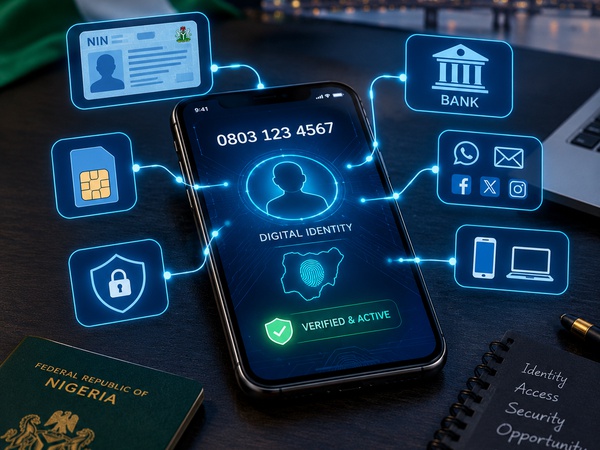
<p>Your phone number used to help people call you. Now it can help determine who you are.</p><p><br/></p><p>There was a time when changing your phone number was almost as unremarkable as changing your SIM card.</p><p><br/></p><p>You told your friends. Updated a few contacts. Maybe informed your bank. Then life moved on.</p><p><br/></p><p>That era is disappearing.</p><p><br/></p><p>In Nigeria, the ordinary mobile number is becoming increasingly connected to banking, social media, identity verification, online services and other parts of digital life. And the country is now building systems specifically designed to understand the status and risks attached to those numbers.</p><p><br/></p><p>That should make us pause.</p><p><br/></p><p>Not because technology is necessarily doing something wrong, but because an identifier that most people still think of as a simple communication tool is becoming something much more consequential.</p><p><br/></p><p>The number in your pocket is becoming an identity signal</p><p><br/></p><p>Nigeria already requires mobile numbers to be linked with the National Identification Number (NIN). The Nigerian Communications Commission (NCC) explains that the linkage provides a means of verifying identity and safeguarding both the identity and mobile line.</p><p><br/></p><p>Now another layer is being added.</p><p><br/></p><p>The NCC's Telecommunications Identity Risk Management System, or TIRMS, is designed to allow authorised organisations to verify the status of mobile numbers in real time.</p><p><br/></p><p>According to the NCC, the system can identify whether a number is active, swapped, churned, blacklisted or has been reassigned to another person.</p><p><br/></p><p>That last part matters more than it sounds.</p><p><br/></p><p>Imagine buying a new SIM card and receiving a number that belonged to someone else. If that number is still associated with the previous owner's bank alerts, social accounts or other services, the new owner could potentially encounter information that was never meant for them.</p><p><br/></p><p>That is not science fiction. It is one of the practical problems TIRMS is intended to reduce.</p><p><br/></p><p>The NCC says TIRMS is scheduled to go live in October 2026.</p><p><br/></p><p>And that tells us something important about where telecommunications is heading.</p><p><br/></p><p>The industry is no longer treating a phone number simply as a destination for calls and messages.</p><p><br/></p><p>It is increasingly treating it as a digital identity risk.</p><p><br/></p><p>Nigeria is building a much larger digital identity machine</p><p><br/></p><p>TIRMS does not exist in isolation.</p><p><br/></p><p>In June 2026, Nigeria's President signed the NIMC Act 2026 into law, replacing the 2007 legislation governing the National Identity Management Commission.</p><p><br/></p><p>The new law gives NIMC a central role in Nigeria's digital identity infrastructure and designates it as the Root Certification Authority for the country's National Public Key Infrastructure and Digital Public Infrastructure.</p><p><br/></p><p>It also establishes the NIN as the country's foundational identity credential and provides a framework for secure identity verification and authentication across public and private-sector platforms.</p><p><br/></p><p>Put these developments together and a larger picture emerges.</p><p><br/></p><p>Nigeria is moving toward a digital environment in which different systems can increasingly establish:</p><p><br/></p><p>Who are you?</p><p><br/></p><p>Is this identity valid?</p><p><br/></p><p>Is this phone number currently associated with that identity?</p><p><br/></p><p>Has the number been swapped, recycled or blacklisted?</p><p><br/></p><p>Can this transaction or service request be trusted?</p><p><br/></p><p>That could make digital services significantly safer.</p><p><br/></p><p>But it also makes the protection of identity significantly more important.</p><p><br/></p><p>And Nigeria is a very large mobile market</p><p><br/></p><p>The scale is enormous.</p><p><br/></p><p>NCC industry data recorded 157.3 million active GSM subscriptions in July 2026.</p><p><br/></p><p>Separately, GSMA Intelligence data cited in DataReportal's Digital 2026 Nigeria report estimated 165 million cellular mobile connections at the end of 2025, equivalent to about 69.2% of the population.</p><p><br/></p><p>Those figures are not the same thing as the number of individual Nigerians because one person can have multiple connections.</p><p><br/></p><p>But they demonstrate the size of the infrastructure being built around mobile identities.</p><p><br/></p><p>And there is another important reality: connectivity is not yet universal.</p><p><br/></p><p>GSMA's 2025 analysis estimated that only about 27% of Nigeria's population owned a smartphone in 2024, while its analysis identified a much larger mobile-internet usage gap.</p><p><br/></p><p>So Nigeria is simultaneously building sophisticated digital identity infrastructure while millions of people remain on the other side of the digital divide.</p><p><br/></p><p>That creates an interesting challenge.</p><p><br/></p><p>A digital identity system can be extremely powerful.</p><p><br/></p><p>But its benefits are limited if the people it is designed to serve cannot reliably access the digital world.</p><p><br/></p><p>The security argument is strong</p><p><br/></p><p>There is a good reason for all of this.</p><p><br/></p><p>Mobile numbers are increasingly connected to valuable accounts.</p><p><br/></p><p>A compromised number can become the starting point for fraud, impersonation or account takeover. SIM swaps and recycled numbers can create vulnerabilities. Stolen devices can also provide another route into someone's digital life.</p><p><br/></p><p>Nigeria's NCC is therefore also deploying a Device Management System designed to improve device compliance and help prevent stolen devices from being used across Nigerian networks.</p><p><br/></p><p>From a security perspective, this makes sense.</p><p><br/></p><p>If telecommunications networks can distinguish legitimate identities and devices from suspicious ones, they can potentially make digital fraud more difficult.</p><p><br/></p><p>But there is an important principle that should not disappear beneath all the talk about security:</p><p><br/></p><p>The more systems know about us, the more carefully those systems must be governed.</p><p><br/></p><p>Convenience and privacy now have to grow together</p><p><br/></p><p>Digital identity can make life easier.</p><p><br/></p><p>Instead of repeatedly proving who you are, properly designed systems can allow trusted organisations to verify you quickly.</p><p><br/></p><p>It can make financial services easier to access.</p><p><br/></p><p>It can reduce identity fraud.</p><p><br/></p><p>It can make government services more efficient.</p><p><br/></p><p>It can help businesses verify customers.</p><p><br/></p><p>It can even make digital commerce more trustworthy.</p><p><br/></p><p>But the same infrastructure creates questions that cannot be answered with technology alone.</p><p><br/></p><p>Who is allowed to access identity information?</p><p><br/></p><p>What exactly can they see?</p><p><br/></p><p>How long is information retained?</p><p><br/></p><p>What happens when information is incorrect?</p><p><br/></p><p>How quickly can a citizen correct an error?</p><p><br/></p><p>What happens when a phone number changes hands?</p><p><br/></p><p>And perhaps most importantly:</p><p><br/></p><p>What happens when the system gets you wrong?</p><p><br/></p><p>A database error is inconvenient when it changes a recommendation on an app.</p><p><br/></p><p>It can be devastating when it affects access to financial services, communication or government services.</p><p><br/></p><p>That is why digital identity is ultimately not just a technology problem.</p><p><br/></p><p>It is a governance problem.</p><p><br/></p><p>The future may make your number even more valuable</p><p><br/></p><p>The strange thing about technological progress is that the objects we take for granted can quietly become infrastructure.</p><p><br/></p><p>A phone number is a good example.</p><p><br/></p><p>It is only a sequence of digits.</p><p><br/></p><p>Yet that sequence can sit between a person and their bank account, their messages, their online accounts and their identity verification.</p><p><br/></p><p>That makes the number valuable.</p><p><br/></p><p>It also makes losing control of it more serious.</p><p><br/></p><p>As Nigeria develops its digital public infrastructure, the country will need something more than technically sophisticated systems.</p><p><br/></p><p>It will need public trust.</p><p><br/></p><p>And public trust does not come simply from announcing that a system is secure.</p><p><br/></p><p>It comes from proving that the system is accurate, accountable, transparent and capable of protecting ordinary people when something goes wrong.</p><p><br/></p><p>The phone number may be becoming more than a phone number.</p><p><br/></p><p>The bigger question is whether Nigeria can build the institutions around it that are worthy of that responsibility.</p><p><br/></p><p>Technology can verify an identity.</p><p><br/></p><p>Only good governance can make people trust the verification.</p>


 37
37


Other insights from Galton







Contributor Points
Points-to-Coupons

Referral Earning

Insights for you.

My Unpopular opinions of Social Media.
I Really Hate Social MediaWait, hear me out.I'm not saying this from a place of pride o...
241 views
33 upvotes
40 comments


Meet Amina the AI
Well yes, the image attached to this post was created with DALLE. After some interestin...
1475 views
19 upvotes
12 comments


If You Can’t Beat Them, Join Them
I didn’t experience the “before.” Before landlines, before phones, before mobile money—...
322 views
28 upvotes
25 comments

Grandpa lied (A little)
"Grandpa said, farming pays and not even your AI can take that away" that was my cousin...
337 views
25 upvotes
26 comments


Social Media vs Reality – Let’s Be Fo...
Let’s talk. Be honest, have you ever looked at someone’s Instagram story and immediatel...
442 views
15 upvotes
15 comments

Are we becoming who we are, or who we...
We are shaped long before we realize itby things we do not question,by voices we do not...
307 views
19 upvotes
20 comments


Three (3) reasons why AI is losing to...
This article explains how Google's new policy affects AI-written content and flagging g...
843 views
18 upvotes
18 comments


Over sharing with a bot : it's not th...
Lately I’ve realized my most stable relationship might actually be with ChatGPT. 😭 I co...
467 views
16 upvotes
16 comments

The Impact Of Social Media vs Books: ...
A social media personality emerged on the internet months ago and a basic small toy tha...
387 views
19 upvotes
15 comments

Tech is the New White Collar Job
Tech is the New White Collar Job
Tech is the new currency; with tech, you can say cr...
1067 views
17 upvotes
11 comments