Score |
66


Galton
 Student @ University of Lagos



The Internet Is Making Everyone an Expert. Nobody Wants to Be a Student.
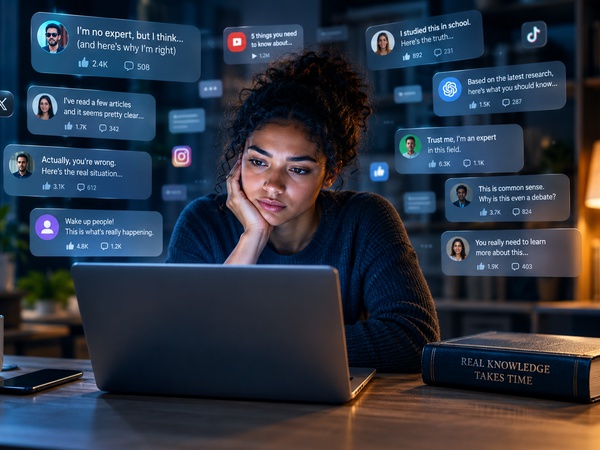
<p><br/></p><p>We have more access to information than any generation before us. But having an answer to everything is not the same as understanding anything.</p><p><br/></p><p>There is something strange about the world we live in.</p><p><br/></p><p>Someone watches a short video about economics and suddenly has an explanation for inflation. Another reads a headline about a medical discovery and begins offering health advice. Someone else asks artificial intelligence a few questions about engineering and confidently challenges a professional who has spent years studying the subject.</p><p><br/></p><p>Everyone has something to say. Everyone has an opinion. And sometimes, everyone seems convinced that their opinion deserves the same weight as years of study, professional experience, or painstaking research.</p><p><br/></p><p>The internet has made information remarkably accessible. A student in Nigeria can learn from universities thousands of kilometres away. An aspiring entrepreneur can study business models without attending business school. Someone curious about electronics can explore circuit design, programming, and engineering concepts without leaving home.</p><p><br/></p><p>That is an extraordinary achievement.</p><p><br/></p><p>But access to information creates an important question: when information becomes easier to obtain, does understanding automatically follow?</p><p><br/></p><p>Not necessarily.</p><p><br/></p><p>We can find answers more easily than ever before. Yet finding an answer and understanding why it is correct are two very different things.</p><p><br/></p><p>Perhaps one of the internet age's most uncomfortable contradictions is that we have made knowledge more accessible while making it easier to mistake exposure to information for expertise.</p><p><br/></p><p>When Information Becomes an Illusion of Intelligence</p><p><br/></p><p>Imagine watching a documentary about the human brain. You learn several new concepts and find yourself explaining how memory works to your friends.</p><p><br/></p><p>You have learned something. That is progress.</p><p><br/></p><p>But have you learned enough to conduct neurological research, diagnose a brain disorder, or evaluate a disputed scientific claim?</p><p><br/></p><p>Probably not.</p><p><br/></p><p>The distinction seems obvious when we put it that way. Yet online discussions can blur the boundaries between exposure, understanding, and expertise.</p><p><br/></p><p>We encounter an idea, become familiar with its vocabulary, and begin to feel that we understand the subject. We can repeat the explanation, recognise related terms, and perhaps argue convincingly about it.</p><p><br/></p><p>But familiarity is not the same as deep understanding.</p><p><br/></p><p>Understanding requires more than remembering what someone said. It involves evaluating evidence, connecting ideas, identifying contradictions, recognising limitations, and knowing when an apparently reasonable explanation fails.</p><p><br/></p><p>It also requires knowing when we do not know enough to reach a reliable conclusion.</p><p><br/></p><p>The internet does not prevent us from developing these abilities. It simply makes it possible to consume enormous amounts of information without necessarily developing them.</p><p><br/></p><p>We can spend hours investigating a subject, comparing evidence, and correcting our misunderstandings. We can also spend those same hours collecting fragments that confirm what we already believe.</p><p><br/></p><p>Both activities can leave us feeling informed. They do not necessarily leave us equally knowledgeable.</p><p><br/></p><p>Social Media Has Turned Confidence Into a Performance</p><p><br/></p><p>Consider the way online discussions unfold.</p><p><br/></p><p>A complicated issue is reduced to a short video. A controversial claim is compressed into a catchy caption. Someone who speaks with absolute certainty can appear more convincing than someone who carefully explains the limitations of the available evidence.</p><p><br/></p><p>Social media platforms compete for attention, and dramatic claims can be highly engaging. But engagement is not a reliable measure of accuracy.</p><p><br/></p><p>Research published in the Journal of Information Science examined the relationship between information overload and misinformation sharing among 385 social media users in Nigeria. The researchers reported associations between information overload, social media fatigue, information stress, and misinformation-sharing behaviour.</p><p><br/></p><p>The study is particularly relevant because it involved Nigerian social media users. However, its questionnaire-based design does not establish that the internet makes people less intelligent or that every user who encounters too much information will spread misinformation. It offers evidence of a more specific problem: the way people experience and process information can influence what they share.</p><p><br/></p><p>The implications deserve attention.</p><p><br/></p><p>When people are overwhelmed by information, they may have less time or motivation to investigate every claim they encounter. When a claim fits their existing beliefs or provokes a strong emotional reaction, they may be tempted to share it before checking whether it is accurate.</p><p><br/></p><p>This does not mean confidence is inherently suspicious. Nor does it mean cautious people are always correct.</p><p><br/></p><p>It means that confidence and accuracy are different things.</p><p><br/></p><p>A person can be absolutely certain and completely mistaken. Another can express uncertainty precisely because they understand how complicated the subject is.</p><p><br/></p><p>Yet the online environment can make certainty more visible than careful reasoning.</p><p><br/></p><p>Over time, we risk creating a culture in which admitting uncertainty feels like losing an argument, changing one's mind looks like weakness, and acknowledging another person's expertise feels like surrender.</p><p><br/></p><p>The result is not necessarily a population that knows less. It is a public conversation in which the distinction between knowledge, belief, and speculation can become difficult to maintain.</p><p><br/></p><p>The Problem Is Not Ignorance. It Is Refusing to Recognise It.</p><p><br/></p><p>Nobody knows everything.</p><p><br/></p><p>A brilliant electrical engineer may know very little about constitutional law. An accomplished physician may struggle to explain international monetary policy. A successful entrepreneur may misunderstand a scientific study.</p><p><br/></p><p>These are not character flaws. They are ordinary consequences of being human.</p><p><br/></p><p>Knowledge is vast, specialised, and constantly developing. Even experts must continue learning, and expertise in one field does not automatically transfer to another.</p><p><br/></p><p>The trouble begins when we treat the limits of our knowledge as something to conceal.</p><p><br/></p><p>In 1999, psychologists Justin Kruger and David Dunning published a paper titled Unskilled and Unaware of It: How Difficulties in Recognizing One's Own Incompetence Lead to Inflated Self-Assessments.</p><p><br/></p><p>Their research examined how people assessed their abilities in particular tasks, including humour, grammar, and logical reasoning. Across four studies, participants who performed in the lowest quartile tended to overestimate their performance.</p><p><br/></p><p>The researchers proposed that some of the skills needed to perform well in a task are also needed to evaluate one's performance accurately.</p><p><br/></p><p>This finding has since become widely known as the Dunning–Kruger effect.</p><p><br/></p><p>However, the concept is frequently oversimplified online. It does not mean that everyone who makes a mistake is incompetent, that confident people are necessarily ignorant, or that people who know very little about a subject are always the most confident.</p><p><br/></p><p>The original research concerned particular tasks and how participants assessed their own performance. It should not be treated as a universal explanation for every disagreement or display of overconfidence.</p><p><br/></p><p>Its broader lesson is more useful: assessing our own knowledge accurately can be difficult, especially when we lack the skills needed to recognise our mistakes.</p><p><br/></p><p>The internet adds another complication. It gives us immediate access to explanations, arguments, and conclusions, making it easier to discuss a subject before we have done the work required to understand it.</p><p><br/></p><p>We can borrow the language of expertise without acquiring its discipline.</p><p><br/></p><p>We can find arguments supporting almost any position and mistake our ability to defend an opinion for evidence that the opinion is correct.</p><p><br/></p><p>Perhaps the real danger is not that we sometimes know too little. It is that we may become so invested in what we believe we know that we lose the willingness to discover what we have misunderstood.</p><p><br/></p><p>Artificial Intelligence Is Making This Question More Urgent</p><p><br/></p><p>Artificial intelligence introduces a new dimension to the problem.</p><p><br/></p><p>Previously, if we wanted to appear knowledgeable about an unfamiliar subject, we had to read enough material to construct a convincing explanation ourselves.</p><p><br/></p><p>Now, AI tools can produce polished essays, technical summaries, sophisticated arguments, and professional-sounding explanations in seconds.</p><p><br/></p><p>This is genuinely useful.</p><p><br/></p><p>A student can use AI to understand a difficult mathematical concept. An entrepreneur can explore a business idea. An engineer can investigate unfamiliar technologies. Someone without access to a private tutor can receive explanations and practise new skills.</p><p><br/></p><p>Research published in PLOS ONE in 2024 examined ChatGPT-generated assistance for mathematics learning. The researchers found that students receiving ChatGPT-generated help achieved learning gains compared with a no-help control group. The gains were not significantly different from those observed with human tutor-authored help.</p><p><br/></p><p>However, the researchers also found that ChatGPT-generated assistance failed their quality checks on 32% of the problems examined. Additional techniques reduced the error rate, illustrating both the potential of AI-assisted learning and the importance of checking its output.</p><p><br/></p><p>The findings do not establish that every AI tool, subject, or learning environment will produce the same results. They demonstrate something more specific: AI can provide useful educational assistance, but the quality of that assistance cannot simply be assumed.</p><p><br/></p><p>That distinction matters.</p><p><br/></p><p>There is a difference between using AI to develop your understanding and using it to avoid developing one.</p><p><br/></p><p>If a student asks AI to explain a concept, examines the explanation, checks the reasoning, and solves related problems independently, the technology can support learning.</p><p><br/></p><p>If that student simply copies the answer and moves on without understanding what it means, the immediate task may be complete while the underlying learning remains unfinished.</p><p><br/></p><p>The same distinction applies to professionals, business owners, writers, and researchers.</p><p><br/></p><p>AI can help us think through problems. It can also make it easier to produce the appearance of understanding without doing the work necessary to acquire it.</p><p><br/></p><p>There is another concern: AI systems can generate incorrect information in language that sounds perfectly reasonable.</p><p><br/></p><p>Fluency is not proof of accuracy.</p><p><br/></p><p>Someone who understands a subject may be better equipped to recognise an error. Someone encountering the subject for the first time may struggle to distinguish a reliable explanation from a convincing mistake.</p><p><br/></p><p>The solution is not to reject AI. It is to become more deliberate about how we use it.</p><p><br/></p><p>The easier it becomes to generate answers, the more important it becomes to evaluate them.</p><p><br/></p><p>We Have Made It Easier to Learn. Are We Losing the Patience to Do So?</p><p><br/></p><p>There is an important difference between wanting to understand something and wanting to appear knowledgeable about it.</p><p><br/></p><p>The first encourages curiosity. The second can encourage performance.</p><p><br/></p><p>Learning is often uncomfortable. It requires patience, repetition, correction, and a willingness to confront ideas that challenge our existing beliefs.</p><p><br/></p><p>Sometimes it means discovering that an argument we confidently defended was wrong. Sometimes it means spending weeks trying to understand something that another person can explain in a sentence.</p><p><br/></p><p>The process does not always offer the immediate satisfaction of appearing intelligent.</p><p><br/></p><p>Online platforms, by contrast, make it easy to display opinions instantly. We can participate in a debate, publish a thread, record a video, or challenge an expert before fully investigating the subject.</p><p><br/></p><p>The temptation is understandable. Being seen as intelligent can be rewarding.</p><p><br/></p><p>But if the desire to appear knowledgeable becomes stronger than the desire to learn, intellectual growth becomes more difficult.</p><p><br/></p><p>We may stop asking questions because we fear looking uninformed. We may resist correction because we interpret it as humiliation. We may defend our positions because changing our minds would require admitting that we were mistaken.</p><p><br/></p><p>Learning then becomes secondary to protecting our image.</p><p><br/></p><p>A genuinely curious person is willing to acknowledge a gap in their understanding and work to close it. Someone concerned primarily with appearances may prefer to remain confidently mistaken.</p><p><br/></p><p>The difference matters far beyond social media. It affects classrooms, workplaces, public debates, scientific inquiry, business decisions, and the way societies respond to difficult problems.</p><p><br/></p><p>Progress depends partly on our willingness to discover that what we believed yesterday is insufficient for what we need to understand tomorrow.</p><p><br/></p><p>What Would It Mean to Become Students Again?</p><p><br/></p><p>The answer is not to abandon the internet, distrust every online explanation, or assume that traditional institutions always possess the truth.</p><p><br/></p><p>The internet remains an extraordinary educational resource. Researchers can access scientific papers. Students can learn from experienced educators. Professionals can acquire new skills. People can encounter perspectives that their immediate communities might never expose them to.</p><p><br/></p><p>The challenge is to use these opportunities without confusing convenience with competence.</p><p><br/></p><p>We can begin with a few practical habits.</p><p><br/></p><p>First, separate what you know from what you believe. An opinion may be reasonable without being established fact. Recognising the difference makes it easier to evaluate new evidence.</p><p><br/></p><p>Second, investigate claims before repeating them. Look beyond headlines, short clips, and screenshots. Find the original source where possible, examine the evidence, and consider whether the conclusion actually follows from it.</p><p><br/></p><p>Third, take expertise seriously without treating experts as infallible. Relevant qualifications, demonstrated competence, professional experience, and transparent evidence matter. Experts can be wrong, but disagreement with an expert should be an invitation to examine the evidence, not an excuse to dismiss specialised knowledge.</p><p><br/></p><p>Fourth, use AI as a learning partner rather than an unquestionable authority. Ask for explanations, examples, alternative arguments, and ways to test your understanding. Verify important claims independently, especially when errors could have serious consequences.</p><p><br/></p><p>Finally, become comfortable saying, "I don't know." Those three words do not diminish intelligence. They establish an honest starting point for learning.</p><p><br/></p><p>None of these habits requires us to become less confident. They require us to make our confidence accountable to evidence.</p><p><br/></p><p>The goal is not to eliminate opinions. It is to cultivate better-informed ones.</p><p><br/></p><p>The Internet Has Given Us Access to Knowledge. What We Do With It Is Up to Us.</p><p><br/></p><p>We should be careful not to romanticise the past.</p><p><br/></p><p>Before the internet, information was harder to access for many people. Educational opportunities were more limited, and misinformation existed long before social media.</p><p><br/></p><p>Today's digital tools have created enormous opportunities for learning and participation.</p><p><br/></p><p>The problem is not that ordinary people can now discuss complex subjects. They should be able to. Knowledge should not be the exclusive property of institutions or professional elites.</p><p><br/></p><p>The problem arises when participation is mistaken for mastery, when confidence becomes more important than accuracy, and when the freedom to express an opinion is confused with an obligation for everyone else to treat it as fact.</p><p><br/></p><p>A healthy knowledge culture does not demand that everyone become an expert in everything.</p><p><br/></p><p>It encourages people to understand what they can, respect what they have not yet learned, and remain open to correction.</p><p><br/></p><p>Perhaps that is the real challenge of living in an age of abundant information.</p><p><br/></p><p>We have spent decades making knowledge easier to find. We must now become more deliberate about learning how to understand it.</p><p><br/></p><p>Access to information is an opportunity, not an achievement in itself.</p><p><br/></p><p>And the person who is always ready to teach but never willing to learn may be missing one of the greatest opportunities the internet has offered.</p><p><br/></p><p>The internet has made it easier than ever to find an answer. The question is whether we still have the patience to understand it.</p><p><br/></p><p>TwoCents examines technology, ideas, and the ways they shape our lives. Because progress deserves more than applause. It deserves questions.</p>


 12


Other insights from Galton












Contributor Points

Points-to-Coupons

Referral Earning

Insights for you.


My Unpopular opinions of Social Media.
I Really Hate Social MediaWait, hear me out.I'm not saying this from a place of pride o...
251 views
33 upvotes
40 comments

New York City bans AI for children.
AI is a very powerful tool.But should young children have unrestricted access to it?On ...
106 views
29 upvotes
34 comments


Meet Amina the AI
Well yes, the image attached to this post was created with DALLE. After some interestin...
1490 views
20 upvotes
12 comments


If You Can’t Beat Them, Join Them
I didn’t experience the “before.” Before landlines, before phones, before mobile money—...
340 views
28 upvotes
25 comments


Grandpa lied (A little)
"Grandpa said, farming pays and not even your AI can take that away" that was my cousin...
345 views
25 upvotes
26 comments


Social Media vs Reality – Let’s Be Fo...
Let’s talk. Be honest, have you ever looked at someone’s Instagram story and immediatel...
454 views
15 upvotes
15 comments

Are we becoming who we are, or who we...
We are shaped long before we realize itby things we do not question,by voices we do not...
322 views
19 upvotes
20 comments


Three (3) reasons why AI is losing to...
This article explains how Google's new policy affects AI-written content and flagging g...
858 views
18 upvotes
18 comments


Over sharing with a bot : it's not th...
Lately I’ve realized my most stable relationship might actually be with ChatGPT. 😭 I co...
477 views
16 upvotes
16 comments

The Impact Of Social Media vs Books: ...
A social media personality emerged on the internet months ago and a basic small toy tha...
405 views
19 upvotes
15 comments

































