Score |
45


Galton
 Student @ University of Lagos
Student @ University of Lagos



The Smartphone Has Become a Semiconductor Battlefield
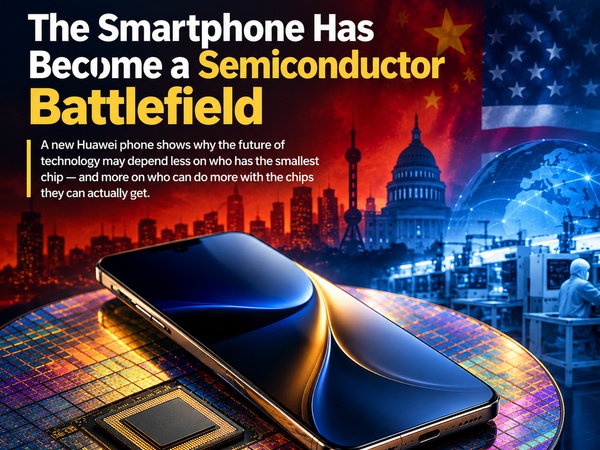
<p>A new Huawei phone shows why the future of technology may depend less on who has the smallest chip — and more on who can do more with the chips they can actually get.</p><p><br/></p><p>For years, the smartphone race seemed straightforward.</p><p><br/></p><p>Apple made a faster chip. Qualcomm answered. Samsung pushed its own silicon. Smaller manufacturing processes promised more performance, better battery life and thinner devices.</p><p><br/></p><p>But that race is changing.</p><p><br/></p><p>The latest Huawei Mate 90 series is a reminder that smartphone technology is no longer just about making the best phone. It is increasingly about who controls the technology underneath the phone.</p><p><br/></p><p>Huawei launched the Mate 90 series on October 1, 2026, with its own HarmonyOS 7 operating system and homegrown Kirin processors. Some higher-end models use Huawei's Kirin 9050 Pro, which incorporates a chip-design approach called LogicFolding.</p><p><br/></p><p>That sounds like another smartphone launch.</p><p><br/></p><p>It isn't.</p><p><br/></p><p>It is a glimpse into a much bigger technological contest.</p><p><br/></p><p>When a phone becomes a geopolitical object</p><p><br/></p><p>A modern smartphone contains an extraordinary chain of technologies: processors, memory, displays, cameras, operating systems, wireless communications, manufacturing equipment and software.</p><p><br/></p><p>Very few companies — and even fewer countries — control all of those layers.</p><p><br/></p><p>That is why semiconductor restrictions have become such a powerful geopolitical tool.</p><p><br/></p><p>The United States has spent years restricting China's access to certain advanced semiconductor technologies and manufacturing equipment. Those restrictions are designed partly around concerns about advanced computing and national security.</p><p><br/></p><p>Huawei has consequently had to develop alternatives.</p><p><br/></p><p>The result is fascinating.</p><p><br/></p><p>Instead of simply waiting until it can manufacture exactly the same kind of chips as its competitors, Huawei is experimenting with different ways of extracting more performance from available hardware.</p><p><br/></p><p>Its LogicFolding architecture is designed to restructure parts of chip circuitry in three dimensions, shortening signal paths and increasing density.</p><p><br/></p><p>That distinction matters.</p><p><br/></p><p>Engineering is often about achieving the required result under constraints.</p><p><br/></p><p>Unlimited resources make some engineering problems easier.</p><p><br/></p><p>Limited resources can force engineers to rethink the problem itself.</p><p><br/></p><p>The smaller-chip obsession may be missing something</p><p><br/></p><p>For years, consumers learned to associate smaller semiconductor manufacturing nodes with technological superiority.</p><p><br/></p><p>7nm sounded better than 10nm.</p><p><br/></p><p>5nm sounded better than 7nm.</p><p><br/></p><p>3nm sounded better than 5nm.</p><p><br/></p><p>And, broadly speaking, smaller manufacturing processes can enable greater transistor density and efficiency.</p><p><br/></p><p>But manufacturing technology is only one part of processor performance.</p><p><br/></p><p>Architecture matters.</p><p><br/></p><p>Software matters.</p><p><br/></p><p>Memory matters.</p><p><br/></p><p>Packaging matters.</p><p><br/></p><p>Cooling matters.</p><p><br/></p><p>Power management matters.</p><p><br/></p><p>The way all these pieces interact matters.</p><p><br/></p><p>Huawei's approach is therefore particularly interesting because it is attempting to compensate for manufacturing constraints through architectural innovation.</p><p><br/></p><p>Reuters reported that Huawei is still dealing with limited advanced chipmaking capacity in China and restrictions affecting access to the most advanced semiconductor manufacturing equipment.</p><p><br/></p><p>The lesson extends far beyond Huawei.</p><p><br/></p><p>The company that owns the most advanced manufacturing process does not automatically own every engineering solution.</p><p><br/></p><p>China is building an ecosystem, not just a phone</p><p><br/></p><p>The Mate 90 also demonstrates another important trend: technological independence requires more than designing a processor.</p><p><br/></p><p>Huawei is simultaneously developing hardware, software and services.</p><p><br/></p><p>HarmonyOS 7 is central to that strategy.</p><p><br/></p><p>According to Xinhua, Huawei said HarmonyOS 6 and HarmonyOS 7 devices had surpassed 90 million terminals, with more than 450,000 applications and services available.</p><p><br/></p><p>That number matters because an operating system becomes powerful when developers and users build an ecosystem around it.</p><p><br/></p><p>This is why Apple's strength is not simply the iPhone.</p><p><br/></p><p>It is iPhone + Apple silicon + iOS + App Store + services + developers + accessories + cloud infrastructure.</p><p><br/></p><p>Google has a similar ecosystem around Android.</p><p><br/></p><p>Microsoft has Windows and its enormous enterprise ecosystem.</p><p><br/></p><p>Huawei is attempting to construct its own increasingly independent stack.</p><p><br/></p><p>And that changes the competition.</p><p><br/></p><p>The question is no longer simply:</p><p><br/></p><p>«Who makes the best phone?»</p><p><br/></p><p>It becomes:</p><p><br/></p><p>«Who can control enough of the technology stack to remain competitive when access to somebody else's technology disappears?»</p><p><br/></p><p>The semiconductor race is already affecting entire economies</p><p><br/></p><p>This is not merely a Huawei story.</p><p><br/></p><p>South Korea's latest trade numbers show just how economically important semiconductors have become.</p><p><br/></p><p>In September 2026, South Korean semiconductor exports increased 262.8% year-on-year to $60.3 billion, according to Reuters. Total exports reached a record $120.9 billion.</p><p><br/></p><p>That is extraordinary.</p><p><br/></p><p>Chips are no longer just components hidden inside computers.</p><p><br/></p><p>They are becoming strategic infrastructure.</p><p><br/></p><p>They influence smartphones, cars, telecommunications equipment, military systems, artificial intelligence, cloud computing and industrial automation.</p><p><br/></p><p>Countries that dominate semiconductor manufacturing therefore gain influence far beyond the technology sector.</p><p><br/></p><p>And then there is the African question</p><p><br/></p><p>This is where the story becomes relevant to someone sitting in Lagos, Nairobi, Accra or Johannesburg.</p><p><br/></p><p>Africa consumes enormous amounts of technology.</p><p><br/></p><p>But consumption is not the same as technological independence.</p><p><br/></p><p>A smartphone can be designed in one country, use a processor designed somewhere else, rely on memory produced in another country, run software developed elsewhere and finally be assembled somewhere completely different.</p><p><br/></p><p>The person buying it may never see that entire chain.</p><p><br/></p><p>Yet disruptions anywhere along that chain can affect the final price.</p><p><br/></p><p>That is why semiconductor policy eventually becomes consumer policy.</p><p><br/></p><p>It can affect the price of phones.</p><p><br/></p><p>It can affect availability.</p><p><br/></p><p>It can affect repairability.</p><p><br/></p><p>It can affect telecommunications infrastructure.</p><p><br/></p><p>It can affect the ability of African companies to build hardware locally.</p><p><br/></p><p>And it can determine whether the next generation of African engineers are primarily users of imported technology or creators of technology themselves.</p><p><br/></p><p>The real lesson isn't “Huawei is winning”</p><p><br/></p><p>It would be too simplistic to conclude that Huawei has suddenly solved China's semiconductor problem.</p><p><br/></p><p>It hasn't.</p><p><br/></p><p>Huawei still faces manufacturing constraints, and independent verification of some of the company's performance claims is important. Reuters reported that the company remains constrained by China's advanced chipmaking capacity.</p><p><br/></p><p>Nor does one smartphone prove that a country's semiconductor ecosystem has caught up with every competitor.</p><p><br/></p><p>But something more interesting is happening.</p><p><br/></p><p>Huawei is demonstrating what companies can do when conventional technological pathways become difficult.</p><p><br/></p><p>They redesign the pathway.</p><p><br/></p><p>That is one of the oldest principles in engineering.</p><p><br/></p><p>When you cannot increase the input, improve the efficiency.</p><p><br/></p><p>When you cannot buy the component, redesign the system.</p><p><br/></p><p>When the obvious route is blocked, find another route.</p><p><br/></p><p>The next technology war may happen underneath the screen</p><p><br/></p><p>Consumers will continue debating cameras, battery capacity, displays and smartphone designs.</p><p><br/></p><p>Those things matter.</p><p><br/></p><p>But beneath all of them is a less visible competition over semiconductor architecture, manufacturing equipment, intellectual property, operating systems and supply chains.</p><p><br/></p><p>And that competition is becoming increasingly geopolitical.</p><p><br/></p><p>The Huawei Mate 90 is therefore more than another premium smartphone.</p><p><br/></p><p>It is a small object sitting at the intersection of engineering, economics, national security and global politics.</p><p><br/></p><p>The most important question about the next decade of technology may not be:</p><p><br/></p><p>“Who has the most advanced technology?”</p><p><br/></p><p>It may be:</p><p><br/></p><p>“Who can still innovate when access to the most advanced technology is taken away?”</p><p><br/></p><p>That is a much harder engineering question.</p><p><br/></p><p>And the answer could reshape the global technology industry.</p>


 40
40


Other insights from Galton












Contributor Points

Points-to-Coupons

Referral Earning

Insights for you.


My Unpopular opinions of Social Media.
I Really Hate Social MediaWait, hear me out.I'm not saying this from a place of pride o...
241 views
33 upvotes
40 comments


Meet Amina the AI
Well yes, the image attached to this post was created with DALLE. After some interestin...
1475 views
19 upvotes
12 comments


If You Can’t Beat Them, Join Them
I didn’t experience the “before.” Before landlines, before phones, before mobile money—...
322 views
28 upvotes
25 comments


Grandpa lied (A little)
"Grandpa said, farming pays and not even your AI can take that away" that was my cousin...
337 views
25 upvotes
26 comments


Social Media vs Reality – Let’s Be Fo...
Let’s talk. Be honest, have you ever looked at someone’s Instagram story and immediatel...
442 views
15 upvotes
15 comments


Are we becoming who we are, or who we...
We are shaped long before we realize itby things we do not question,by voices we do not...
307 views
19 upvotes
20 comments


Three (3) reasons why AI is losing to...
This article explains how Google's new policy affects AI-written content and flagging g...
843 views
18 upvotes
18 comments


Over sharing with a bot : it's not th...
Lately I’ve realized my most stable relationship might actually be with ChatGPT. 😭 I co...
467 views
16 upvotes
16 comments


The Impact Of Social Media vs Books: ...
A social media personality emerged on the internet months ago and a basic small toy tha...
387 views
19 upvotes
15 comments

Tech is the New White Collar Job
Tech is the New White Collar Job
Tech is the new currency; with tech, you can say cr...
1067 views
17 upvotes
11 comments