Score |
19


Galton
 Student @ University of Lagos
Student @ University of Lagos



The Next Smartphone May Not Fit in Your Pocket — But It May See Everything
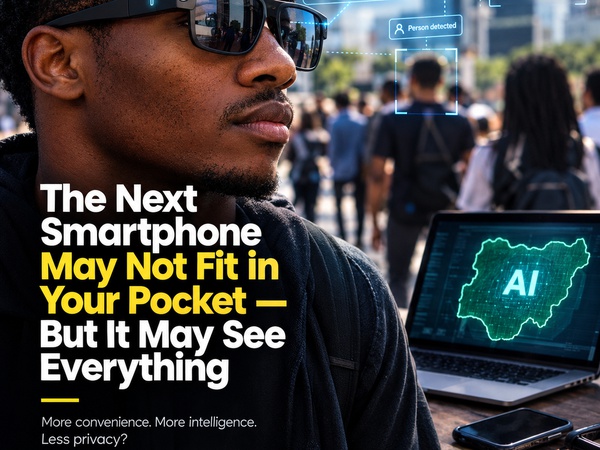
<p>For more than a decade, we have carried computers in our pockets.</p><p><br/></p><p>Now Silicon Valley wants to move them onto our faces.</p><p><br/></p><p>Smart glasses, AI pins, voice recorders and other wearable devices are being positioned as the next step in personal technology — devices that can see what we see, hear what we hear and respond without requiring us to pull out a phone.</p><p><br/></p><p>It sounds convenient.</p><p><br/></p><p>It could also change one of the oldest rules of social life: you usually know when someone is watching you.</p><p><br/></p><p>That rule is becoming surprisingly difficult to guarantee.</p><p><br/></p><p>The smartphone may not be the end of the story</p><p><br/></p><p>The smartphone became so successful because it concentrated an extraordinary amount of computing power into something people could carry everywhere.</p><p><br/></p><p>The next generation of devices is trying to do the opposite.</p><p><br/></p><p>Instead of making people interact with a screen, companies want technology to interact with the environment around them.</p><p><br/></p><p>Meta has already pushed aggressively in this direction with its Ray-Ban smart glasses. The company has also introduced Meta Charm, a small handheld device designed to work with its Muse AI assistant. Reuters reported that the gadget is expected to ship during the 2026 holiday season.</p><p><br/></p><p>Snap is also pushing augmented-reality glasses toward workplaces, announcing partnerships involving Salesforce, Nvidia and Amazon Web Services. Its enterprise-focused Specs are designed for applications including factories, retail and field services.</p><p><br/></p><p>The message from the industry is becoming increasingly clear:</p><p><br/></p><p>The computer does not necessarily have to remain a rectangle in your hand.</p><p><br/></p><p>But there is another question.</p><p><br/></p><p>What happens when the computer is constantly looking at the world?</p><p><br/></p><p>Your phone mostly watches you. Wearables can watch everybody.</p><p><br/></p><p>A smartphone contains an enormous amount of personal information, but there is still a physical action involved in many forms of recording.</p><p><br/></p><p>You take it out.</p><p><br/></p><p>You point it.</p><p><br/></p><p>You press something.</p><p><br/></p><p>Smart glasses complicate that social signal.</p><p><br/></p><p>A person standing in front of you may not know whether your glasses are simply glasses or whether they are recording, listening or processing what is happening around them.</p><p><br/></p><p>That concern is no longer hypothetical.</p><p><br/></p><p>Reuters reported in September that privacy fears surrounding AI-powered glasses and other wearable devices were growing internationally. Several venues in the United Kingdom have restricted the use of Meta's smart glasses, while legal and regulatory scrutiny has also increased.</p><p><br/></p><p>Then, on October 2, Dutch eyewear retailer Hans Anders suspended sales of Meta's Ray-Ban smart glasses in the Netherlands and Belgium amid privacy concerns.</p><p><br/></p><p>That is significant.</p><p><br/></p><p>The problem is no longer simply whether consumers want the technology.</p><p><br/></p><p>It is whether the people around the consumer are willing to live with it.</p><p><br/></p><p>The uncomfortable mathematics of privacy</p><p><br/></p><p>The smartphone revolution already made digital surveillance an ordinary part of modern life.</p><p><br/></p><p>Pew Research Center's 2025 survey found that 91% of U.S. adults owned a smartphone.</p><p><br/></p><p>That means billions of people globally are already carrying network-connected cameras, microphones, GPS sensors and computing systems.</p><p><br/></p><p>But wearables could expand the amount of information captured without requiring conscious interaction.</p><p><br/></p><p>Imagine walking into a restaurant.</p><p><br/></p><p>Someone wearing AI glasses could potentially ask their device to identify objects, remember conversations, describe people or interpret what is happening around them.</p><p><br/></p><p>Now imagine a classroom.</p><p><br/></p><p>A hospital.</p><p><br/></p><p>A business meeting.</p><p><br/></p><p>A protest.</p><p><br/></p><p>A religious gathering.</p><p><br/></p><p>A private conversation.</p><p><br/></p><p>The technology might be useful to the wearer while simultaneously being intrusive to everyone else.</p><p><br/></p><p>That is the privacy problem Silicon Valley cannot solve with better advertising.</p><p><br/></p><p>The tiny light may not be enough</p><p><br/></p><p>Manufacturers have tried to address recording concerns with indicators showing when cameras are active.</p><p><br/></p><p>That sounds reasonable.</p><p><br/></p><p>But privacy advocates have questioned whether tiny indicators provide meaningful consent in real-world environments.</p><p><br/></p><p>Texas Attorney General Ken Paxton launched an investigation into Meta's smart glasses in May 2026, citing concerns about recordings, facial data and privacy representations. The investigation specifically raised questions about the glasses' recording indicators and an "always enabled" mode for processing video data.</p><p><br/></p><p>The engineering challenge is therefore not simply:</p><p><br/></p><p>"How do we build a camera that fits into glasses?"</p><p><br/></p><p>It is:</p><p><br/></p><p>"How do we build a camera that society can trust?"</p><p><br/></p><p>Those are very different engineering problems.</p><p><br/></p><p>Privacy could become a product feature</p><p><br/></p><p>There is, however, an interesting opportunity hidden inside the controversy.</p><p><br/></p><p>The companies that solve privacy properly could gain an enormous advantage.</p><p><br/></p><p>Imagine glasses with a physical camera shutter.</p><p><br/></p><p>Or a genuine hardware switch that disconnects the microphone.</p><p><br/></p><p>Or a visible recording indicator that cannot be disabled by software.</p><p><br/></p><p>Or processing that happens locally on the device rather than sending sensitive information to the cloud.</p><p><br/></p><p>Some companies are already moving in this direction.</p><p><br/></p><p>Solos, for example, has introduced a physical privacy kit for its AirGo V2 smart glasses, including components designed to physically block the camera.</p><p><br/></p><p>That may sound primitive compared with sophisticated AI.</p><p><br/></p><p>But sometimes the best technology is the technology that makes its limitations obvious.</p><p><br/></p><p>A physical shutter tells you something immediately:</p><p><br/></p><p>the camera cannot see through it.</p><p><br/></p><p>No privacy policy required.</p><p><br/></p><p>Africa should be paying attention</p><p><br/></p><p>This conversation should not remain a Silicon Valley conversation.</p><p><br/></p><p>Africa is already becoming a major consumer market for smartphones, digital payments, social media and connected services.</p><p><br/></p><p>The next wave of technology will eventually reach African consumers too.</p><p><br/></p><p>And African societies have their own privacy challenges.</p><p><br/></p><p>Many people interact with technology through shared environments: campuses, markets, public transport, workplaces, religious centres and crowded urban spaces.</p><p><br/></p><p>A technology designed in California or Seoul may encounter very different social conditions when deployed in Lagos, Nairobi, Accra or Johannesburg.</p><p><br/></p><p>The question should therefore not be:</p><p><br/></p><p>"Can we afford the newest gadget?"</p><p><br/></p><p>It should also be:</p><p><br/></p><p>"What does this gadget allow other people to know about us?"</p><p><br/></p><p>The post-smartphone era needs a new social contract</p><p><br/></p><p>The smartphone changed how humans communicate.</p><p><br/></p><p>Wearable AI could change how humans experience being around one another.</p><p><br/></p><p>That is much bigger.</p><p><br/></p><p>If cameras become ordinary accessories, recording could become socially invisible.</p><p><br/></p><p>If microphones become permanently available, conversations could become data.</p><p><br/></p><p>If AI assistants can interpret everything around us, the boundary between experiencing the world and collecting information about the world could become increasingly blurred.</p><p><br/></p><p>Technology companies will probably continue pushing forward.</p><p><br/></p><p>They should.</p><p><br/></p><p>Innovation is not the enemy.</p><p><br/></p><p>But innovation without trust eventually creates resistance.</p><p><br/></p><p>The companies that win the next hardware revolution may not simply be the ones with the smartest AI.</p><p><br/></p><p>They may be the ones that answer a much older human question:</p><p><br/></p><p>"How do I know you are not watching me?"</p><p><br/></p><p>The future may not be screenless.</p><p><br/></p><p>It may be privacy-conscious.</p><p><br/></p><p>And if the industry gets that part wrong, consumers may not reject the future because it is too advanced.</p><p><br/></p><p>They may reject it because it feels too intrusive.</p><p><br/></p><p>**The next great gadget might not be the one that sees everything.</p><p><br/></p><p>It might be the one that knows when to look away.**</p>


 32
32


Other insights from Galton













Contributor Points

Points-to-Coupons

Referral Earning

Insights for you.


My Unpopular opinions of Social Media.
I Really Hate Social MediaWait, hear me out.I'm not saying this from a place of pride o...
241 views
33 upvotes
40 comments


Meet Amina the AI
Well yes, the image attached to this post was created with DALLE. After some interestin...
1475 views
19 upvotes
12 comments


If You Can’t Beat Them, Join Them
I didn’t experience the “before.” Before landlines, before phones, before mobile money—...
322 views
28 upvotes
25 comments


Grandpa lied (A little)
"Grandpa said, farming pays and not even your AI can take that away" that was my cousin...
337 views
25 upvotes
26 comments


Social Media vs Reality – Let’s Be Fo...
Let’s talk. Be honest, have you ever looked at someone’s Instagram story and immediatel...
442 views
15 upvotes
15 comments

Are we becoming who we are, or who we...
We are shaped long before we realize itby things we do not question,by voices we do not...
307 views
19 upvotes
20 comments


Three (3) reasons why AI is losing to...
This article explains how Google's new policy affects AI-written content and flagging g...
843 views
18 upvotes
18 comments


Over sharing with a bot : it's not th...
Lately I’ve realized my most stable relationship might actually be with ChatGPT. 😭 I co...
467 views
16 upvotes
16 comments


The Impact Of Social Media vs Books: ...
A social media personality emerged on the internet months ago and a basic small toy tha...
387 views
19 upvotes
15 comments

Tech is the New White Collar Job
Tech is the New White Collar Job
Tech is the new currency; with tech, you can say cr...
1067 views
17 upvotes
11 comments