Score |
67


Galton
 Student @ University of Lagos



Nigeria's Internet Is Growing. Can Its Infrastructure Keep Up?
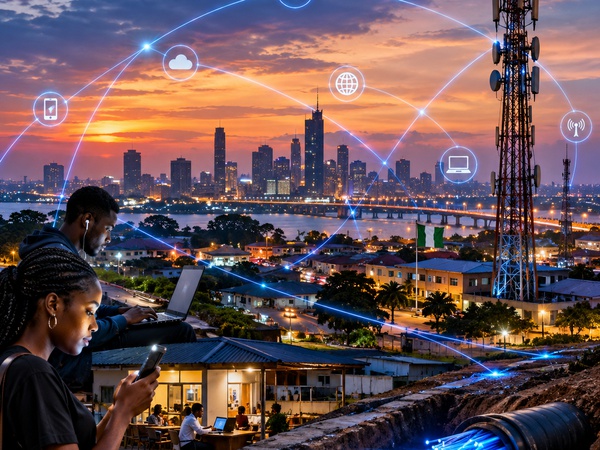
<p>More Nigerians are going online, and existing users are consuming more data. But beneath the growth lies a difficult question: can the infrastructure supporting Nigeria's digital economy keep pace?</p><p><br/></p><p>Nigeria's internet is getting busier.</p><p><br/></p><p>People are streaming videos, attending online classes, running businesses on social media, making digital payments, downloading software and using artificial intelligence tools. For millions of Nigerians, internet access has become part of everyday life rather than an occasional convenience.</p><p><br/></p><p>The numbers reflect this change.</p><p><br/></p><p>According to industry statistics published by the Nigerian Communications Commission (NCC), Nigeria consumed approximately 1.76 million terabytes of internet data in August 2026, compared with about 1.15 million terabytes in August 2025. That represents an increase of roughly 52% in one year.</p><p><br/></p><p>It is an impressive increase in digital activity. However, it also raises an important question.</p><p><br/></p><p>Is Nigeria expanding its internet infrastructure quickly enough to support the growing demand?</p><p><br/></p><p>The answer requires looking beyond the number of people connected. It means examining the fibre-optic cables, telecommunications towers, power systems and network capacity that make internet access possible.</p><p><br/></p><p>More Data, Greater Pressure on Existing Networks</p><p><br/></p><p>Internet growth is not simply about connecting more people. It is also about how much data each person consumes.</p><p><br/></p><p>Someone who previously used the internet mainly for text messages and occasional browsing might now stream videos, participate in video calls, download large files and use cloud-based applications.</p><p><br/></p><p>Multiply that change across millions of users, and the demands on telecommunications infrastructure become substantial.</p><p><br/></p><p>The NCC recorded approximately 1.66 million terabytes of data consumption in July 2026, rising to around 1.76 million terabytes in August. These figures show that demand continued to increase during the period.</p><p><br/></p><p>For network operators, higher data consumption means more traffic must move through existing infrastructure. Capacity must expand where demand exceeds what current networks can comfortably handle.</p><p><br/></p><p>That can require additional base stations, upgraded telecommunications equipment, more fibre connections and improvements to the infrastructure linking different parts of the network.</p><p><br/></p><p>Without sufficient investment, growing demand can contribute to congestion, inconsistent speeds and unreliable connections, particularly in areas where network capacity is already stretched.</p><p><br/></p><p>The important distinction is that rising data consumption is evidence of increased usage, not proof that every Nigerian experiences poor service. Network performance varies by location, operator, available technology and time of day.</p><p><br/></p><p>Nevertheless, the growing volume of traffic makes infrastructure expansion increasingly important.</p><p><br/></p><p>The Fibre-Optic Problem Beneath the Surface</p><p><br/></p><p>When people complain about slow internet, they often blame their mobile network provider or assume that a stronger phone signal would solve the problem.</p><p><br/></p><p>Sometimes it might. But the infrastructure supporting an internet connection is more complicated than the signal displayed on a smartphone.</p><p><br/></p><p>Fibre-optic cables are a crucial part of that system.</p><p><br/></p><p>They transmit large volumes of data over long distances and connect telecommunications facilities, internet exchange points, data centres and other network infrastructure. They also provide backhaul connections that allow mobile base stations to carry traffic into the wider internet.</p><p><br/></p><p>In simple terms, a mobile network needs more than towers. Those towers must also have sufficient capacity to move the data they receive.</p><p><br/></p><p>According to an analysis of NCC infrastructure data published by Nairametrics in July 2026, Nigeria had approximately 101,148 kilometres of deployed fibre-optic cable.</p><p><br/></p><p>However, the distribution was uneven.</p><p><br/></p><p>Lagos accounted for approximately 11,587 kilometres, while the Federal Capital Territory had about 6,973 kilometres. Together, they represented approximately 18.4% of the country's deployed fibre network.</p><p><br/></p><p>At the other end of the distribution, Ebonyi State had approximately 587 kilometres of deployed fibre, while Bayelsa had around 657 kilometres.</p><p><br/></p><p>These figures do not establish the quality of internet service in each state on their own. Fibre coverage, population, demand, network design and the availability of other infrastructure all matter.</p><p><br/></p><p>They do, however, illustrate a challenge: infrastructure is not distributed evenly across the country.</p><p><br/></p><p>Building a national digital economy requires more than expanding connectivity in commercial centres. Smaller cities, rural communities, educational institutions and underserved areas also need reliable access.</p><p><br/></p><p>Otherwise, the benefits of digital growth risk remaining concentrated in places where the necessary infrastructure is already available.</p><p><br/></p><p>Why More Mobile Towers Are Not the Whole Solution</p><p><br/></p><p>Telecommunications towers are another important part of the equation.</p><p><br/></p><p>They connect mobile devices to cellular networks, making calls, mobile browsing and other data services possible. But towers require supporting infrastructure, including power, transmission links and telecommunications equipment.</p><p><br/></p><p>An increase in internet traffic can require operators to upgrade existing sites, add new ones or improve the connections between them.</p><p><br/></p><p>These investments are expensive.</p><p><br/></p><p>Operators must account for equipment, electricity, site maintenance, security, land access and the cost of expanding networks across different locations.</p><p><br/></p><p>Nigeria's operating environment adds further complications. Infrastructure providers must navigate issues such as right-of-way charges for laying fibre, multiple levies, vandalism and the practical difficulties of maintaining equipment in areas with unreliable electricity.</p><p><br/></p><p>These challenges can increase the cost and time required to expand a network.</p><p><br/></p><p>The result is a difficult balancing act. Operators must invest enough to accommodate growing demand while maintaining financially sustainable businesses.</p><p><br/></p><p>For consumers, the consequences are straightforward: a growing appetite for data must be matched by sufficient investment in the systems that deliver it.</p><p><br/></p><p>Broadband Growth Is Encouraging, but the Numbers Need Context</p><p><br/></p><p>There is evidence that Nigeria's connectivity is expanding.</p><p><br/></p><p>NCC statistics reported in September 2026 showed that broadband penetration reached 57.4% in July 2026, with approximately 124.42 million broadband subscriptions.</p><p><br/></p><p>That is meaningful progress, but broadband penetration should not be confused with the percentage of Nigerians who enjoy reliable, high-speed internet at home.</p><p><br/></p><p>The figure is a regulatory industry measure based on broadband subscriptions and the population denominator used by the NCC. Subscriptions are not necessarily unique individuals, and the measure does not directly establish affordability, service quality or equal access.</p><p><br/></p><p>A person can live in an area with mobile broadband coverage and still struggle with expensive data, inconsistent speeds or an unreliable connection.</p><p><br/></p><p>Likewise, a small business may have access to mobile internet but lack an affordable fixed broadband connection suitable for large downloads, cloud applications or several employees working simultaneously.</p><p><br/></p><p>This distinction matters because connectivity is useful only when people can access and use it meaningfully.</p><p><br/></p><p>Nigeria's next phase of internet development must therefore consider not only how many subscriptions exist but also whether connections are dependable, affordable and capable of supporting increasingly demanding applications.</p><p><br/></p><p>The Government's Fibre Expansion Plans</p><p><br/></p><p>Nigeria's connectivity challenges are not new, and the government has announced plans to address some of the underlying infrastructure gaps.</p><p><br/></p><p>In an official statement published in May 2026, the Federal Ministry of Communications, Innovation and Digital Economy identified Project BRIDGE as a long-term initiative intended to expand nationwide open-access fibre infrastructure.</p><p><br/></p><p>The ministry also referred to plans for additional telecommunications tower deployments and satellite connectivity.</p><p><br/></p><p>The objective is to improve the foundational infrastructure needed to extend reliable internet access to more communities and businesses.</p><p><br/></p><p>Open-access fibre is particularly relevant because it can allow multiple telecommunications providers to use shared infrastructure rather than requiring every operator to build an entirely separate network along the same routes.</p><p><br/></p><p>If implemented effectively, this approach could reduce duplication, extend the reach of fibre infrastructure and make it easier for service providers to connect customers.</p><p><br/></p><p>However, announced plans and completed infrastructure are not the same thing.</p><p><br/></p><p>The real test will be deployment: where the cables are laid, which communities receive connections, how quickly the infrastructure becomes operational and whether the resulting services are affordable.</p><p><br/></p><p>Nigeria needs transparent progress reports and measurable outcomes, not just ambitious connectivity targets.</p><p><br/></p><p>The Next Challenge: Artificial Intelligence and Cloud Computing</p><p><br/></p><p>Nigeria's internet infrastructure must also prepare for changes in how people use technology.</p><p><br/></p><p>Artificial intelligence applications, cloud computing, remote collaboration, online education and digital business services can increase demand for reliable, high-capacity connections.</p><p><br/></p><p>Consider a university student downloading lecture materials, an engineer accessing large design files, a business owner managing cloud-based inventory or a developer using remote computing resources.</p><p><br/></p><p>All these activities depend on infrastructure that can deliver data reliably.</p><p><br/></p><p>AI adoption could introduce additional demands as more individuals and businesses use tools that process large amounts of information. The precise effect will depend on how those tools are deployed, where computing takes place and how frequently people use them.</p><p><br/></p><p>Not every AI interaction requires enormous amounts of data. Nevertheless, a digital economy built around more sophisticated online services needs networks capable of supporting a broader range of workloads.</p><p><br/></p><p>Infrastructure planning must therefore look beyond today's consumption figures.</p><p><br/></p><p>Investments made now will influence whether Nigerian businesses, students and technology developers can take advantage of future opportunities without being held back by inadequate connectivity.</p><p><br/></p><p>Who Will Pay for the Expansion?</p><p><br/></p><p>This is one of the most difficult questions facing Nigeria's telecommunications industry.</p><p><br/></p><p>Fibre cables, network equipment, towers and supporting power systems require substantial capital. They also need regular maintenance and upgrades.</p><p><br/></p><p>Telecommunications operators cannot expand indefinitely without considering the financial returns on those investments. Meanwhile, consumers want better service without facing costs they cannot afford.</p><p><br/></p><p>Government intervention alone cannot guarantee a sustainable solution, just as private investment alone may not deliver commercially unattractive infrastructure to every underserved community.</p><p><br/></p><p>A practical approach requires cooperation among government, regulators, telecommunications operators, infrastructure providers and investors.</p><p><br/></p><p>Government can help establish predictable rules for infrastructure deployment, coordinate right-of-way policies and support connectivity projects in areas where commercial returns may be limited.</p><p><br/></p><p>Regulators can monitor service quality, promote competition and make infrastructure and performance information more transparent.</p><p><br/></p><p>Operators and infrastructure providers must continue investing in network capacity, maintenance and resilience.</p><p><br/></p><p>Investors can support projects that expand fibre networks, improve connectivity between cities and extend services to underserved locations.</p><p><br/></p><p>The challenge is to create conditions in which infrastructure investment becomes financially sustainable while the benefits of connectivity reach more Nigerians.</p><p><br/></p><p>What This Means for Ordinary Nigerians</p><p><br/></p><p>Infrastructure discussions can sound distant from everyday life, but their consequences are easy to recognise.</p><p><br/></p><p>For a student, reliable internet can determine whether online learning materials are accessible before an examination.</p><p><br/></p><p>For a small business, a stable connection can make the difference between completing an online transaction and losing a customer.</p><p><br/></p><p>For a remote worker, network reliability can influence productivity and the ability to participate in international opportunities.</p><p><br/></p><p>For a technology startup, affordable connectivity can reduce operating difficulties and make it easier to develop and deliver digital products.</p><p><br/></p><p>These benefits extend beyond convenience. They affect education, commerce, employment and the competitiveness of Nigerian businesses.</p><p><br/></p><p>Better infrastructure will not automatically solve every problem in these areas, but unreliable connectivity can make existing challenges harder to overcome.</p><p><br/></p><p>Consumers should also distinguish between problems that infrastructure investment can solve and those that require other interventions. Lower data prices, for example, depend on several factors, including competition, operating costs, regulation and commercial decisions.</p><p><br/></p><p>Expanding fibre and network capacity can help, but it is not a complete solution on its own.</p><p><br/></p><p>Nigeria's Internet Needs More Than Growth</p><p><br/></p><p>Nigeria's rising data consumption demonstrates how important internet access has become to everyday life and economic activity.</p><p><br/></p><p>The country's challenge is to ensure that infrastructure develops alongside demand.</p><p><br/></p><p>More subscriptions are valuable. Higher data consumption can reflect greater participation in the digital economy. New technologies create opportunities for businesses, students and individuals.</p><p><br/></p><p>But these developments must be supported by sufficient network capacity, broader fibre coverage, reliable power, sustainable investment and meaningful access beyond major commercial centres.</p><p><br/></p><p>The goal should not simply be to make Nigeria more connected on paper.</p><p><br/></p><p>It should be to make connectivity reliable enough for people to study, work, build businesses and participate in the global digital economy without their opportunities being unnecessarily limited by the quality of their internet connection.</p><p><br/></p><p>Nigeria's digital future will depend partly on what happens beneath the surface: the cables, towers, power systems and network investments that most users never see.</p><p><br/></p><p>The internet is growing. The question is whether the infrastructure will grow with it.</p>


 30


Other insights from Galton













Contributor Points

Points-to-Coupons

Referral Earning

Insights for you.


My Unpopular opinions of Social Media.
I Really Hate Social MediaWait, hear me out.I'm not saying this from a place of pride o...
254 views
33 upvotes
40 comments

New York City bans AI for children.
AI is a very powerful tool.But should young children have unrestricted access to it?On ...
108 views
29 upvotes
34 comments


Meet Amina the AI
Well yes, the image attached to this post was created with DALLE. After some interestin...
1493 views
20 upvotes
12 comments


If You Can’t Beat Them, Join Them
I didn’t experience the “before.” Before landlines, before phones, before mobile money—...
343 views
28 upvotes
25 comments


Grandpa lied (A little)
"Grandpa said, farming pays and not even your AI can take that away" that was my cousin...
347 views
25 upvotes
26 comments


Social Media vs Reality – Let’s Be Fo...
Let’s talk. Be honest, have you ever looked at someone’s Instagram story and immediatel...
455 views
15 upvotes
15 comments


Are we becoming who we are, or who we...
We are shaped long before we realize itby things we do not question,by voices we do not...
323 views
19 upvotes
20 comments


Three (3) reasons why AI is losing to...
This article explains how Google's new policy affects AI-written content and flagging g...
861 views
18 upvotes
18 comments


Over sharing with a bot : it's not th...
Lately I’ve realized my most stable relationship might actually be with ChatGPT. 😭 I co...
477 views
16 upvotes
16 comments


The Impact Of Social Media vs Books: ...
A social media personality emerged on the internet months ago and a basic small toy tha...
408 views
19 upvotes
15 comments

































