Score |
96


Galton
 Student @ University of Lagos
Student @ University of Lagos



The AI Skills Gap May Be Bigger Than the AI Gap
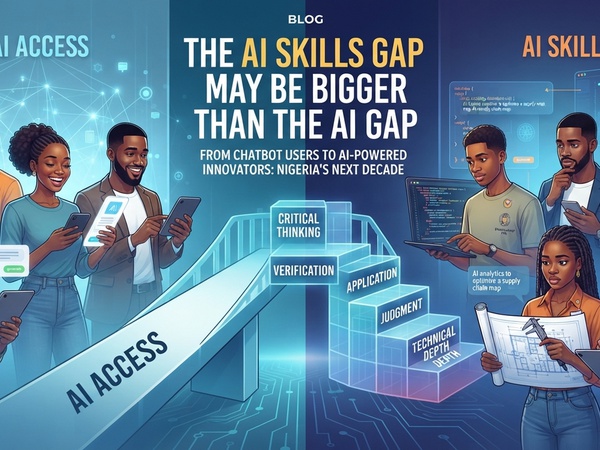
<p>AI is becoming easier to access. But knowing how to use it effectively is becoming a different kind of advantage.</p><p><br/></p><p>Artificial intelligence is becoming easier to access.</p><p><br/></p><p>A student with a smartphone can ask an AI assistant to explain a difficult engineering concept. A small business owner can generate marketing content in seconds. A developer can use AI to debug code. A researcher can process large amounts of information without manually going through every page.</p><p><br/></p><p>The technology is becoming increasingly available.</p><p><br/></p><p>But access to AI is not the same as having the skills to use it well.</p><p><br/></p><p>That distinction could become one of the most important technology issues of the next decade.</p><p><br/></p><p>The world may not only face an AI access gap between people who have AI tools and those who do not. It could increasingly face an AI skills gap between people who know how to use AI critically and productively and those who simply know how to ask a chatbot questions.</p><p><br/></p><p>For Nigeria, that distinction matters.</p><p><br/></p><p>Having AI is not the same as knowing AI</p><p><br/></p><p>Generative AI has dramatically reduced the barrier to interacting with sophisticated technology.</p><p><br/></p><p>You do not need to understand machine-learning architectures to ask an AI system to explain a concept, write code or analyse information.</p><p><br/></p><p>That accessibility is one of AI's greatest strengths.</p><p><br/></p><p>But it also creates a potential illusion of competence.</p><p><br/></p><p>Knowing how to generate an answer is different from knowing whether the answer is correct.</p><p><br/></p><p>Someone with strong knowledge of a subject can use AI to accelerate research, test ideas, automate repetitive tasks and explore possibilities.</p><p><br/></p><p>Someone without that foundation may simply accept whatever the system produces.</p><p><br/></p><p>That creates an important distinction:</p><p><br/></p><p>AI can make someone faster without necessarily making them better.</p><p><br/></p><p>The skills problem is already becoming an economic issue</p><p><br/></p><p>The World Economic Forum's Future of Jobs Report 2025, based on responses from more than 1,000 companies, identified skills gaps as the biggest barrier to business transformation, with 63% of surveyed employers citing them.</p><p><br/></p><p>The report also estimates that 39% of workers' existing skill sets could be transformed or become outdated between 2025 and 2030.</p><p><br/></p><p>AI and big data are among the fastest-growing skill areas, but they are not alone.</p><p><br/></p><p>Analytical thinking, creative thinking, technological literacy, resilience, flexibility and lifelong learning are also expected to become increasingly important.</p><p><br/></p><p>That tells us something important about the future of work.</p><p><br/></p><p>The valuable worker will not simply be someone who knows how to use AI.</p><p><br/></p><p>It will increasingly be someone who can think, understand, create and make decisions while using AI as a tool.</p><p><br/></p><p>Nigeria has a major opportunity</p><p><br/></p><p>Nigeria is already beginning to address the importance of AI skills.</p><p><br/></p><p>The country's National Artificial Intelligence Strategy identifies the development of an AI-ready workforce as an objective, including expanding AI education, research and skills development.</p><p><br/></p><p>Nigeria has also pursued broader digital-skills initiatives, including the 3 Million Technical Talent programme, which was designed to develop technical skills among millions of Nigerians.</p><p><br/></p><p>But the challenge is bigger than teaching people how to operate software.</p><p><br/></p><p>Nigeria needs people who can build with technology, understand technology and apply technology to local problems.</p><p><br/></p><p>That means the country needs to move beyond basic digital literacy toward deeper technical capability.</p><p><br/></p><p>The future will need more than prompt writers</p><p><br/></p><p>Consider two engineering students using the same AI assistant to solve a problem.</p><p><br/></p><p>The first asks the AI for the solution and submits it.</p><p><br/></p><p>The second understands the underlying mathematics and physics, uses AI to explore the problem, checks the calculations independently and then adapts the solution.</p><p><br/></p><p>Both students used AI.</p><p><br/></p><p>But they used it differently.</p><p><br/></p><p>The first outsourced part of the thinking process.</p><p><br/></p><p>The second used AI to extend the thinking process.</p><p><br/></p><p>That distinction will become increasingly important as AI systems become more capable.</p><p><br/></p><p>The same principle applies to programming, research, writing, design, finance, business and engineering.</p><p><br/></p><p>AI should not eliminate the need to understand a subject.</p><p><br/></p><p>It should increase what someone who understands the subject can accomplish.</p><p><br/></p><p>The danger of becoming an AI-dependent learner</p><p><br/></p><p>AI has made learning incredibly convenient.</p><p><br/></p><p>That is useful, but convenience can become a trap.</p><p><br/></p><p>If a student uses AI to solve every mathematical problem, write every essay, generate every piece of code and explain every concept without attempting to understand the underlying ideas, the student may accumulate outputs without accumulating capability.</p><p><br/></p><p>That is a dangerous trade.</p><p><br/></p><p>The strongest AI users will probably not be the people who simply know the most prompts.</p><p><br/></p><p>They will be people with enough foundational knowledge to know:</p><p><br/></p><p>What to ask.</p><p><br/></p><p>Why to ask it.</p><p><br/></p><p>How to verify the answer.</p><p><br/></p><p>What to do with the result.</p><p><br/></p><p>That is a much deeper form of AI literacy.</p><p><br/></p><p>AI literacy needs a broader definition</p><p><br/></p><p>AI literacy should not be reduced to prompt engineering.</p><p><br/></p><p>A more useful definition includes several abilities.</p><p><br/></p><p>Understanding: Knowing what AI systems can and cannot reliably do.</p><p><br/></p><p>Verification: Checking AI-generated information rather than automatically trusting it.</p><p><br/></p><p>Application: Using AI to solve genuine problems instead of merely generating content.</p><p><br/></p><p>Technical depth: Developing expertise in areas such as programming, mathematics, engineering, data or another professional field.</p><p><br/></p><p>Judgment: Knowing when AI should not be trusted or allowed to make a decision independently.</p><p><br/></p><p>The last one may become particularly important.</p><p><br/></p><p>AI can generate an answer.</p><p><br/></p><p>It cannot automatically take responsibility for the consequences of that answer.</p><p><br/></p><p>Nigeria's AI opportunity is bigger than chatbots</p><p><br/></p><p>Nigeria's technology opportunity should not be measured only by how many people are using generative AI.</p><p><br/></p><p>The country's future technology workforce will also need cybersecurity professionals, software developers, engineers, researchers, data specialists, automation experts and entrepreneurs.</p><p><br/></p><p>The World Economic Forum's Nigeria analysis found that employers expect network and cybersecurity skills, AI and big data, and systems thinking to become increasingly important through 2030.</p><p><br/></p><p>This matters because it shows that the AI economy is not simply about people sitting in front of chatbots.</p><p><br/></p><p>It is also about the systems behind them.</p><p><br/></p><p>It is about the infrastructure supporting them.</p><p><br/></p><p>It is about the businesses built around them.</p><p><br/></p><p>And it is about the people capable of solving problems that AI alone cannot solve.</p><p><br/></p><p>Young Nigerians can combine AI with real expertise</p><p><br/></p><p>A student studying electrical engineering does not necessarily need to abandon engineering to pursue AI.</p><p><br/></p><p>AI can intersect with electrical engineering through automation, control systems, robotics, power systems and intelligent devices.</p><p><br/></p><p>A business student can learn AI-assisted analysis and automation.</p><p><br/></p><p>A designer can combine traditional design principles with generative tools.</p><p><br/></p><p>A programmer can use AI coding assistants while developing a deeper understanding of software architecture and debugging.</p><p><br/></p><p>A writer can use AI for research assistance while maintaining strong judgment and verification skills.</p><p><br/></p><p>The important thing is not simply to learn AI.</p><p><br/></p><p>It is to combine AI with something worth knowing deeply.</p><p><br/></p><p>That combination can become far more valuable than generic AI usage.</p><p><br/></p><p>The difference between AI-powered and AI-dependent</p><p><br/></p><p>There is a useful distinction between being AI-powered and being AI-dependent.</p><p><br/></p><p>An AI-dependent person needs the tool to produce the answer.</p><p><br/></p><p>An AI-powered person uses the tool to extend what they are already capable of doing.</p><p><br/></p><p>That difference may become increasingly visible in schools and workplaces.</p><p><br/></p><p>When the AI produces an impressive result, the important question will not always be:</p><p><br/></p><p>"Did you get the answer?"</p><p><br/></p><p>It may increasingly become:</p><p><br/></p><p>"Do you understand the answer?"</p><p><br/></p><p>And:</p><p><br/></p><p>"Could you recognise when the answer is wrong?"</p><p><br/></p><p>Those questions separate assistance from dependence.</p><p><br/></p><p>The real competition may be human capability amplified by AI</p><p><br/></p><p>The World Economic Forum expects AI and information-processing technologies to be among the major forces transforming businesses through 2030. Its research also shows that employers are responding through reskilling and upskilling rather than treating AI simply as a replacement technology.</p><p><br/></p><p>This points toward a future in which human capability and AI capability increasingly operate together.</p><p><br/></p><p>The objective should therefore not be to compete with AI at everything.</p><p><br/></p><p>Humans should become better at the things that require understanding, creativity, judgment, responsibility and real-world execution and learn how AI can amplify those abilities.</p><p><br/></p><p>Nigeria does not only need AI users</p><p><br/></p><p>Nigeria has a young population, a growing technology ecosystem and a huge collection of problems that technology could potentially help address.</p><p><br/></p><p>But solving those problems will require more than access to ChatGPT or other AI tools.</p><p><br/></p><p>It will require engineers who can build.</p><p><br/></p><p>Researchers who can investigate.</p><p><br/></p><p>Developers who can create systems.</p><p><br/></p><p>Cybersecurity professionals who can protect them.</p><p><br/></p><p>Entrepreneurs who can identify meaningful problems.</p><p><br/></p><p>Educators who can prepare the next generation.</p><p><br/></p><p>And professionals who understand both the capabilities and limitations of artificial intelligence.</p><p><br/></p><p>The AI revolution therefore presents Nigeria with a question deeper than:</p><p><br/></p><p>"How many people have access to AI?"</p><p><br/></p><p>The more important question may be:</p><p><br/></p><p>"How many people have the knowledge to use it meaningfully?"</p><p><br/></p><p>AI is becoming easier to access.</p><p><br/></p><p>The next challenge is making sure that as AI becomes more powerful, the people using it become more capable not simply more dependent.</p><p><br/></p><p>Sources</p><p><br/></p><p>World Economic Forum, Future of Jobs Report 2025.</p><p><br/></p><p>Nigeria National Centre for Artificial Intelligence and Robotics, National Artificial Intelligence Strategy.</p><p><br/></p><p>Federal Government of Nigeria, 3 Million Technical Talent programme.</p>


 16
16


Other insights from Galton









Contributor Points

Points-to-Coupons

Referral Earning

Insights for you.


My Unpopular opinions of Social Media.
I Really Hate Social MediaWait, hear me out.I'm not saying this from a place of pride o...
224 views
33 upvotes
40 comments


Meet Amina the AI
Well yes, the image attached to this post was created with DALLE. After some interestin...
1469 views
19 upvotes
12 comments

If You Can’t Beat Them, Join Them
I didn’t experience the “before.” Before landlines, before phones, before mobile money—...
314 views
28 upvotes
25 comments


Grandpa lied (A little)
"Grandpa said, farming pays and not even your AI can take that away" that was my cousin...
323 views
25 upvotes
26 comments


Social Media vs Reality – Let’s Be Fo...
Let’s talk. Be honest, have you ever looked at someone’s Instagram story and immediatel...
435 views
15 upvotes
15 comments

Are we becoming who we are, or who we...
We are shaped long before we realize itby things we do not question,by voices we do not...
297 views
19 upvotes
20 comments


Three (3) reasons why AI is losing to...
This article explains how Google's new policy affects AI-written content and flagging g...
817 views
18 upvotes
18 comments


Over sharing with a bot : it's not th...
Lately I’ve realized my most stable relationship might actually be with ChatGPT. 😭 I co...
461 views
16 upvotes
16 comments


The Impact Of Social Media vs Books: ...
A social media personality emerged on the internet months ago and a basic small toy tha...
370 views
19 upvotes
15 comments

Tech is the New White Collar Job
Tech is the New White Collar Job
Tech is the new currency; with tech, you can say cr...
1057 views
17 upvotes
11 comments