Score |
64


Galton
 Student @ University of Lagos
Student @ University of Lagos



The Data Centre Boom Has a Problem Nobody Can Ignore: Electricity
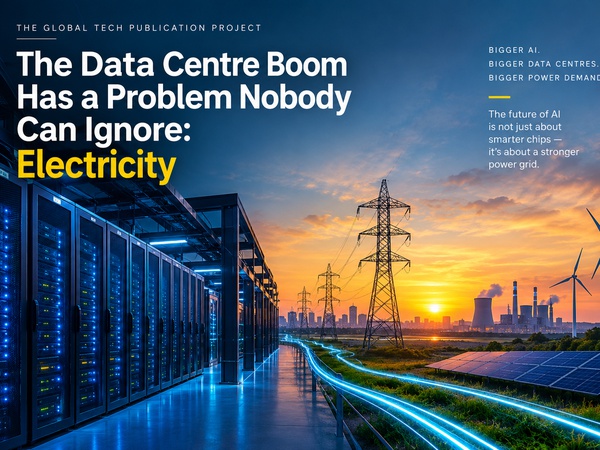
<p>Artificial intelligence is becoming more powerful by the month.</p><p>AI can generate images, write software, analyse enormous datasets, produce videos, operate as an assistant and increasingly perform tasks that once required human workers.</p><p>But behind every AI model is something much less glamorous: Electricity.</p><p>Every prompt sent to an AI system, every model trained, every image generated and every video processed ultimately depends on computers running inside data centres.</p><p>And the world is building more of them.</p><p>The International Energy Agency (IEA) estimates that global data-centre electricity consumption increased by 17% in 2025, reaching approximately 485 terawatt-hours (TWh). The agency expects consumption to roughly double to about 950 TWh by 2030.</p><p>That is where the AI revolution meets an old-fashioned engineering problem:</p><p>Where will all the electricity come from?</p><p>AI does not live in the cloud</p><p>We often talk about “the cloud” as if our data and applications exist somewhere in an invisible digital space.</p><p>They don't.</p><p>The cloud is physical infrastructure.</p><p>Inside data centres are servers, GPUs, networking equipment, storage systems, cooling equipment, backup systems and electrical infrastructure. These facilities consume electricity continuously.</p><p>According to the IEA, servers account for around 60% of electricity consumption in modern data centres, although the proportion varies by facility. Cooling and other infrastructure consume much of the remainder.</p><p>AI is making this infrastructure significantly more demanding.</p><p>The IEA's latest analysis found that the power density of AI servers increased 11-fold between 2020 and 2025 and could increase another fourfold by 2027.</p><p>In practical terms, increasingly powerful computing equipment is being packed into increasingly energy-intensive facilities.</p><p>This means the AI race is also becoming a race for power.</p><p><br/></p><p><strong>The numbers are getting difficult to ignore</strong></p><p><br/></p><p>In 2024, data centres consumed about 415 TWh, equivalent to around 1.5% of global electricity consumption.</p><p>That might not sound enormous at the global level.</p><p>But the important issue is concentration.</p><p>Data centres tend to be built in particular locations rather than being evenly distributed across the world's electricity networks. This can create significant pressure on local grids even when the global percentage appears relatively small.</p><p>The United States provides one of the clearest examples.</p><p>A 2026 Lawrence Berkeley National Laboratory report estimates that U.S. data centres could consume approximately 649 TWh of electricity in 2030, equivalent to about 11.8% of total U.S. electricity consumption under its reference case. Its broader scenarios range from 521 TWh to 843 TWh.</p><p>Another analysis from the Electric Power Research Institute estimates that data centres could account for 9% to 17% of U.S. electricity consumption by 2030, compared with roughly 4% to 5% today.</p><p>These are projections, not guaranteed outcomes. But the fact that independent analyses are identifying such a large potential increase illustrates the scale of the infrastructure challenge.</p><p><br/></p><p><strong>Efficiency is improving — but demand is rising faster</strong></p><p><strong><br/></strong></p><p>There is an important part of this story that is often missed.</p><p>AI is becoming more energy efficient.</p><p>The IEA says energy consumption per individual AI task has fallen dramatically as hardware and software have improved. Simple text-based AI queries can now require relatively little electricity compared with more intensive applications.</p><p>But efficiency does not automatically mean lower total electricity consumption.</p><p>If each task becomes cheaper while the number of tasks increases enormously, total demand can still rise.</p><p>That is exactly what is happening.</p><p>AI is expanding from simple text generation into video generation, reasoning systems, autonomous agents and other computationally intensive applications.</p><p>The IEA estimates that electricity consumption from AI-focused data centres tripled between 2025 and 2030 in its updated outlook.</p><p><br/></p><p>So the question is no longer simply:</p><p>“Can we make AI more efficient?”</p><p>It is also:</p><p>“Can our electricity infrastructure expand quickly enough to support how much AI people will use?”</p><p><br/></p><p><strong>The grid is becoming part of the AI race</strong></p><p><br/></p><p>Building a data centre can happen much faster than building the electricity infrastructure required to support it.</p><p>That creates a mismatch.</p><p>Technology companies can plan and deploy computing infrastructure rapidly, while power plants, transmission lines, substations and transformers often require much longer planning and construction periods.</p><p>The IEA says data-centre expansion is already encountering bottlenecks involving grid connections, transformers, gas turbines, advanced chips and other infrastructure.</p><p>This is why the AI competition is increasingly becoming an energy-infrastructure competition.</p><p>Countries are not simply competing over who has the best AI models.</p><p>They are also competing over who can provide:</p><p>- reliable electricity</p><p>- sufficient generation capacity</p><p>- transmission infrastructure</p><p>- advanced power electronics</p><p>- transformers</p><p>- cooling systems</p><p>- energy storage</p><p>- suitable land and grid connections</p><p>In other words, AI is becoming an electrical engineering problem.</p><p>And then there is the question of where the electricity comes from</p><p>More electricity demand means more generation.</p><p>The solution will not necessarily come from one technology.</p><p>The IEA expects renewables, natural gas, nuclear power, storage and other sources to contribute to meeting growing data-centre demand. It also notes increasing interest from technology companies in nuclear and geothermal technologies.</p><p>This creates an interesting technological feedback loop.</p><p>AI needs electricity.</p><p>Electricity systems need better forecasting, optimisation and management.</p><p>AI itself could potentially help improve those systems.</p><p>The IEA estimates that proven applications of AI could help energy-intensive industries reduce their energy costs by 3 to 10 percentage points, although adoption remains constrained by factors including digital skills and data availability.</p><p>So AI could simultaneously increase electricity demand and help the energy sector operate more efficiently.</p><p>That is one of the most important contradictions of the AI era.</p><p><br/></p><p><strong>What does this mean for Africa?</strong></p><p><br/></p><p>Africa enters this technological race from a very different starting point.</p><p>The IEA estimates that Africa had the lowest per-capita data-centre electricity consumption among world regions in 2024, at less than 1 kWh per person. Its base case sees this rising to slightly below 2 kWh per person by 2030.</p><p>At the same time, basic electricity access remains a major challenge.</p><p>World Bank data shows that electricity access in Nigeria stood at 62.5% of the population in 2024.</p><p>That creates an important question for countries such as Nigeria.</p><p>Should the priority be simply to build more data centres?</p><p>Or should investment first focus on the wider electricity infrastructure needed to support households, businesses, industries and digital infrastructure simultaneously?</p><p>The answer will determine more than the future of AI.</p><p>It will influence the future of the digital economy itself.</p><p><br/></p><p><strong>Nigeria's opportunity is bigger than AI</strong></p><p><strong><br/></strong></p><p>For countries with electricity constraints, the AI boom should not only be viewed as a threat.</p><p>It can also create demand for engineering innovation.</p><p>There will be opportunities in:</p><p>Power generation: renewable energy, gas, hybrid systems and emerging technologies.</p><p>Energy storage: batteries and other technologies capable of balancing intermittent generation and sudden changes in demand.</p><p>Power electronics: inverters, converters, UPS systems and high-efficiency power-management equipment.</p><p>Cooling: increasingly sophisticated systems for managing the heat produced by high-density computing.</p><p>Grid technology: monitoring, automation, forecasting and intelligent distribution.</p><p>Energy efficiency: technologies that allow businesses and data centres to accomplish more computing with less electricity.</p><p>For electrical and electronics engineers, this is particularly significant.</p><p>The AI revolution may be marketed as a software revolution.</p><p>But underneath the software is hardware.</p><p>And underneath the hardware is electricity.</p><p><br/></p><p><strong>The real AI infrastructure race</strong></p><p>The world has spent enormous attention on who will build the most capable AI model.</p><p>That competition matters.</p><p>But another competition is happening beneath the surface.</p><p>Who will build enough power generation?</p><p>Who will expand transmission networks?</p><p>Who will manufacture the transformers?</p><p>Who will develop better batteries?</p><p>Who will design more efficient cooling systems?</p><p>Who will build data centres that can respond intelligently to changes in electricity supply?</p><p>And who will make all of this affordable enough for emerging economies to participate?</p><p>The IEA expects global electricity demand to grow at an average annual rate of 3.6% between 2026 and 2030, significantly faster than the 2.8% annual rate recorded over the previous decade. Data centres are one of several major contributors to this broader growth in electricity demand.</p><p><br/></p><p><strong>The AI era therefore has a lesson that the technology industry cannot afford to forget:</strong></p><p><strong><br/></strong></p><p>Digital progress still depends on physical infrastructure.</p><p>The next major breakthrough in AI may come from a better model, a faster chip or a more intelligent algorithm.</p><p>But supporting millions of those breakthroughs will require something much simpler.</p><p>A reliable power supply.</p><p>And increasingly, the countries that understand that connection may have an important role in the technological economy of the future.</p>


 5
5


Other insights from Galton







Contributor Points

Points-to-Coupons

Referral Earning

Insights for you.


My Unpopular opinions of Social Media.
I Really Hate Social MediaWait, hear me out.I'm not saying this from a place of pride o...
219 views
33 upvotes
40 comments


Meet Amina the AI
Well yes, the image attached to this post was created with DALLE. After some interestin...
1459 views
19 upvotes
12 comments


If You Can’t Beat Them, Join Them
I didn’t experience the “before.” Before landlines, before phones, before mobile money—...
309 views
27 upvotes
25 comments

Grandpa lied (A little)
"Grandpa said, farming pays and not even your AI can take that away" that was my cousin...
315 views
25 upvotes
26 comments


Social Media vs Reality – Let’s Be Fo...
Let’s talk. Be honest, have you ever looked at someone’s Instagram story and immediatel...
433 views
15 upvotes
15 comments


Are we becoming who we are, or who we...
We are shaped long before we realize itby things we do not question,by voices we do not...
294 views
19 upvotes
20 comments


Over sharing with a bot : it's not th...
Lately I’ve realized my most stable relationship might actually be with ChatGPT. 😭 I co...
458 views
16 upvotes
16 comments

The Impact Of Social Media vs Books: ...
A social media personality emerged on the internet months ago and a basic small toy tha...
361 views
19 upvotes
15 comments

Tech is the New White Collar Job
Tech is the New White Collar Job
Tech is the new currency; with tech, you can say cr...
1055 views
17 upvotes
11 comments

Three (3) reasons why AI is losing to...
This article explains how Google's new policy affects AI-written content and flagging g...
811 views
17 upvotes
17 comments